Last updated: October 24, 2026
TL;DR
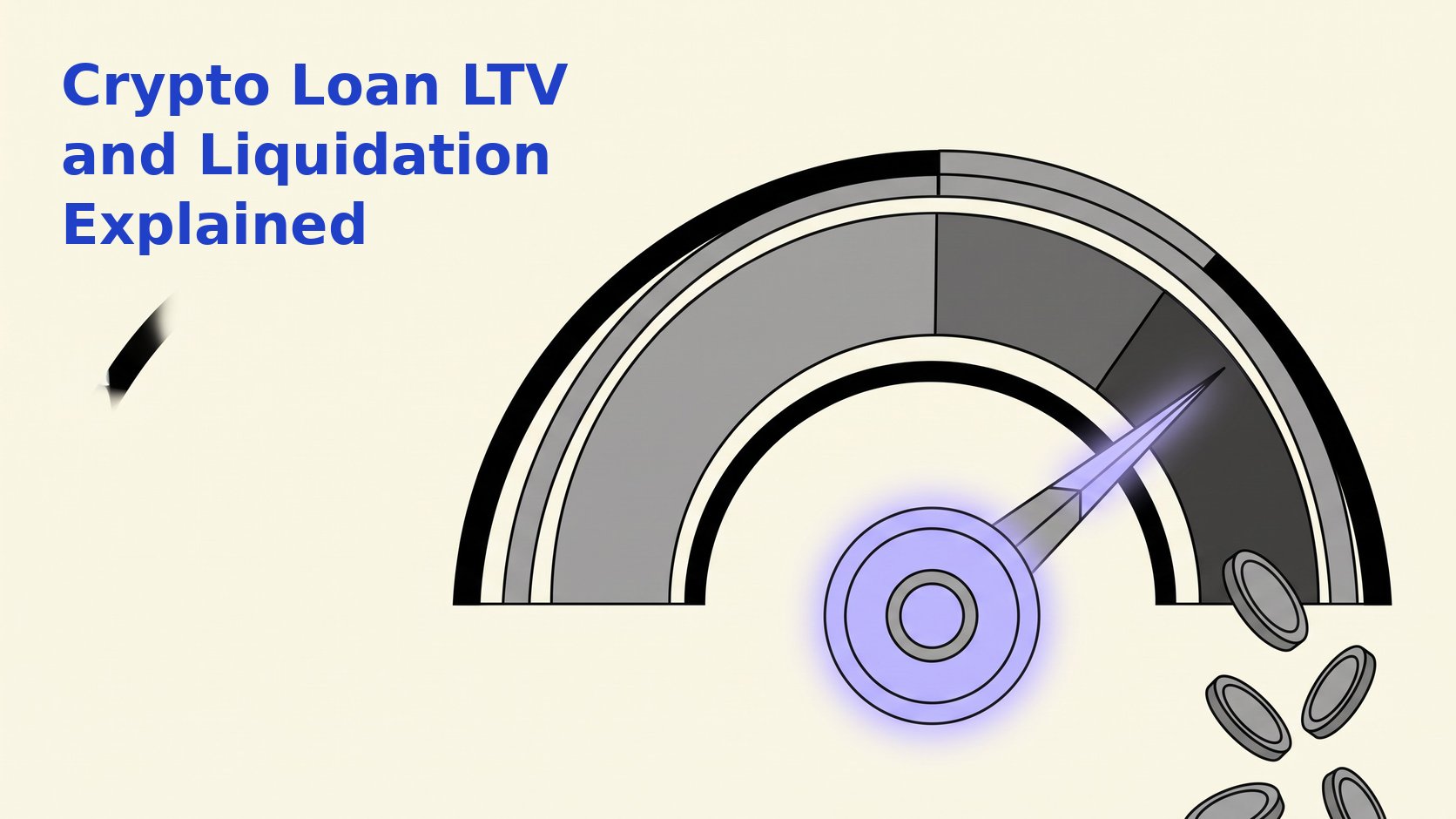
Loan-to-value (LTV) is your loan balance divided by the value of your crypto collateral. Crypto loan liquidation happens when LTV rises past the lender's threshold, usually because the collateral's price fell, and the lender sells some or all of your collateral to repay the loan. Your liquidation price is your loan balance divided by your collateral amount times the liquidation LTV. Borrowing at a low starting LTV is the single best protection.
LTV and liquidation: definition and positioning
LTV measures how much of your collateral's value you have borrowed. If you post $100,000 of bitcoin and borrow $50,000, your LTV is 50%. Because the loan is fixed in dollars and the collateral is not, LTV moves every time the price moves.
Three LTV levels matter on every crypto loan:
- Starting LTV: where the loan begins, often 50% or lower.
- Margin call LTV: where the lender warns you to add collateral or repay.
- Liquidation LTV: where collateral is sold automatically.
A liquidation is not a default in the traditional sense. You keep the money you borrowed, and the lender recovers its loan by selling your collateral. What you lose is the crypto that was sold, usually at the worst possible price, plus a fee, and possibly a tax bill.
The distinction that matters in practice: the maximum LTV a lender allows tells you how much you can borrow. The gap between your starting LTV and the liquidation LTV tells you how much of a price drop you can survive. Borrowers who focus on the first number get liquidated.
How crypto loan liquidation works
The liquidation price formula
For a single collateral asset:
Liquidation price = loan balance ÷ (collateral amount × liquidation LTV)
An equivalent shortcut: liquidation price = current price × (current LTV ÷ liquidation LTV). The percentage drop you can survive is 1 − (current LTV ÷ liquidation LTV).
Worked example 1: a conservative loan
You post 1 BTC worth $80,000 and borrow $40,000. Starting LTV is 50%. Your lender liquidates at 80% LTV, which is Ledn's threshold.
- Liquidation price = $40,000 ÷ (1 × 0.80) = $50,000.
- Drop you can survive = 1 − (50% ÷ 80%) = 37.5%.
- Margin calls at 70% and 75% LTV arrive at roughly $57,143 and $53,333, giving you time to act.
Worked example 2: a maximized loan
Same 1 BTC at $80,000, but you borrow $60,000 at 75% LTV on a platform that liquidates at 86%, like Coinbase's Morpho-powered loans.
- Liquidation price = $60,000 ÷ (1 × 0.86) = $69,767.
- Drop you can survive = 1 − (75% ÷ 86%) = about 12.8%.
Bitcoin has fallen more than 12.8% in a single week many times. The second loan is not cheaper or more expensive than the first in interest terms. It is simply far more likely to end in a forced sale.
What else moves your LTV
- Accrued interest. Where interest is added to the loan balance, LTV creeps up even if prices are flat. A $40,000 loan at 11.49% APR accrues about $4,596 over 12 months.
- Collateral swaps or withdrawals. Removing collateral raises LTV.
- Stablecoin depegs. If you borrowed a stablecoin that trades above $1, repaying it costs more.
What happens during a liquidation
The process differs by lender, which is why it matters which one you pick:
| Lender | Starting / max LTV | Margin call | Liquidation | What gets sold |
|---|---|---|---|---|
| Ledn | 50% | 70% and 75% | 80% | Enough BTC to repay the loan, plus a 0.50% trade spread; remainder returned |
| Figure | Up to 75% | Margin calls below liquidation | 90% | All collateral, with a 2% fee |
| Coinbase (Morpho) | Up to 75% (BTC, ETH) | Not specified | 86% | Collateral via Morpho, plus a penalty fee |
| Nexo | Up to 50% (BTC, ETH) | Best-efforts notifications | Platform threshold | Partial automatic repayment from collateral |
| Aave | Up to 80% (WETH) | None; you monitor | Health factor below 1 | Part of the collateral at a discount to liquidators |
Sources: Ledn, Figure, The Block, Nexo, DeFi Rate. Checked October 24, 2026.
Partial versus full liquidation is a bigger deal than it looks. Ledn and Nexo sell only enough to bring the loan back into line. Figure sells everything. On Aave, liquidators repay part of your debt and take collateral at a discount, which is the liquidation penalty you pay.
Aave's health factor
DeFi protocols express the same idea differently. On Aave, your health factor equals the value of your collateral, weighted by each asset's liquidation threshold, divided by your debt. A health factor of 2 means your collateral could roughly halve before liquidation. At 1, you are liquidatable. It is LTV turned upside down, and it handles multiple collateral assets in one number.
LTV in practice: how to avoid liquidation
- Start low. Borrowing at 25% to 35% LTV means bitcoin must fall by more than half before most lenders liquidate. If you need $40,000, posting $120,000 of collateral instead of $80,000 buys a much wider buffer.
- Pre-calculate your liquidation price. Write it down before you borrow and set price alerts above it.
- Keep dry powder. Hold spare collateral or stablecoins you can add quickly. Ledn's Auto Top-Up, where available, draws on BTC in your account automatically at 70% LTV.
- Repay partially in a drawdown. Paying down a slice of the loan lowers LTV as effectively as adding collateral.
- Prefer lenders with wide gaps and partial liquidation. A 30-point gap between start and liquidation, as at Ledn, is safer than an 11-point one.
Compare lenders on these terms in our guide to the best crypto-backed loans, or see how custodial and onchain liquidation differ in Aave vs Nexo.
Trade-offs and limitations
- Low LTV means less borrowing power. Safety costs capital: locking up three times your loan in collateral is expensive if that crypto could be working elsewhere.
- Notifications are not guarantees. Nexo states its alerts are best-efforts and automatic repayments can happen without notice in fast markets. Weekend crashes and blockchain congestion can make topping up too slow.
- Liquidation can be a taxable event. In the US, a forced sale of collateral is generally treated as a disposal, with gain or loss measured against your cost basis. See are crypto loans taxable.
- Formulas simplify reality. Liquidation fees, spreads, accrued interest and price slippage mean the real outcome is usually slightly worse than the math.
FAQs
What is LTV on a crypto loan?
LTV, or loan-to-value, is your outstanding loan balance divided by the current value of your crypto collateral. Borrowing $50,000 against $100,000 of bitcoin is a 50% LTV. Because crypto prices move, LTV changes constantly, and lenders liquidate when it reaches their threshold.
How do I calculate my crypto loan liquidation price?
Divide your loan balance by your collateral amount multiplied by the lender's liquidation LTV. For a $40,000 loan against 1 BTC with liquidation at 80%, the liquidation price is $40,000 divided by 0.8, or $50,000. Account for accrued interest and fees, which push it higher.
What happens when a crypto loan is liquidated?
The lender sells some or all of your collateral to repay the loan, usually charging a fee or spread. You keep the money you borrowed but lose the crypto that was sold. Some lenders, such as Ledn, sell only what is needed; others, such as Figure, sell all collateral.
What is a safe LTV for a crypto loan?
There is no universally safe level, but 25% to 35% LTV gives most borrowers room to survive a halving in bitcoin's price before liquidation. Borrowing at the maximum allowed, often 75%, can leave as little as a 13% buffer. Lower is safer, at the cost of borrowing power.
Can I avoid liquidation on a crypto loan?
Yes, if you act before LTV reaches the threshold. Add collateral, repay part of the loan, or use an automatic top-up feature where available. Setting price alerts above your liquidation price and keeping spare collateral or stablecoins ready are the most reliable protections.
The takeaway: liquidation risk is arithmetic, not luck. Know your liquidation price before you borrow, and choose a starting LTV that survives the drawdowns bitcoin actually has. The open question is whether more lenders will adopt partial liquidation and liquidation protection as standard, as Ledn and Figure have in different ways. If you are building risk tooling for crypto credit, reach out.