Travel rule compliance means collecting, verifying and passing originator and beneficiary information with a transfer. In the US the FinCEN funds travel rule applies to transmittals of $3,000 or more, while FATF Recommendation 16 sets the global standard for virtual asset service providers. Most explainers collapse these into one obligation. They are not one obligation, and a stablecoin operator moving USDC or USDT across borders needs to know which regime governs which leg of a transfer.
Definition: What the Travel Rule Requires

The travel rule is an anti-money-laundering requirement that obligates financial institutions and virtual asset service providers to send the originator's and beneficiary's details with a transfer, so the data stays with the payment through every institution in the chain. The global standard is FATF Recommendation 16, titled "Payment transparency". In the US, the domestic version is FinCEN's Funds "Travel" Regulations under the Bank Secrecy Act.
In plain language
When money moves, the identity of who sent it and who receives it has to move with it.
Takeaway: the word "travel" is literal. The data accompanies the value, hop by hop.
How It Works: US Rule Versus FATF Standard
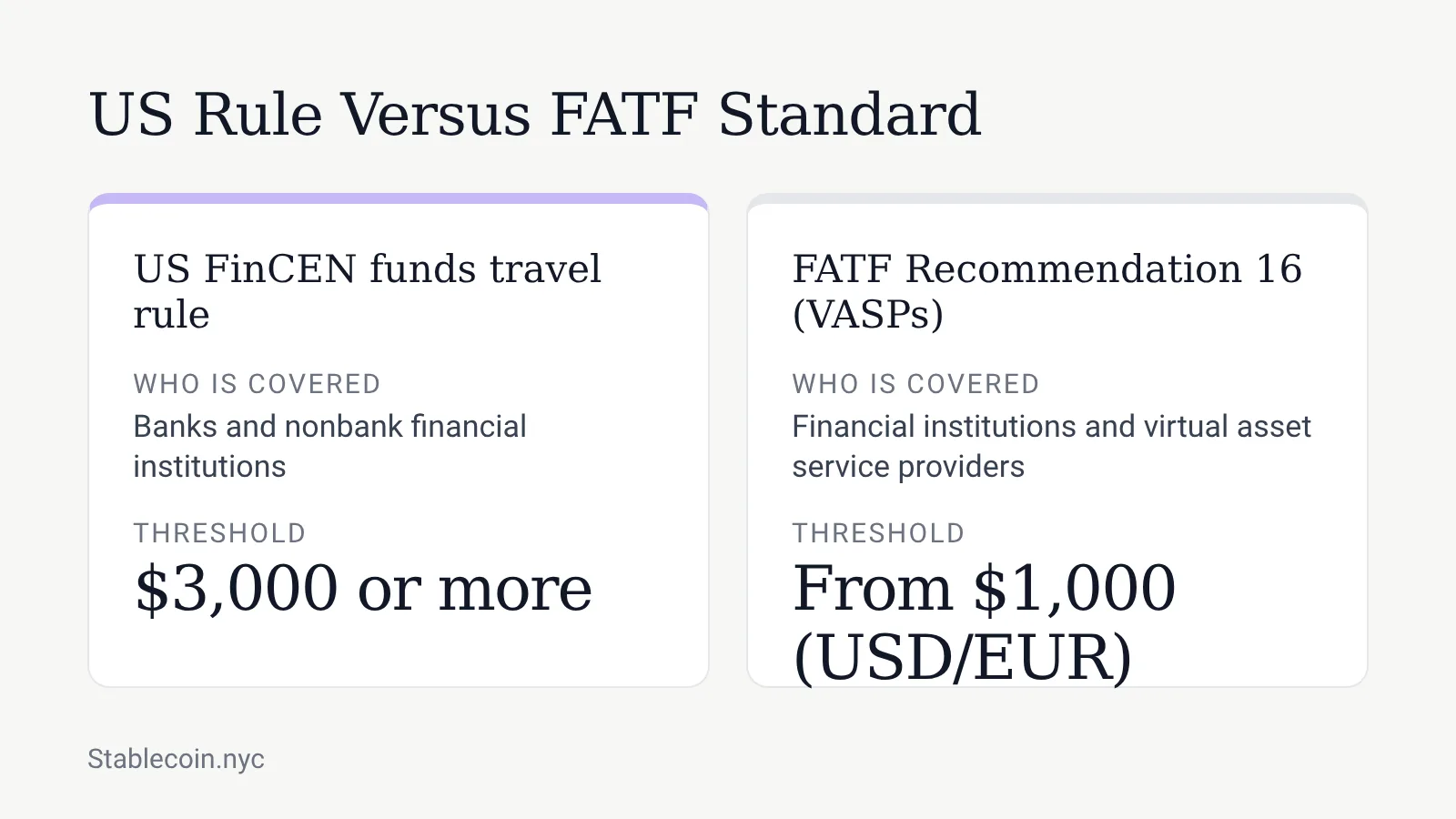
Two regimes, two origins. The US rule was written for funds transfers and predates crypto. The FATF standard was extended to virtual assets in June 2019.
Comparison of regimes
| Regime | Who is covered | Threshold | Source |
|---|---|---|---|
| US FinCEN funds travel rule | Banks and nonbank financial institutions sending transmittals of funds | $3,000 or more | FinCEN Q&A |
| FATF Recommendation 16 (VASPs) | Financial institutions and virtual asset service providers | Virtual asset transfers from $1,000 (USD/EUR) | FATF text; Money Laundering Watch |
| EU approach to crypto | Crypto-asset transfers | Every transfer, whatever the amount | Sanction Scanner summary |
FinCEN's Q&A also excludes Reg E, ATM and point-of-sale systems from the funds rule. The FATF figure is a recommendation that each jurisdiction transposes into local law, which is where the thresholds diverge.
Worked example: a stablecoin transfer
Example: a US-regulated custodial platform sends 5,000 USDC on behalf of a customer to a counterparty exchange abroad. The amount clears both the $3,000 US figure and the $1,000 FATF figure, so both frames are relevant.
- Collect. The originating VASP obtains and holds the originator's required data and the beneficiary's required data.
- Identify the counterparty. It determines whether the destination address belongs to another regulated provider or a self-hosted wallet.
- Screen. It runs sanctions screening on both parties before release.
- Transmit. It submits the data immediately and securely to the beneficiary VASP. The data does not need to be written on-chain; a separate secure channel linked to the transfer is acceptable.
- Retain. It keeps records and an audit trail explaining the transfer decision.
- Handle exceptions. If the counterparty cannot receive the message, or data is missing, the workflow decides whether to hold, return or escalate.
Takeaway: the on-chain settlement is the easy part. The off-chain data obligation is where operational risk sits.
Why It Matters: Enforcement and Adoption

Westpac penalty
On 21 October 2020, Australia's Federal Court ordered Westpac to pay a A$1.3 billion penalty, part of it under Australia's version of the travel rule. Westpac had sent 8,140 international transfers without some or all of the required transfer information and 2,400 without complete payer information. The court set A$3 million for those 10,540 contraventions, noting its processes did not identify these systemic failures for over five years.
The lesson for stablecoin operators is not the size of the fine. It is that the failure was systemic and invisible to internal monitoring for years.
FATF adoption data
The FATF reported in July 2026 that 83% of surveyed jurisdictions had passed legislation implementing the travel rule, compared with 73% in 2025. It also warned that practical implementation, supervision and enforcement remained inconsistent. Legislation is spreading, but enforcement is still catching up.
US proposed crypto changes
FinCEN's October 2020 notice of proposed rulemaking included new requirements for cryptocurrency and digital asset transfers. Separately, a Department of Justice report urged FinCEN to issue a final rule expanding the travel rule under the BSA to digital asset transfers.
Takeaway: the US crypto-specific rule has been proposed, discussed and pushed for; operators should design for the stricter FATF frame now.
Common Misconceptions

Misconception: The travel rule is only a crypto rule
Reality: it began with funds transfers. FinCEN's Q&A was first issued in 1997 and covers banks and nonbanks, including transfers booked through correspondent "due from" and "due to" accounts.
Misconception: One threshold applies everywhere
Thresholds, data fields and self-hosted wallet rules differ by jurisdiction.
Misconception: Sending a message is enough
Reality: compliance depends on customer data quality, counterparty identification, sanctions screening, transaction monitoring, exception handling and an audit trail. A vendor can support this, but the regulated business stays responsible.
Misconception: Passing legislation means consistent enforcement
Reality: FATF itself flags inconsistent supervision, and Protiviti highlights timing differences and hybrid approaches across jurisdictions, including under MiCA regulation in the EU. A compliant counterparty in one country may face a different regime in another.
Takeaway: treat the travel rule as a workflow, not a message format.
Related Concepts
FATF
The Financial Action Task Force is the intergovernmental body that sets global AML and counter-terrorist financing standards, including Recommendation 16. Countries implement its standards through national law.
FinCEN and the Bank Secrecy Act
It also proposes expansions, such as bringing investment advisers under the BSA.
VASP
A virtual asset service provider is a business that exchanges, transfers or safekeeps virtual assets for others. Exchanges, custodial wallets, brokers and payment platforms typically qualify.
OFAC sanctions screening
OFAC is the US Treasury office that administers sanctions. Screening checks both parties to a transfer against sanctions lists before funds or stablecoins are released.
Originator and beneficiary
The originator is the party initiating the transfer; the beneficiary is the intended recipient. Their identifying data is what must travel.
How to Get Started
- Map transfers against thresholds. Tag flows by jurisdiction and amount so each transfer resolves to a regime: $3,000 funds rule, $1,000 FATF-aligned rule or all-transfer EU treatment.
- Inventory customer data fields. Confirm KYC and KYB records hold what each regime requires for originators and beneficiaries.
- Evaluate messaging solutions.
- Document exception handling. Write the rules for self-hosted wallets, unresponsive counterparties and incomplete data before volume forces improvisation.
Takeaway: the first deliverable is a transfer map, not a vendor contract.
FAQ: Frequently Asked Questions
What is the travel rule in banking?
It is the FinCEN funds travel rule under the Bank Secrecy Act, which applies to transmittals of funds of $3,000 or more and requires originator and beneficiary information to pass along so every institution in the chain receives the data.
What is OFAC and FATF?
OFAC is the US Treasury office that administers economic sanctions. FATF is the intergovernmental body setting global AML standards. OFAC lists drive sanctions screening; FATF recommendations, including the travel rule, shape national laws.
How do banks know if you are money laundering?
Through customer due diligence, transaction monitoring and sanctions screening. Systems flag unusual patterns, and transfers missing required originator or beneficiary data are one of the gaps monitoring rules look for.
What are the 5 pillars of AML?
The pillars of AML are the core elements of a compliance program, and the list varies by institution and regulator. Travel rule processes, such as collecting, transmitting and retaining originator and beneficiary data, belong in the internal controls and recordkeeping part of that program.
What is the US travel rule threshold?
FinCEN's funds travel rule applies to transmittals of $3,000 or more. It excludes Reg E, ATM and point-of-sale systems. Other jurisdictions use lower thresholds or none for crypto transfers.
Does the travel rule apply to stablecoins?
Generally yes. Under the FATF framework, stablecoins are virtual assets, so VASPs transferring them must collect and transmit originator and beneficiary data. Exact obligations depend on the jurisdiction's implementing law.
Conclusion
The travel rule is converging in principle and diverging in practice. FATF's adoption numbers show legislation spreading, while thresholds, wallet rules and enforcement timing still vary by jurisdiction. For a stablecoin operator, the open question is whether the US, through measures such as the Clarity Act, formalizes a digital asset rule closer to the FATF $1,000 line or the EU's zero threshold. Until it does, the stricter regime sets the effective standard for any cross-border flow.