Shopify stablecoin checkout lets a customer pay in USDC on the Base network through Shopify Payments, and the merchant receives local currency by default or can claim USDC into their own wallet, with no new gateway required. That is the whole product in one sentence. The interesting part is what happens between the buyer's wallet and the merchant's balance, and why the design choices matter for anyone running payments at scale.
Definition: What Shopify Stablecoin Payments Are
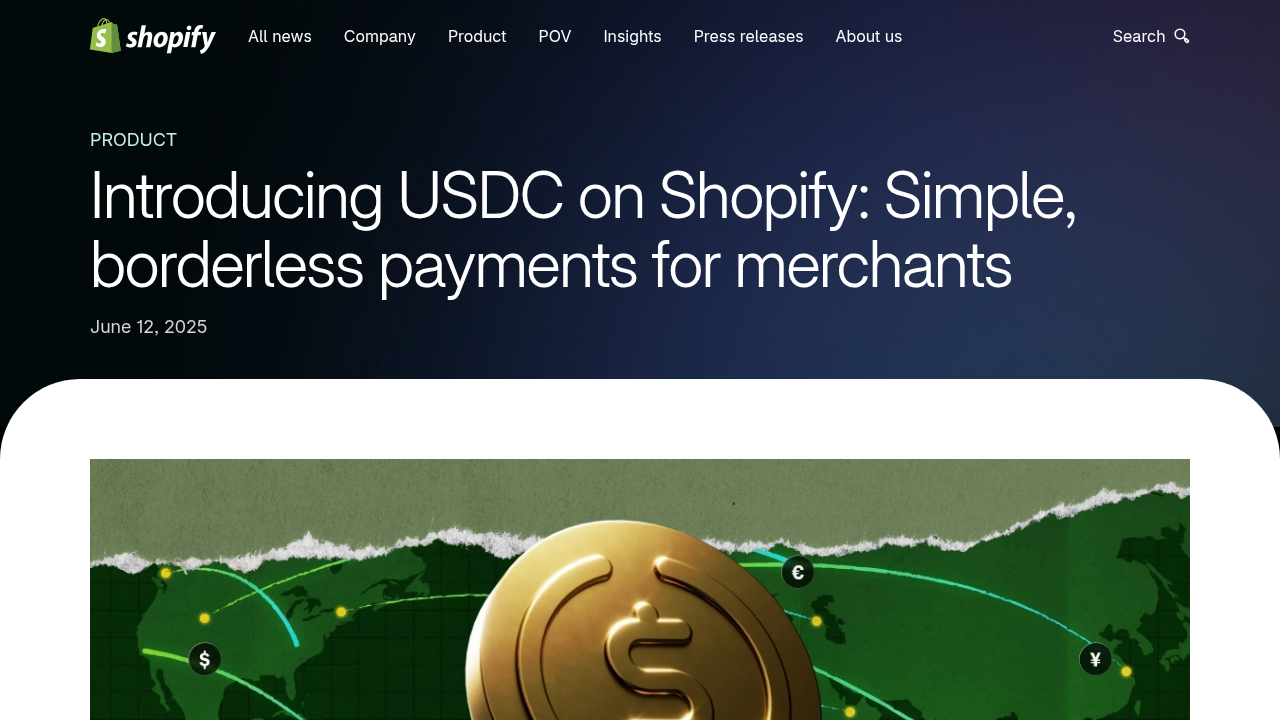
Stablecoin payments on Shopify are a payment method, not a new platform. According to the Shopify Help Center, merchants using Shopify Payments can offer USDC as a payment method at checkout, and USDC is a stablecoin linked to the US dollar.
The feature came out of a partnership between Shopify, Coinbase and Stripe, announced on June 12, 2025. Shopify describes USDC as backed 1:1 by US dollar reserves, which separates it from volatile assets like Bitcoin or Ether. Transactions run on Base, the network built by Coinbase.
In plain language: your customer pays with digital dollars from a crypto wallet, and you still get paid in dollars unless you choose otherwise.
The framing that matters: this is a stablecoin acceptance rail bolted onto an existing processor, not a crypto gateway competing with it.
How On-Chain Checkout Works

The mechanics are simple on the surface. For more background, see the crypto payment rails page. Underneath, Shopify had to reconcile two very different settlement models: card payments, which authorize first and capture later, and blockchain transfers, which are final once confirmed.
Step-by-step payment flow
- Wallet selection. At checkout the buyer chooses USDC and connects a wallet. Shopify states that customers can pay from hundreds of supported crypto wallets.
- Payment on Base. The buyer sends USDC on the Base network. Other chains and other stablecoins are not part of this flow.
- Checkout surface. The payment works on guest checkout and with Shop Pay, so the buyer does not need a separate crypto storefront.
- Authorization and capture. Shopify and Coinbase built a smart contract that gives merchants the "authorize now, capture later" behavior of credit cards. That matters for steps like tax finalization and inventory reservation, which happen after the buyer commits but before funds are final.
- Processing. Shopify Payments handles the transaction inside the merchant's existing payment and order fulfillment flows. Shopify says no integrations or new gateways are required.
- Settlement. By default the merchant receives local currency. Alternatively, the merchant can choose to claim USDC directly into their own wallet.
Step four is the real engineering. A naive on-chain transfer is push-only and irreversible; commerce needs a hold state. The smart contract creates that hold state, which is why this integrates with order management instead of sitting beside it.
Worked example: one US order
Example: assume a US apparel merchant on Shopify Payments, a cart totaling $150, and a buyer holding USDC on Base in a self-custody wallet.
- The buyer reaches checkout as a guest, or through Shop Pay, and selects USDC.
- The buyer approves a transfer of 150 USDC on Base from their wallet. Because USDC is dollar-linked, the cart price and the token amount line up without a volatile conversion at the point of sale.
- The smart contract authorizes the payment. Shopify finalizes tax and reserves inventory, then captures.
- Shopify Payments processes the order through the same flow the merchant already uses for cards.
- Under the default setting, the merchant is settled in USD, its local currency. If the merchant opted to claim USDC, the funds go to the merchant's own wallet instead.
From the merchant's ledger, the default path looks like any other Shopify Payments order. The on-chain leg is abstracted away. Takeaway: the decision a merchant actually faces is not "do we accept crypto" but "do we want to hold the stablecoin or the dollar."
Why It Matters for Merchants

Three use cases stand out.
Global buyers. Shopify positions USDC on Base as a way to accept payments from customers globally. A buyer abroad holding dollar stablecoins can pay without routing through local card networks.
Currency friction. Shopify states merchants receive local currency by default with no foreign transaction or exchange fees. For merchants with a meaningful cross-border mix, avoiding foreign transaction and exchange fees can matter. Other costs of processing are a separate question to confirm with Shopify.
Distribution through incumbents. Stripe's expanded partnership with Shopify is meant to let Shopify merchants accept stablecoin payments. This is a hot-start distribution model: the rail inherits an existing merchant base rather than recruiting one, the opposite of the cold-start problem standalone crypto processors face.
Timing is staged. Coverage at launch described early access to USDC on Base, and reports cited a rollout starting in June with a full launch targeted by the end of 2025. Coverage also mentioned cashback for buyers as part of the rollout.
Takeaway: the significance is distribution, not technology. Stablecoin acceptance now sits one setting away for a very large merchant base.
Common Misconceptions

Misconception: Merchants must hold crypto / Reality: local currency is the default
Merchants receive local currency by default. Holding USDC is an opt-in choice, claimed into the merchant's own wallet. A merchant with no treasury appetite for stablecoins can accept them without ever touching one.
Misconception: It needs a new gateway / Reality: existing flows are used
Shopify states that payments run through existing payment and order fulfillment flows, with no integrations or new gateways required. The integration burden sits with Shopify, Coinbase and Stripe, not the merchant.
Misconception: Any stablecoin or chain works / Reality: USDC on Base
The supported asset is USDC and the supported network is Base. A buyer holding USDT, or USDC on another chain, would need to move or convert funds first. Merchants should not advertise broader crypto acceptance than the product supports.
Misconception: It is fully launched for everyone / Reality: early access first
The product launched in early access, with a staged rollout reported through the end of 2025. Availability for a given store depends on Shopify Payments eligibility, which merchants should verify directly.
Related Concepts
Stablecoin
A token designed to hold a stable value against a reference asset, usually the US dollar, through reserves or other mechanisms.
USDC
A dollar-linked stablecoin that Shopify describes as backed 1:1 by US dollar reserves. It is the only stablecoin in Shopify's checkout flow.
Base network
An Ethereum layer-2 network built by Coinbase. Shopify uses it as the settlement network for USDC payments.
Layer-2
A network that processes transactions off Ethereum's main chain and settles back to it, typically lowering cost and latency.
Shop Pay
Shopify's accelerated checkout. USDC on Base is available through Shop Pay as well as guest checkout.
Self-custody wallet
A wallet where the holder controls the private keys. Merchants who claim USDC instead of local currency receive funds into their own wallet, which brings key management into scope.
How to Get Started
- Confirm eligibility. Check the USDC page in the Shopify Help Center to see whether your Shopify Payments account can offer USDC.
- Review the payment method settings. Enable USDC as a payment method where available and confirm how it appears at checkout.
- Decide the settlement mode. Choose between the local currency default and claiming USDC to your own wallet. Claiming USDC is a treasury decision: it requires custody controls, reconciliation and a view on holding dollar tokens.
- Brief your accountant. Ask how stablecoin receipts, and any USDC you hold, should be recorded and reported for your entity.
The open question is behavioral, not technical. If most merchants keep the local currency default, USDC becomes a buyer-side funding source and Shopify a quiet off-ramp. If a meaningful share claims USDC, Shopify becomes an on-ramp for merchant treasuries holding digital dollars, and that is a different market entirely.
FAQ: Frequently Asked Questions
Can a business accept crypto payments?
Yes. On Shopify, merchants using Shopify Payments can offer USDC as a checkout payment method where eligible. Other platforms and processors offer their own crypto acceptance options, each with different supported assets and settlement terms.
What cryptocurrencies are considered stablecoins?
Stablecoins are tokens built to hold a steady value against a reference asset, usually the US dollar. USDC and USDT are common examples. Shopify's checkout supports only USDC, specifically on the Base network.
What is the downside to Shopify?
Merchants depend on one platform's rules, fees and feature availability. For stablecoins specifically, support is limited to USDC on Base, availability depends on Shopify Payments eligibility, and the rollout began as early access.
Which network does Shopify use for USDC?
Shopify uses Base, the Ethereum layer-2 network built by Coinbase. Buyers must send USDC on Base; USDC held on other chains needs to be bridged or moved before it can be used at checkout.
Do merchants receive USDC or dollars?
Merchants receive local currency by default, which means US dollars for a US store. They can alternatively choose to claim USDC directly into their own wallet if they want to hold the stablecoin.