Circle and Fireblocks mostly solve different problems. Circle supplies regulated stablecoin infrastructure and banking rails, while Fireblocks supplies MPC-based custody and tokenization tooling, and the two have announced a partnership for institutional USDC operations. Framing this as a head-to-head misreads the stack. The better question for a treasurer or builder is which layer you are buying, and whether you need one vendor or two.
Quick verdict: issuer versus custody layer
Circle sits at the issuance and settlement layer. Fireblocks sits at the key management and workflow layer. One creates and redeems the dollar; the other controls who can move it.
- Circle. Best for: issuance access, mint and redeem, and banking rails between fiat and on-chain dollars.
- Fireblocks. Best for: MPC custody, policy-controlled transaction approvals, and tokenization tooling across assets.
The verdict is not a winner. They are complements more than rivals, and the announced partnership confirms both companies see it that way.
Takeaway: decide which layer is your bottleneck before you compare vendors.
At a glance: Circle and Fireblocks compared
Every comparison on this site uses the same criteria for every product in the category, including partners.
| Feature | Circle | Fireblocks | Winner |
|---|---|---|---|
| Core role | Stablecoin issuer and infrastructure | Custody and MPC infrastructure | Depends on layer |
| Custody and key management | Not its core positioning | MPC-based custody | Fireblocks |
| Issuance and banking rails | Regulated stablecoin infrastructure and banking rails | Not an issuer | Circle |
| Tokenization | - | Tokenization tooling | Fireblocks |
| Partnership | Announced collaboration on institutional USDC | Announced collaboration on institutional USDC | Tie |
| Target user | Enterprises needing regulated dollar rails | Institutions needing secure custody and workflows | Depends on use case |
| Pricing | See vendor | See vendor | - |
| Free tier | See vendor | See vendor | - |
Takeaway: Circle wins the rails row, Fireblocks wins custody and tokenization, and the rest depends on what you are building.
Role in the stack: issuer, rails and custody
Institutional stablecoin operations break into three distinct functions. Conflating them is the most common error in vendor selection.
- Issuer. The entity that mints a token against reserves and redeems it for fiat.
- Rails. The connections that move value between bank accounts and blockchains.
- Custody and wallets. The systems that hold private keys and govern transaction signing.
According to an enterprise comparison surfaced in search, Circle provides regulated stablecoin infrastructure and banking rails, whereas Fireblocks delivers MPC-based custody and tokenization.
Circle: regulated stablecoin infrastructure and banking rails
Circle occupies functions one and two. Its value is the convertibility guarantee: an institution holding USDC cares most about whether it can redeem at par through regulated channels. That is an issuer property, not a software property. No custody vendor can replicate it, because convertibility depends on the issuer's reserves and banking relationships.
Fireblocks: MPC custody and tokenization
Fireblocks occupies function three, plus tooling for issuing and managing tokenized assets. Multi-party computation splits signing authority into key shares held by separate parties or devices. No single share can sign a transaction alone, which removes the single point of failure of a conventional private key. Layered on top is a policy engine: approval quorums, address whitelists, and transaction limits. For the broader category, see tokenization infrastructure explained.
Is Circle the same as USDC, and is Fireblocks a wallet provider?
No on the first. USDC is a token; Circle is the company that issues it. Mixing the two blurs counterparty risk (Circle) with asset behavior (USDC).
Partly on the second. Fireblocks provides wallet infrastructure, but the product is better described as institutional custody and workflow software than a consumer wallet.
Takeaway: map each vendor to a function before mapping it to a budget line.
The Circle and Fireblocks partnership for institutional USDC
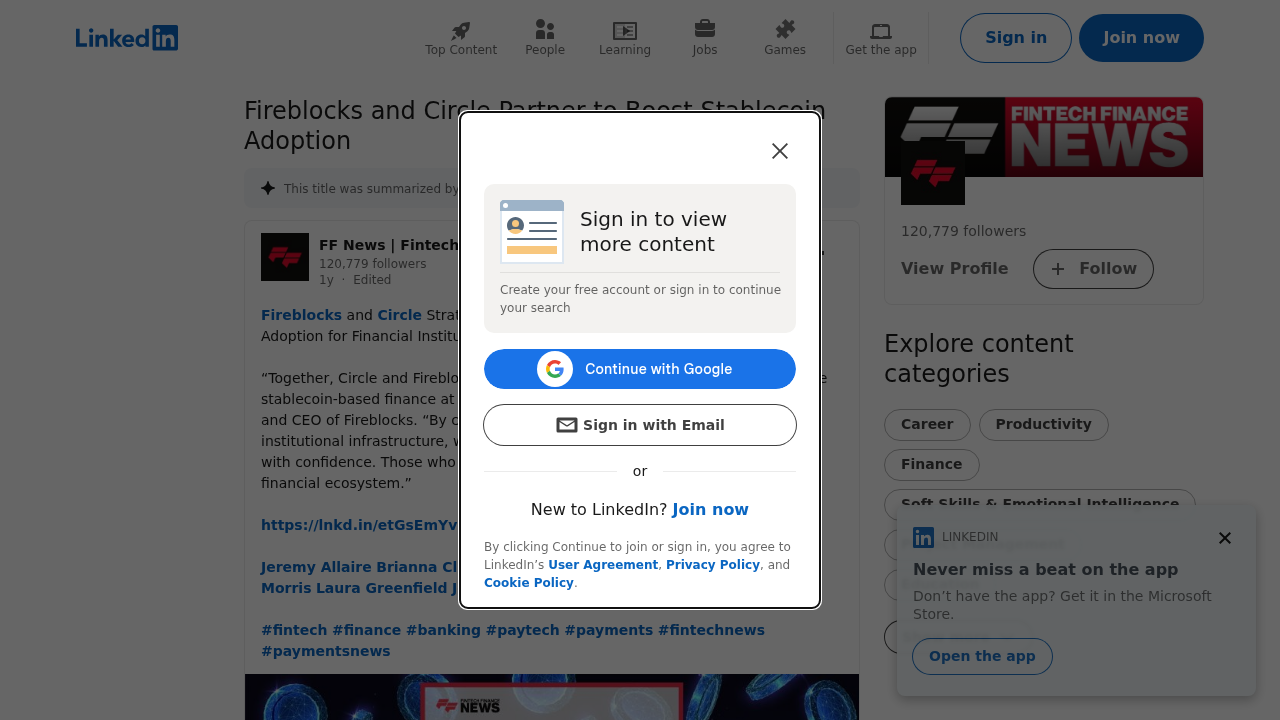
The relationship is formal. Fireblocks' own materials describe how Fireblocks and Circle are partnering to streamline institutional USDC operations, and the theme recurs in a Fireblocks custody webinar.
FF News, the Fintech Finance publication, reported the collaboration as aimed at accelerating stablecoin adoption for financial institutions. It quoted Michael Shaulov, Co-founder and CEO of Fireblocks: "Together, Circle and Fireblocks are working to build the trusted rails that enable stablecoin-based finance at a global scale." He framed the arrangement as combining Circle's stablecoin expertise with Fireblocks' institutional infrastructure.
Read that language carefully. The CEO describes a division of labor, not overlap. Circle brings the asset and its expertise; Fireblocks brings the operational layer institutions already run.
The better framing is that this is a hot-start distribution play for both sides. Circle reaches institutions already custodying on Fireblocks. Neither has to cold-start the other's customer base.
Takeaway: treat the partnership as evidence of complementarity, and confirm specific integration terms directly with both vendors.
Target fit: who builds on which
Vendor fit follows operating model. An issuer-adjacent treasury and a multi-asset custody desk have different failure modes, so they should ask different questions.
Operational checklist for institutions
- Mint and redeem access. Do you need direct issuance and redemption, or is secondary-market liquidity enough? Direct access points to Circle.
- Custody policy engine. Do you need quorum approvals and address controls? That points to Fireblocks.
- Approval workflows. Who signs, under what limits, with what audit trail?
- Chain coverage. Which networks must your stablecoin balances live on, and does each vendor support them?
- Asset scope. Is USDC your only asset, or one of many?
Integration and counterparty questions
- What is your vendor concentration risk if issuance, rails and custody all depend on one relationship?
- How do redemption flows reach your custody wallets, and who reconciles them?
- What happens operationally if one provider has an outage?
Takeaway: score each checklist item separately; a single vendor rarely clears all five.
Where Fireblocks wins
Fireblocks is the stronger choice on three dimensions.
- Custody and key management. MPC key-share architecture and policy controls are its core product, not an adjacent feature.
- Tokenization breadth. Fireblocks offers tokenization tooling, relevant for institutions issuing their own tokenized assets rather than holding someone else's.
- Multi-asset scope. As infrastructure, it is not tied to a single issuer's token. A desk holding several stablecoins and other digital assets can run them under one policy framework.
Takeaway: if your risk is operational (keys, signers, approvals), Fireblocks is the relevant vendor.
Where Circle wins
Circle wins where a custody platform cannot compete: being the issuer.
- Regulated issuance. Only the issuer can mint and redeem its token at the source.
- Banking rails. Moving between bank deposits and on-chain dollars requires the fiat connectivity Circle provides as part of its infrastructure.
- Settlement anchor. For payments, the issuer's rails define how quickly value converts back to fiat.
The business-model question matters for counterparty analysis. An issuer's economics are tied to the reserves behind its token, which makes Circle's incentives different from a software vendor's. For adjacent rail options, compare Circle Payment Network alternatives.
Takeaway: if your risk is convertibility, Circle is the relevant counterparty.
Who should pick which

- Issuer-side treasury. A corporate treasury that needs to mint and redeem USDC against bank balances should start with Circle's rails.
- Institutional custody. A fund, exchange or bank safeguarding multiple digital assets should start with Fireblocks' MPC custody and policy engine.
- Combined stack. An institution moving real volume will likely need both: Circle for convertibility, Fireblocks for control. The partnership exists for this case.
The open question is concentration. If the combined stack becomes the institutional default, the industry swaps many small vendor risks for two large ones.
FAQ: Frequently Asked Questions
Is Fireblocks a wallet provider?
In part. Fireblocks provides wallet infrastructure, but it is better understood as institutional custody software built on MPC key shares, with policy controls and tokenization tooling, rather than a retail wallet app for individuals.
Is Circle the same as USDC?
No. USDC is a stablecoin token, and Circle is the company that issues it. Evaluating Circle means assessing an issuer and counterparty; evaluating USDC means assessing a token's liquidity, chain support and redemption behavior.
How does Circle Internet Group make money?
As a stablecoin issuer, Circle's economics are linked to the reserves backing its tokens, alongside its infrastructure and rails services. Check Circle's own investor disclosures for current revenue composition rather than relying on secondary summaries.
Can institutions use Circle and Fireblocks together?
Yes. The two companies have announced a partnership to streamline institutional USDC operations. A typical combined setup uses Circle for issuance and banking rails and Fireblocks for custody and transaction approvals.
Where can I find the Fireblocks status page?
Go to Fireblocks' own website and support resources for current system status and incident updates. Operations teams should subscribe to vendor status alerts as part of their outage and escalation planning for custody.
Which is better for tokenization?
Fireblocks. It offers tokenization tooling as part of its infrastructure. Circle's strength is issuing its own regulated stablecoins and connecting them to banking rails, not providing general tokenization tooling for third-party assets.
Conclusion: complements, not substitutes
Circle answers whether a dollar on-chain can become a dollar in a bank. Fireblocks answers who is allowed to move it. Most institutions need both answers, which is why the two companies chose collaboration over competition. The implication: the real decision is no longer Circle or Fireblocks, but how much of the institutional stablecoin stack you are willing to concentrate in two counterparties.