What Is Tokenization Infrastructure and Why It Matters
Tokenization infrastructure is the set of systems that issue, record, transfer and settle ownership of financial assets as tokens on a blockchain, with compliance and auditability built into those rails. It matters because it replaces slower, fragmented processes with programmable, round-the-clock settlement. The token is the visible output. The infrastructure underneath, legal wrappers, custody, identity checks and settlement logic, is what makes that token a claim an institution can hold. For readers weighing how on-chain assets work in finance, the stack is the right unit of analysis.
Definition: What Tokenization Infrastructure Is
The thesis is simple: a token is only as good as the systems around it.
Asset tokenization, as Chainalysis describes it, means putting the record of ownership for traditional assets on blockchains, recording the rights to an asset into a digital token that can be held, sold and traded. Deloitte frames the basics as linking financial assets to digital tokens traded on distributed ledgers. McKinsey's definition is broader still: issuing a digital, unique representation of a real thing.
Tokenization infrastructure is everything required to make that representation enforceable and operable. It includes the legal entity that holds the asset, the custodian that safeguards keys and underlying holdings, the identity and eligibility controls that decide who may hold the token, the settlement mechanism that moves it against cash, and the records that let auditors reconcile on-chain balances with off-chain books.
The distinction matters. The token is a data object on a ledger. The infrastructure is the operating system that gives that object legal meaning.
In plain language
Tokenization infrastructure is the plumbing that lets a share, bond or fund unit live on a blockchain and still behave like a regulated financial asset.
How the Stack Works: Issuance to Settlement

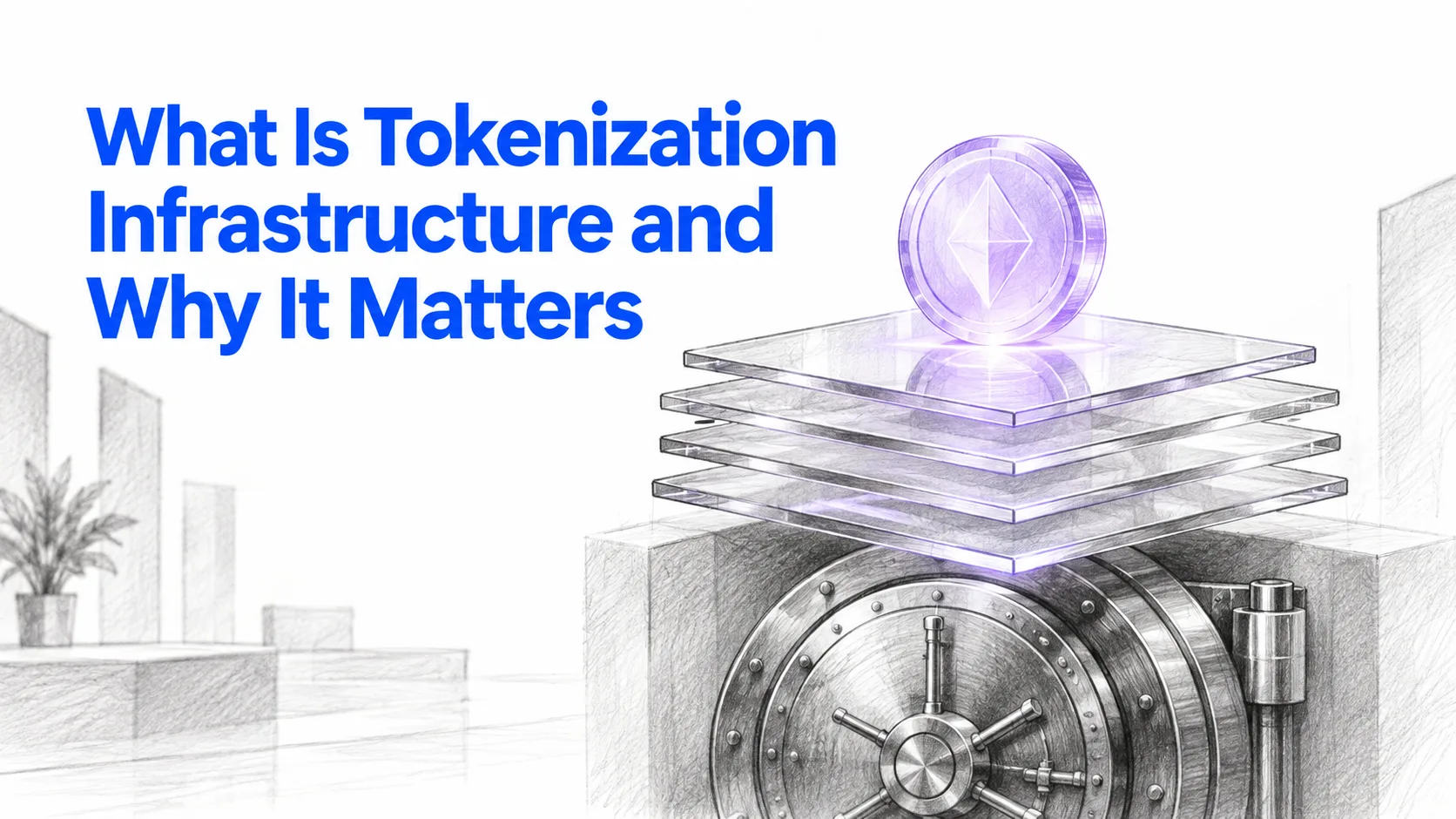
The clearest way to understand the category is as a layered stack. Each layer has a distinct job, and each fails in a distinct way. A weak layer is not offset by a strong one; the asset inherits the weakest link.
The five layers
- Issuance and legal wrapper. Defines what the token is a claim on.
- Custody. Safeguards the underlying asset and the keys that control the token.
- Compliance and identity. Determines who may hold, receive or transfer the token.
- Trading and settlement. Moves the token against payment and finalises ownership.
- Auditability. Keeps on-chain and off-chain records consistent and inspectable.
| Layer | What it does | What goes wrong if weak | Source framing |
|---|---|---|---|
| Issuance and legal wrapper | Creates the token and binds it to a legal claim, often through a special-purpose entity that owns the asset | Token holders hold a data entry with an unclear or unenforceable claim on the underlying | Chainalysis describes creating a legal entity to own the asset, with tokens representing shares in that entity |
| Custody | Holds the underlying asset and controls the keys that govern minting and transfers | Loss of keys or commingled assets breaks the link between token and asset | InvestaX lists custody among the licences tech-only providers lack |
| Compliance and identity | Runs KYC, eligibility and transfer restrictions, ideally enforced in the token logic | Tokens move to ineligible holders, creating securities-law exposure | Antier argues platforms must prioritise compliance-first architecture |
| Trading and settlement | Executes transfers and settles them against cash on a shared ledger | Settlement reverts to slow, siloed reconciliation, removing the core benefit | Forbes frames tokenization as transforming how assets are issued, transferred and settled |
| Auditability | Produces a single, shared record that operators, auditors and regulators can inspect | On-chain balances diverge from the official register; trust erodes | Antier lists auditability among the priorities for tokenization platforms |
An academic taxonomy of RWA tokenization systems on arXiv attempts a formal classification of these systems, a useful signal that the field is maturing from vendor diagrams toward shared vocabulary.
Takeaway: evaluate tokenization projects layer by layer, not by the chain they run on.
Worked example: a tokenized money-market fund share
Assume a US fund manager issues shares of a government money-market fund as tokens on a permissioned ledger. The figures are irrelevant here; the sequence is the point.
- Onboarding. An institutional investor applies. The transfer agent or platform collects entity documents.
- KYC and eligibility. Identity is verified and the investor's wallet address is added to an allowlist.
- Mint. On subscription, cash arrives and the issuance contract mints fund-share tokens to the approved wallet.
- Transfer restriction check. When the investor later sends tokens to a counterparty, the contract checks that the recipient is also on the allowlist. If not, the transfer fails.
- Settlement. An approved transfer settles against a cash leg, such as a stablecoin or tokenized deposit, in a single atomic step.
- Record reconciliation. The ledger state is reconciled against the fund's official register and the custodian's holdings, giving auditors one consistent view.
Every step maps to a layer. Remove step four and the fund has a compliance problem. Remove step six and it has an audit problem.
Why It Matters for US Markets
The US relevance is not speculative. Institutions are already building on these rails.
Settlement and operational efficiency
In its Forbes Technology Council piece, Hashgraph CEO Eric Piscini frames tokenization as replacing outdated systems with programmable, 24/7 infrastructure where speed, compliance and transparency are built in. The same piece notes BlackRock tokenizing money market funds, Citi piloting custody and settlement, Franklin Templeton issuing shares on-chain since 2021, and J.P. Morgan piloting a USD deposit token (JPMD) for institutional settlement.
The Federal Reserve Bank of New York hosted a research conference on April 4, 2025, that included a panel on tokenization platforms and the future of financial infrastructure. When a Reserve Bank convenes on the subject, it is a market structure question, not a product trend.
Takeaway: the efficiency case rests on shared ledgers replacing bilateral reconciliation.
Compliance built into the rails
Traditional compliance sits beside the transaction: checks happen before or after settlement in separate systems. Tokenized systems can move those checks into the transfer itself. An allowlisted token cannot settle to an unverified wallet. That changes compliance from a reporting function into a pre-trade control.
Takeaway: programmable restrictions reduce the gap between policy and execution, provided the identity layer is accurate.
Fractional access to illiquid assets
Deloitte argues tokenization is likely to help reach new customers through fractional trading in illiquid assets such as real estate, artwork and collectibles. Chainalysis makes a parallel point: divisibility can broaden ownership and add liquidity to asset classes that have historically traded rarely.
The caveat is structural. Fractionalisation creates smaller units; it does not create buyers. Liquidity still depends on secondary market venues and eligible counterparties.
Takeaway: fractional access is real, but liquidity is a market outcome, not a token feature.
Common Misconceptions
Misconception: Tokenization is a digital assets trend / Reality: it is an infrastructure upgrade
The Forbes piece explicitly positions tokenization against the metaverse and memecoins: an operational overhaul of issuance, transfer and settlement. The relevant comparison is the move from paper certificates to book-entry, not the latest token cycle.
Misconception: A token is the whole product / Reality: legal and custody layers decide value
A token without an enforceable claim is a database row. Chainalysis's own walkthrough starts with a legal entity owning the asset, before any smart contract is written. Value flows from the wrapper and custodian, not from the mint function.
Misconception: All platform providers are the same / Reality: models range from tech-only to licensed
InvestaX, itself a provider, sorts the market into tech-only, exchange-only and licensed platforms, arguing that tech-only providers without broker-dealer or custody licences cannot facilitate compliant fundraising or trading. Treat that as one vendor's framing, but the underlying question holds: which layers does a provider actually operate?
Misconception: Only real estate gets tokenized / Reality: money-like instruments are leading
Real estate dominates explainers. Activity tells a different story: the NY Fed conference materials note that stablecoins, Treasury securities and money-market funds are being tokenized and made available on blockchain systems. Short-duration, standardised instruments are the natural first movers because their legal and valuation layers are already simple.
Related Concepts
Real-world asset (RWA) tokenization
The tokenization of off-chain assets such as bonds, funds, credit or property. The term usually implies an issuer, a legal wrapper and an off-chain asset that the token tracks.
Tokenized deposits and stablecoins
Both are on-chain cash. A tokenized deposit is a bank liability recorded on a ledger, as with J.P. Morgan's JPMD pilot; a stablecoin is typically issued by a non-bank and backed by reserves. Either can serve as the cash leg in settlement.
Transfer agent and registry
The transfer agent maintains the official record of security holders. In a tokenized structure, the ledger may serve as or mirror that register, which is why reconciliation sits in the auditability layer.
Smart contract compliance controls
Code-level rules such as allowlists, holding limits, lockups and forced transfers. They let issuers enforce eligibility at the moment of transfer rather than after the fact.
Payment tokenization versus asset tokenization
In card payments, tokenization means substituting sensitive data, such as a card number, with a non-sensitive reference token. That is a security technique. Asset tokenization records ownership on a blockchain. Same word, unrelated systems.
How to Get Started

A practical sequence for treasurers, operators and builders:
- Map one asset workflow. Pick a single instrument, such as a fund share or a note, and trace its current issuance, transfer and settlement path, including every reconciliation step.
- List the required controls. Identify KYC, eligibility, transfer restrictions, custody arrangements and reporting duties. Each maps to a layer of the stack.
- Compare provider models. Ask which layers each provider operates directly, which it outsources and which licences it holds.
- Read primary research. Deloitte's financial services analysis and the arXiv taxonomy are better starting points than vendor decks.
The open question is not whether tokens can move. It is which institution owns the register when the ledger and the books disagree.
FAQ: Frequently Asked Questions
What is blockchain tokenization?
Blockchain tokenization records the rights to an asset in a digital token on a blockchain. The token can be held, transferred and traded, while the ledger serves as a shared record of who owns what.
What is tokenized stock trading and how does it work?
Tokenized stock trading uses tokens that represent shares or exposure to shares. An issuer or custodian holds the underlying equity, and tokens move on a ledger, subject to eligibility checks and the platform's legal structure.
What is tokenization in payment systems?
In payments, tokenization replaces sensitive data such as a card number with a substitute reference value. It protects data during transactions and is unrelated to recording asset ownership on a blockchain.
Is it possible to tokenize real estate?
Yes. A common structure places a property in a legal entity, then issues tokens representing shares in that entity. Holders gain a fractional economic claim, though resale liquidity depends on available venues and buyers.
How is tokenization infrastructure different from a blockchain?
A blockchain is only the ledger. Tokenization infrastructure adds the legal wrapper, custody, identity and compliance controls, settlement and audit records required to make a token an enforceable financial asset.
What types of providers offer tokenization platforms?
Providers range from technology-only vendors that supply issuance software to licensed platforms that also handle custody, brokerage or trading. The key question is which layers a provider operates and which it leaves to the issuer.
Who regulates tokenized assets in the United States?
It depends on what the token represents. A tokenized security generally remains subject to securities regulation, while tokenized deposits fall under banking oversight. Issuers should confirm classification with qualified US counsel before launch.
Conclusion: The Stack Is the Product
Tokenization infrastructure is best understood as five layers, issuance, custody, compliance, settlement and audit, that together turn a ledger entry into an enforceable claim. Money-like instruments are moving first because their layers are simplest to build. The implication for allocators and operators is direct: diligence the weakest layer, not the headline chain. The harder question remains open. As more assets settle on shared ledgers, will the official record of ownership migrate on-chain, or will the ledger remain a mirror of books kept elsewhere?