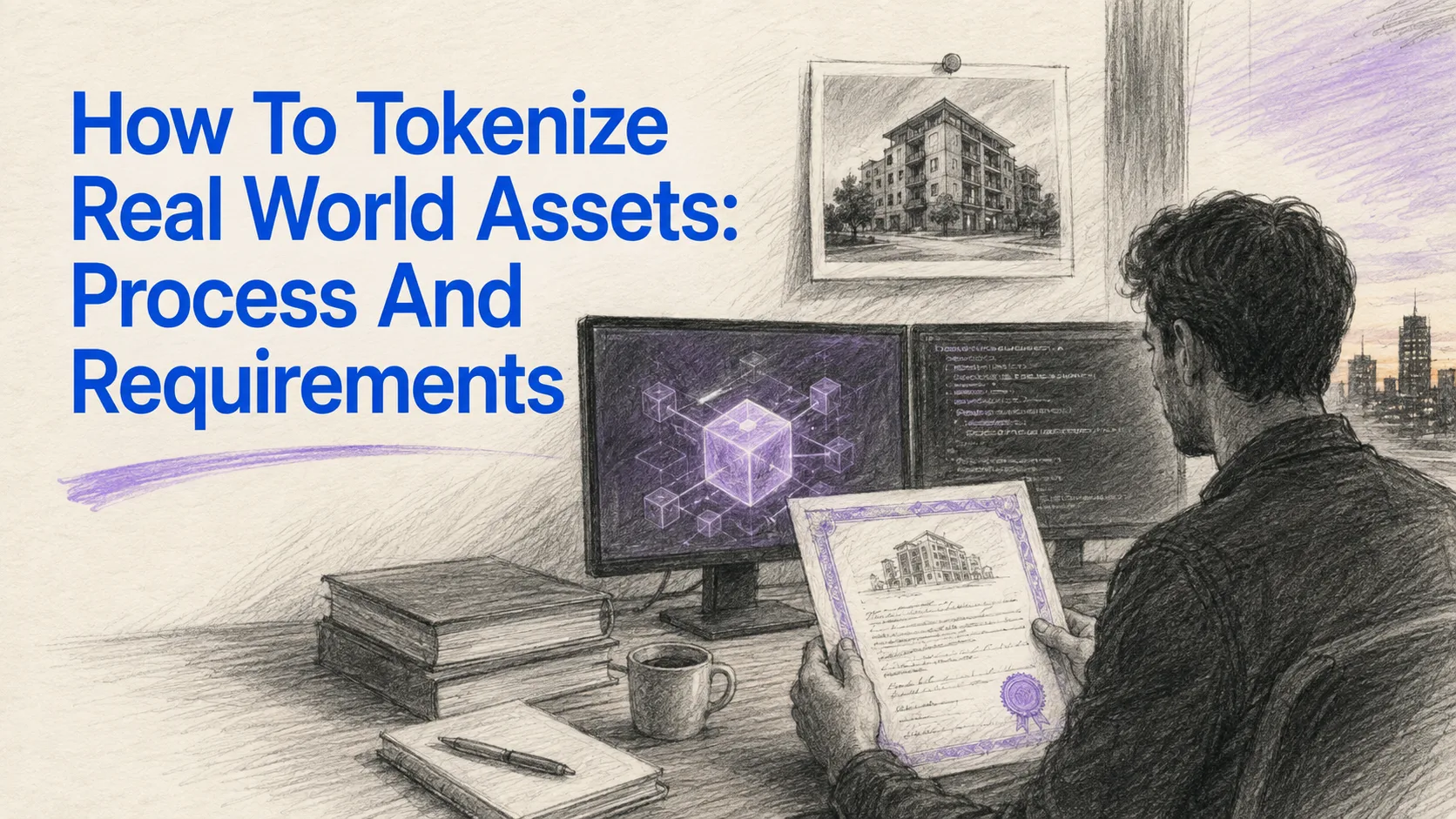
How To Tokenize Real World Assets: Process And Requirements
Tokenizing real world assets converts physical and traditional financial holdings into blockchain-based digital tokens, opening fractional ownership and continuous secondary market access to a broader investor base. From real estate and Treasuries to commodities, private credit, and art, the process spans legal structuring, smart contract deployment, and ongoing compliance. Stablecoin.nyc covers the full landscape of on-chain asset infrastructure, including practical guidance on getting a tokenization project from term sheet to first mint. This guide walks through the process, requirements, and failure modes. Total time to first issuance: roughly three to nine months. Skill level: advanced.
What You Will Need Before You Start

Before any smart contract is deployed, an issuer needs a defensible asset, the right counterparties, and a jurisdiction that accepts the structure. Skipping any of these three creates rework that is significantly more expensive than getting them right the first time. For a broader view of how the primary market has developed, see primary market dynamics for tokenized real world assets.
Asset eligibility checklist
The asset must satisfy four preconditions before it is a candidate for tokenization:
- Clear, documented legal ownership with no contested title or undisclosed liens.
- A credible, independent valuation mechanism (appraisal, market price, or NAV methodology).
- A custody solution capable of holding the underlying asset on behalf of token holders.
- A revenue or redemption model that can be expressed in a smart contract or a scheduled off-chain workflow.
Assets that fail any of these tests are not disqualified forever, but they need remediation before issuance. A background primer on the broader on-chain asset stack is available in the Stablecoin.nyc fundamentals hub.
Key participants in the ecosystem
A live RWA deal typically involves the following counterparties:
- Issuer: the SPV or fund entity that holds the asset and issues tokens.
- Legal counsel: securities, property, or fund formation specialists in each relevant jurisdiction.
- Tokenization platform or developer: builds and operates the token contracts.
- Custodian: a licensed entity that holds the underlying asset (bank, trust company, or qualified digital asset custodian).
- Compliance officer: runs KYC/AML onboarding, transfer monitoring, and reporting.
- Auditor and oracle provider: independent smart contract audit plus a data feed for NAV or price attestations.
Jurisdictional choice is a first-order design variable. The EU's MiCA framework, Liechtenstein's Token Act, Luxembourg's Blockchain Law IV, and Singapore's MAS guidelines each create meaningfully different structuring options. Coverage of the next round of European rulemaking is in MiCA 2.0 and what the next phase means for funds.
Budget realistically. A first issuance typically absorbs six figures in legal, audit, and platform costs before a single token is minted. Ongoing regulatory reporting and custody fees continue for the life of the token. Practical takeaway: line up counsel, custodian, and jurisdiction before you commit to a chain or token standard.
Before You Start: What to Back Up and What Can Break

Nothing to back up in the traditional sense, but four categories of pre-work almost always determine whether an issuance ships on schedule. Regulatory posture is downstream of these decisions; see the SEC revisiting custody rules for digital asset managers for context on how U.S. custody expectations are shifting.
- Ownership documentation. Incomplete or contested title is the single most common cause of a failed tokenization. Verify chain of title, existing liens, and encumbrances before any blockchain work begins. Confirm the asset can legally be contributed to an SPV.
- Token standard selection. Choosing ERC-20 for an asset that requires transfer restrictions forces a full redeploy once compliance requirements surface. Decide fungibility and transfer-control needs before you write Solidity.
- Regulatory classification. Treating a security token as a utility token can trigger enforcement action. Obtain a written legal opinion on token classification, in every jurisdiction where investors will be onboarded, before issuance.
- Custodian agreements. The custody agreement must explicitly acknowledge the token-holder relationship. Ambiguity here becomes catastrophic in an insolvency scenario, where token holders may otherwise be treated as unsecured creditors of the issuer rather than beneficial owners of the asset. Institutional patterns for handling this are discussed in Goldman Sachs expanding its asset tokenization desk.
Takeaway: pre-issuance failures are legal and structural, not technical. Fix them on paper before you touch a contract.
Step-by-Step: How To Tokenize Real World Assets
Seven steps take a candidate asset from selection to a live, tradable token. Institutional demand context for the end state is covered in the great decoupling and how Treasury-backed assets redefined yield.
Step 1: Select and Verify the Asset
Confirm the asset is free of legal disputes, can be independently valued, and has a workable custody path. Common asset classes include real estate, U.S. Treasuries, commodities (gold, silver, oil), private credit, invoices, and art. Output of this step: an asset dossier with title docs, valuation report, and a signed custody term sheet. Broader ecosystem context is in the Stablecoin.nyc analysis category.
Step 2: Create the Legal Wrapper
Incorporate a Special Purpose Vehicle (SPV) in a jurisdiction that recognizes token holders as beneficial owners. The SPV holds the underlying asset and issues tokens representing fractional claims, isolating liability from the sponsor's balance sheet. Standard forms include a Delaware LLC, a Cayman SPC, a Luxembourg SCSp, or a Liechtenstein AG under the Token Act. The choice affects tax treatment, investor eligibility, and secondary market rules. Institutional flow context is discussed in the Stablecoin.nyc institutions category.
Step 3: Choose a Blockchain and Token Standard
Blockchain selection is a function of liquidity, custody support, and fee tolerance. Ethereum mainnet remains the default for institutional issuance; Polygon, Avalanche, and Base are common alternatives for higher throughput. Token standard is where compliance logic lives:
| Standard | Fungibility | Transfer controls | Typical use |
|---|---|---|---|
| ERC-20 | Fungible | None built-in | Open, unrestricted tokens |
| ERC-1400 | Fungible with partitions | Transfer restrictions, forced transfers | Security tokens |
| ERC-3643 (T-REX) | Fungible | On-chain identity, allowlist, compliance modules | Regulated RWA issuance |
| ERC-721 / ERC-1155 | Non-fungible | Optional | Unique assets (single property, single artwork) |
For most regulated RWA deals, ERC-3643 or ERC-1400 is the working answer. Additional macro context on how yield-bearing tokens fit into portfolios is in the liquidity trap and why yields are stalling.
Step 4: Deploy and Audit the Smart Contract
Independent third-party audit is non-negotiable before mainnet deployment. Reputable audit firms review access control, minting and burn logic, upgradeability, reentrancy, oracle dependencies, and compliance module correctness. Budget two to six weeks for the audit cycle depending on contract complexity, plus a remediation pass. On-chain risk patterns that audits should stress-test are covered in arbitrage loops in automated market makers.
Step 5: Mint Tokens and Run KYC/AML Onboarding
Every investor completes KYC/AML verification before tokens are transferred to their wallet. This is usually enforced through an on-chain identity layer (such as an ONCHAINID contract) or a permissioned allowlist maintained by the issuer. Accredited or professional investor status is verified where relevant. According to MetaMask's RWA explainer, the token contract itself typically enforces allowlist logic so that unverified addresses are rejected at the transfer layer. Coverage of how U.S. rulemaking is shaping this workflow is in the Stablecoin Act facing a new hurdle in Senate committee.
Step 6: Distribute Tokens to Investors
Distribution follows a subscription agreement executed off-chain, followed by an on-chain mint to the investor's verified wallet. Primary distribution can happen via a regulated STO platform, a private placement to accredited investors, or a broker-dealer network. Secondary market listings on regulated venues come later, once the underlying legal opinions confirm transferability. For a market snapshot of how listed digital asset products are trending, see spot ETF volumes hitting record monthly highs.
Step 7: Manage Ongoing Administration and Reporting
Post-issuance the SPV runs indefinitely. Yield or rental income distribution can be automated by pushing stablecoin payments to holder addresses on a set schedule, or handled off-chain by the issuer. Periodic obligations include NAV or valuation reporting, redemption processing, regulatory filings, holder communications, and cap table maintenance. Some platforms automate a large portion of this workflow. Related infrastructure context is in the de-pegging paradox and why liquidity cycles are shortening.
Regulatory and Compliance Requirements

Regulation is the single largest determinant of what a tokenized asset can and cannot do. The rules are jurisdiction-specific and evolving; treat this section as a map of the questions, not a legal opinion. Broader macro framing is available in the Stablecoin.nyc macro category.
Securities law considerations
In the United States, most tokenized assets qualify as securities under the Howey Test. Issuance therefore requires either SEC registration or a valid exemption. The common exemptions in practice:
- Reg D 506(c): general solicitation permitted, accredited investors only, no dollar cap.
- Reg D 506(b): no general solicitation, up to 35 non-accredited investors, no dollar cap.
- Reg A+: up to $75 million per year, retail investors permitted, requires SEC qualification.
- Reg S: offshore offerings to non-U.S. persons, no U.S. registration required.
The choice cascades into investor eligibility checks, secondary trading restrictions (a 12-month lockup under Rule 144 for Reg D), and disclosure obligations. Custody expectations for registered advisers are shifting; see the SEC revisiting custody rules for digital asset managers.
Cross-border tokenization rules
The EU's Markets in Crypto-Assets (MiCA) regulation became fully applicable in December 2024 and establishes a licensing framework for asset-referenced tokens and e-money tokens across member states. Security tokens sit under MiFID II and the pilot regime for DLT market infrastructures rather than under MiCA. In Asia, Singapore's Payment Services Act and Japan's amended FIEA both accommodate regulated token issuance. According to Chainlink's RWA education hub, cross-chain compliance often relies on interoperability protocols that carry identity and transfer-restriction data alongside the token.
Cross-border issuances must map every investor's jurisdiction to the applicable transfer restrictions, and smart contract allowlists are the standard technical enforcement mechanism. AML obligations under FATF virtual asset guidance apply to tokenized asset issuers on the same terms as traditional financial institutions, including transaction monitoring, travel rule compliance, and suspicious activity reporting. See also sovereign debt and the silent pivot to digital collateral for how public-sector issuance patterns interact with these rules.
Takeaway: pick your jurisdiction, exemption, and investor pool together. They are not separable decisions.
Troubleshooting Common Tokenization Failures
Four failure modes account for a disproportionate share of post-launch incidents. For a market view of how these show up in practice, see the psychology of the bull and why this cycle is different.
Symptom: Tokens cannot be transferred after minting. Cause: The recipient address is not on the smart contract allowlist, or the sender's compliance status has expired. Fix: Complete KYC verification, refresh the on-chain identity claim, and update the allowlist. Retry the transfer.
Symptom: Yield payments fail to reach token holders. Cause: The smart contract references an incorrect or expired oracle price feed, or the reserve wallet holds insufficient stablecoin balance to cover the distribution. Fix: Verify oracle configuration and heartbeat, confirm the reserve wallet has adequate stablecoin balance, and retrigger the distribution function.
Symptom: Custodian refuses to honor a redemption request. Cause: The custody agreement does not explicitly reference the token-holder relationship, leaving redemption rights ambiguous. Fix: Amend the custody agreement and obtain a written legal opinion confirming token holder standing before the next distribution window.
Symptom: A regulator issues a stop-trade order. Cause: The token was classified incorrectly, most often as a utility rather than a security, or the exemption was misapplied. Fix: Engage securities counsel immediately, pause secondary market trading, and assess reclassification or remediation options. Document the response for future filings. Related coverage is in the Stablecoin.nyc resources hub.
Takeaway: every one of these failures traces back to a decision made before mainnet deployment. Post-mortem accordingly.
Frequently Asked Questions
What types of assets can be tokenized as real world assets?
Real estate, U.S. Treasuries, corporate bonds, private credit, commodities such as gold and oil, equities, invoices, carbon credits, and fine art are all being tokenized today. The asset needs clear title, an independent valuation, and a workable custody arrangement.
How long does the tokenization process take from start to finish?
A first issuance typically takes three to nine months. Legal structuring and jurisdictional selection consume the bulk of that time; smart contract deployment and audit are usually four to eight weeks. Repeat issuances from the same platform run considerably faster.
What is a Special Purpose Vehicle (SPV) and why is it needed for RWA tokenization?
An SPV is a bankruptcy-remote legal entity that holds the underlying asset and issues tokens representing fractional claims. It isolates the asset from the sponsor's balance sheet, clarifies token holder rights, and gives regulators and custodians a recognizable counterparty.
Do I need regulatory approval to tokenize a real world asset?
In most jurisdictions, yes. Tokenized assets that meet a securities definition require registration or a valid exemption. Even non-security tokenizations typically trigger AML, KYC, and consumer-protection obligations. Obtain a jurisdiction-specific legal opinion before issuance.
What is the difference between ERC-20, ERC-1400, and ERC-3643 for tokenized assets?
ERC-20 is fungible with no compliance logic. ERC-1400 adds partitions and transfer restrictions suitable for security tokens. ERC-3643 (T-REX) extends this with on-chain identity, allowlists, and compliance modules, and is the working standard for regulated RWA issuance.
How do investors receive yield or income from tokenized real world assets?
Yield is typically distributed as stablecoin payments pushed to holder wallets on a set schedule, or claimed via a smart contract function. Some issuers accrue yield in the token's price rather than distributing it. The mechanism is disclosed in the offering documents.
What are the main risks of investing in tokenized real world assets?
Key risks include custodian failure, smart contract exploits, oracle manipulation, illiquid secondary markets, regulatory reclassification, and mismatch between the on-chain token and the off-chain legal claim. Investors should review the custody arrangement, audit report, and legal opinion.
How much does it cost to tokenize a real world asset?
Initial costs typically run from roughly $75,000 at the low end to well over $500,000 for a fully regulated multi-jurisdiction issuance, covering legal, audit, platform, and custody setup. Ongoing costs include reporting, custody fees, and platform maintenance.
Conclusion
Tokenizing real world assets is a legal exercise wrapped around a technical one. The determinants of success are decided long before the token contract is deployed: asset quality, jurisdictional fit, custody structure, and regulatory classification. Get those four right and the smart contract work is largely mechanical. Get any of them wrong and no amount of on-chain engineering will fix the resulting exposure. For continuing coverage of on-chain asset infrastructure, market structure, and regulation, Stablecoin.nyc tracks the primary and secondary market as it develops.