Buying crypto by credit card is rarely free. Most pages ranking for this query promote a single provider. The options below are ranked by the drivers that set your all-in cost, not by marketing claims.
How we ranked these

The ranking rests on five criteria. Readers should feel free to weight them differently.
- Total card fee. The stated fee plus any spread embedded in the quoted price.
- US availability. Whether a US buyer can complete a card purchase.
- Card types accepted. Visa, Mastercard, American Express, prepaid.
- Identity verification. How the KYC step is handled before the first purchase.
- Custody delivery. Whether coins land in your own wallet or stay with the platform.
Only two options had enough published evidence to rank. A short list with defensible inputs is more useful than a long one built on guesses.
Quick summary
- Banxa: Published 3-5% card fee, broad card support. Best for Fee Transparency
- Coinbase: US exchange with familiar card checkout flow. Best for US Exchange Users
What a no-fee card purchase really costs
The phrase "no fees" usually describes one layer of cost, not the total. A card purchase has up to three layers:
- Platform or processor fee. According to Banxa, credit cards carry 3-5% in combined processing and interchange fees, compared with 1-2% for bank transfers.
- Spread. The gap between the quoted price and the market price. A platform can advertise a low fee and recover margin here.
- Issuer treatment.
The first-principles reason is simple. Card networks give cardholders chargeback rights. Banxa notes that dispute risk drives up processing costs for crypto platforms, and those costs pass to buyers. Instant settlement and consumer protection are being priced in.
Worked example: $1,000 purchase
Assume a $1,000 card purchase and an issuer that adds no cash advance fee.
| Provider | Card fee basis | Fee on $1,000 | Crypto value received (before spread) |
|---|---|---|---|
| Banxa | 3-5% (Banxa) | $30-$50 | $950-$970 |
| MoonPay | Up to 4.5% for card, 1% for bank transfer (MoonPay) | Up to $45 | From $955 |
Now relax the assumption. If the issuer codes the same purchase as a cash advance at 3%, add another $30, and interest starts on day one. The takeaway: the issuer layer can double the cost, and the platform cannot see or control it.
At a glance
| Rank | Tool | Pricing | Best for | Standout |
|---|---|---|---|---|
| 1 | Banxa | 3-5% card fees | Fee transparency | 180+ countries, 30+ fiat currencies |
| 2 | Coinbase | See vendor | US exchange users | Established US exchange |
Banxa
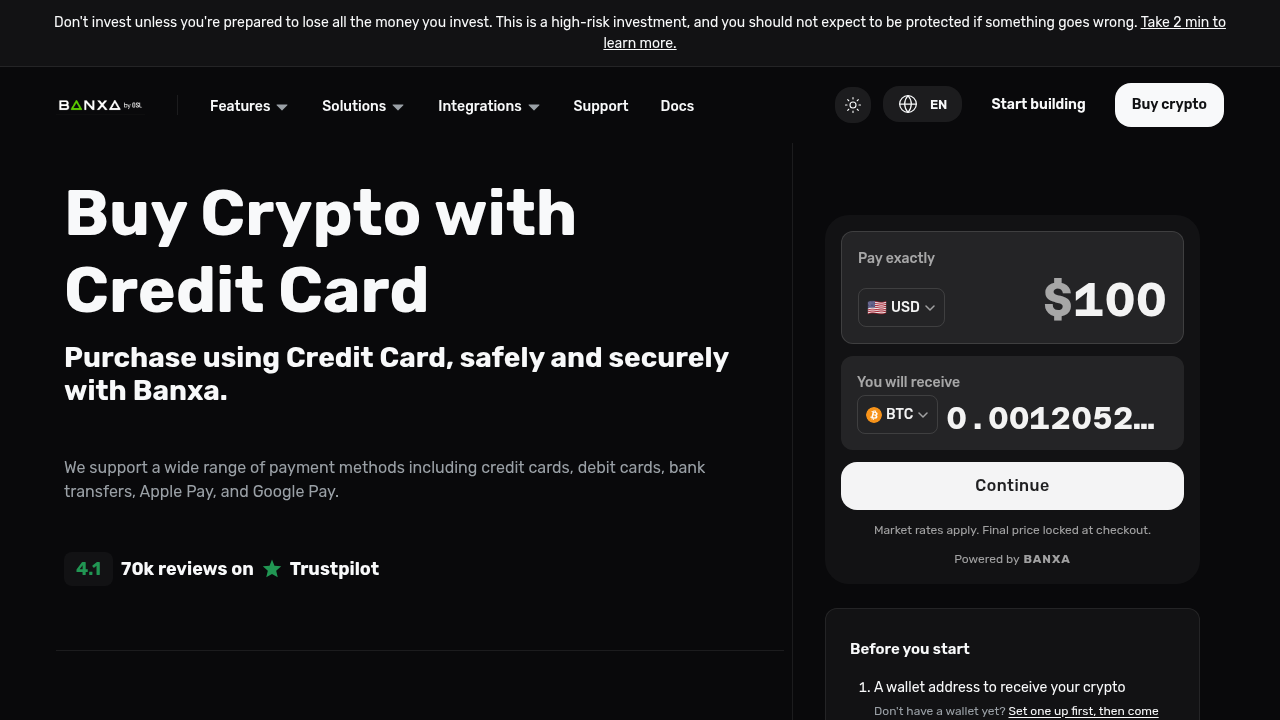
- Fees: 3-5% in combined processing and interchange fees on credit cards, per Banxa.
- Reach: Available in 180+ countries with 30+ fiat currencies.
- Cards: Banxa states most platforms accept Visa and Mastercard; American Express is less common, and Discover works in the US with limited international acceptance.
- KYC: A verification step precedes the first order.
- Delivery: Crypto is delivered directly to the buyer's wallet.
Banxa also notes that issuers often cap crypto purchases per transaction and per month, separately from your overall credit limit.
Caveat: The fee level itself. At 3-5%, Banxa is not a no-fee route; it is a priced-in-advance route. Its value is predictability, not cheapness.
Coinbase
Coinbase is a US exchange that comes up when retail buyers ask whether card purchases are possible; one Reddit thread on r/CryptoCurrency points to its gift card section as an example. It is a reasonable default for buyers who already hold an account.
The practical step: read the fee and price breakdown on the confirmation screen before you approve the charge, and compare the quoted coin price with the market price to estimate the spread.
Caveat: Without a published card fee, the all-in cost is only visible at checkout. That makes pre-trade comparison harder.
How to judge other card on-ramps
The market is wider than two names. For comparing more providers, see the best crypto on-ramp platforms page.
- Fee shown before payment. A quote that itemizes the processor fee is the minimum standard.
- Spread. Compare the quote with a market price at the same moment.
- Self-custody delivery. BitPay routes purchases through partner providers and delivers to any wallet, and says it charges no hidden fees. Treat that as a vendor claim and verify against the quote.
- KYC. Expect identity verification on any regulated route.
- Issuer coding. Check your first statement to see how the charge was categorized.
Takeaway: an on-ramp that will not show the full cost before you pay fails the first test.
How to choose

If fee predictability matters most, Banxa's published 3-5% range makes the cost knowable in advance. If you already use a US exchange, Coinbase keeps the purchase inside an existing account, but the cost is only visible at checkout, and a guide on how to buy USDC covers a related purchase. In either case, the largest swing factor sits outside the platform: issuer cash advance coding can add a second fee layer. For anyone without urgency, a bank transfer generally costs less, as OKX's guide notes card fees are higher than ACH. The open question is whether card networks standardize crypto as a purchase rather than a cash advance; until they do, "no-fee" card buying remains a marketing category rather than a pricing reality.
FAQ: Frequently Asked Questions
Can the IRS see your crypto wallet?
A self-custody wallet address is not tied to your name by default, but regulated platforms collect identity data through KYC. Purchases made through those platforms are linked to you. Consult a tax professional for reporting obligations.
Why are card purchases more expensive than bank transfers?
Card processors charge platforms more, and chargeback rights create dispute risk. Platforms pass those costs to buyers. OKX's guide notes card fees are generally higher than ACH, though card settlement is far faster.
Does my card issuer treat crypto as a cash advance?
It depends on your bank and card network. Many issuers do, which can trigger a separate fee and immediate interest. Call your issuer before buying, then confirm the category on your first statement.
Can I buy crypto with a prepaid card?
Sometimes. Some prepaid issuers block crypto merchants entirely, so declines happen.
Which crypto can I buy by card?
It varies by platform. MoonPay lists 100+ assets including BTC, ETH, SOL, USDT and USDC.