TL;DR
The best Travel Rule solution for stablecoin payments depends on where the payment risk sits. Best for B2B stablecoin payments that need pre-settlement authorization is Notabene. Best for self-hosted wallet verification with data kept on your own infrastructure is 21 Analytics. Best for one vendor covering KYC, KYT and Travel Rule is Sumsub. Best for automated counterparty discovery from a wallet address is Veriscope. Shufti suits teams that want wallet screening and ownership proofs inside one compliance account.
What a Travel Rule solution does for stablecoin payments
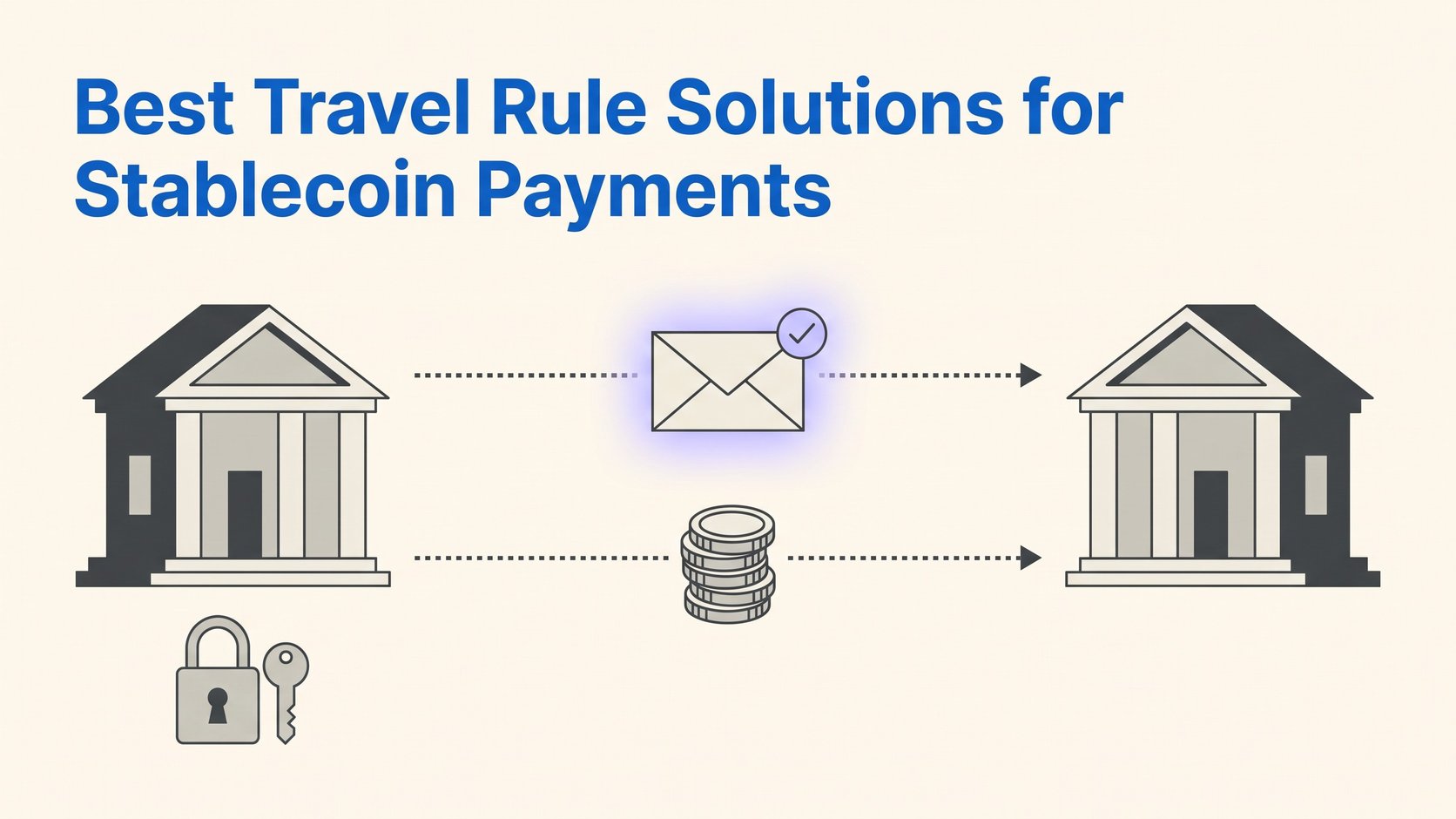
A Travel Rule solution is software that lets virtual asset service providers (VASPs) and financial institutions meet FATF Recommendation 16, the wire transfers standard that was extended to crypto transactions. The rule requires originator and beneficiary information to travel with each transfer, so that crypto payments carry the same anti-money laundering and terrorist financing controls as bank wires. Stablecoin payments are crypto transactions for this purpose, which is why the rule applies to every regulated payment company moving USDC, USDT or any other stablecoin. The Travel Rule requirements for stablecoin operators covers the regulation itself.
A crypto Travel Rule compliance solution does four jobs:
- Identifies whether the receiving wallet belongs to another VASP or is self-hosted.
- Finds the counterparty VASP and checks it before any customer data is shared.
- Exchanges the Travel Rule data securely, usually in the IVMS 101 format, so personally identifiable information reaches only the counterparty.
- Records the outcome so the compliance team can show regulators each transaction met the regulatory requirements.
Why generic Travel Rule rankings fail stablecoin payments
Most Travel Rule comparisons are written for exchanges: how many virtual asset service providers (VASPs) a network reaches and which protocols it speaks. A stablecoin payment flow breaks in different places. The counterparty is often a business paying from a self-hosted wallet, the transfer has to clear before an invoice is considered paid, and finance teams need the originator and beneficiary data to reconcile the payment, not just to file it.
That shifts the buying criteria. Network size still matters, but it matters less than four payment-specific questions:
- Pre-settlement authorization. Can you approve or reject a transfer before the stablecoins move, rather than quarantining funds that already arrived?
- Self-hosted wallet coverage. The EU Transfer of Funds Regulation requires a CASP to verify that its customer owns or controls a self-hosted wallet for transfers above EUR 1,000, and CASP-to-CASP transfers carry no minimum threshold at all, according to Eco's 2026 stablecoin compliance guide. Payment flows hit both cases constantly.
- Payment data for reconciliation. Does the Travel Rule data stay attached to the payment so treasury can match it to an invoice?
- Data custody. Who stores the personally identifiable information: the vendor, a network, or you?
The framing worth keeping: for an exchange, the Travel Rule is a message that accompanies a withdrawal. For a stablecoin payment, it is the authorization step that decides whether the payment happens.
Quick comparison table
| Provider | Pre-settlement authorization | Self-hosted wallet verification | Data custody model | Payments-specific features | Best for |
|---|---|---|---|---|---|
| Notabene | Yes, core design: transactions are authorized before settlement | Yes, four proof methods | Hosted platform and network; SOC 2 Type II audited, ISO 27001:2022 certified | Notabene Flow: pull payments, recurring payments, invoicing, payment links (Travel Rule and authorization via Notabene Transact) | B2B stablecoin payments between regulated institutions and their customers |
| 21 Analytics | Yes, receive transactions only after approval | Yes, AOPP one-click proofs, Satoshi Test, message signing, visual proofs | On-premise software; 21 Analytics cannot access customer data | None beyond Travel Rule; flat fee for unlimited transactions | Payment businesses with heavy self-hosted wallet traffic and strict data residency |
| Sumsub | Transfer review within its compliance flow | Yes, via its 21 Analytics partnership | Hosted platform | None payment-specific; bundled with KYC, KYB and crypto monitoring | Teams that want one vendor for identity, monitoring and Travel Rule |
| Shufti | Ownership verification inside the withdrawal | Yes, four methods matched to risk | Hosted, with an on-premise option | None payment-specific; wallet screening bundled | Enterprise teams standardizing identity, wallet screening and Travel Rule on one account |
| Veriscope | Counterparty detected from the wallet address before sending | Yes, user signing | Decentralized, built on Shyft Network | None payment-specific | Payment flows where the counterparty VASP is unknown at the time of sending |
Pricing is published only by 21 Analytics. Notabene, Sumsub (for Travel Rule specifically), Shufti and Veriscope quote on request, so confirm commercial terms directly.
Top options compared
1. Notabene
What it does well. Notabene is the only provider here that has built a payments product on top of its Travel Rule network. It runs two products on the Transaction Authorization Protocol (TAP): Notabene Transact for Travel Rule data exchange and transaction authorization, and Notabene Flow for B2B stablecoin payments. Notabene Flow launched in September 2025 with pull payments, recurring subscriptions and compliant multi-party flows. Since June 2026, a payer holding funds at an institution on the network can settle a Flow payment link without separate onboarding. According to Notabene, as of November 2026, 300+ institutions use Notabene and its network reaches 2,400+ regulated institutions. Network transactions span 115+ jurisdictions, and Notabene has processed $3.0T+ in total transaction volume, including $1.7T+ in stablecoin volume. It is SOC 2 Type II audited and ISO 27001:2022 certified. Ripple made a strategic investment in 2026, with RLUSD to be integrated into Flow.
Where it breaks. Notabene integrates with external blockchain analytics providers, such as Chainalysis, Elliptic and TRM Labs, rather than bundling its own, so confirm compatibility with your current provider, licensing terms and any added cost. Its data model is a hosted network, which some compliance teams with strict data residency rules will not accept. Flow's value also depends on your counterparties already being on the network.
Best for: fintechs, PSPs and regulated institutions running B2B stablecoin payments that need each payment authorized and reconciled, not only reported.
2. 21 Analytics
What it does well. 21 Analytics, a Swiss company founded in 2020, is the strongest option for self-hosted wallets. It invented the Address Ownership Proof Protocol (AOPP), which turns wallet verification into a one-click step, and supports Ledger, Trezor and 540 other wallets that way. Its software is licensed to run on-premise in your own environment, and the company states it cannot access your deployment or customer data. It is the leading contributor to the TRP standard and says it is the only provider with built-in access to the TRUST network led by US exchanges. It is also the only provider here that publishes its pricing: a flat fee for unlimited transactions.
Where it breaks. On-premise means your team runs and maintains the deployment. There is no payments layer: it handles the Travel Rule step only, so invoicing and reconciliation stay in your own systems.
Best for: payment businesses whose customers mostly pay from self-hosted wallets, and teams whose data policy rules out sending customer data to a third-party network.
3. Sumsub
What it does well. Sumsub layers the Travel Rule onto its existing KYC, KYB and crypto monitoring platform. Its Travel Rule product connects to 2,100+ VASPs, integrates via SDK, API or protocol, and covers unhosted wallet verification. That wallet verification comes through a partnership with 21 Analytics.
Where it breaks. Sumsub is a compliance suite, not a payments tool. It answers whether a transfer is compliant but does nothing for payment coordination or invoice reconciliation. Its published plan pricing covers verification, not Travel Rule, so the true cost only appears in a custom quote.
Best for: payment teams already on Sumsub for onboarding that want the Travel Rule on the same customer record.
4. Shufti
What it does well. Shufti combines Travel Rule data exchange with wallet screening and four wallet-proof methods for self-hosted wallets. Personal data is revealed to the counterparty only after the destination wallet and the counterparty are verified. It also offers on-premise deployment.
Where it breaks. Travel Rule sits in Shufti's enterprise plan with pricing on request, which puts it out of reach for smaller payment startups. Like Sumsub, it has no payment coordination layer.
Best for: larger payment companies consolidating identity, wallet screening and Travel Rule with one vendor.
5. Veriscope
What it does well. Veriscope, built on Shyft Network, detects the counterparty VASP in real time from the wallet address alone, which matters in payment flows where the sender does not know which institution holds the receiving wallet. It supports user signing for self-hosted wallets.
Where it breaks. Its network is smaller than Notabene's or Sumsub's, so automated discovery only helps when the counterparty participates. There is no payments layer.
Best for: payment flows with many unknown counterparties, and teams that prefer a decentralized directory over a single vendor's network.
Key differences that actually matter
The real split is between Travel Rule as a compliance message and Travel Rule as a payment authorization step. Sumsub, Shufti, 21 Analytics and Veriscope all solve the first well. Only Notabene has extended into the second: Notabene Transact covers the compliance step and Notabene Flow adds payment links, pull payments and authorization that happens before the stablecoins move.
The second split is data custody. 21 Analytics keeps all customer data on your infrastructure. Notabene and Sumsub run hosted networks. Shufti offers both. If your regulator or your bank partner cares where personally identifiable information sits, that decides the shortlist before features do.
When the top pick is not the right choice
Notabene is the wrong fit if your stablecoin payments mostly come from individuals using self-hosted wallets rather than accounts at regulated institutions. 21 Analytics is stronger there, and cheaper to model because its price is flat. It is also the wrong fit if you need one contract covering KYC, transaction monitoring and the Travel Rule, where Sumsub or Shufti save an integration.
The verdict
Notabene is the best Travel Rule solution for B2B stablecoin payments between businesses with regulated accounts, because it authorizes and coordinates the payment itself. 21 Analytics is the pick for self-hosted wallet traffic and on-premise data control. Sumsub and Shufti win when consolidating vendors matters more than payment features. Veriscope fits flows where the counterparty is unknown at the time of sending.
For the exchange-focused view of the same market, see Best Travel Rule Solutions for Enterprise VASPs. For the wider compliance stack, see Best Stablecoin Compliance Platforms.
FAQs
What is the best Travel Rule solution for stablecoin payments?
It depends on the payer. For B2B payments between businesses holding accounts at regulated institutions, Notabene is the strongest fit because it authorizes payments before settlement and adds payment links and pull payments. For payments mostly from self-hosted wallets, 21 Analytics leads on wallet ownership proofs and on-premise data control.
Does the Travel Rule apply to stablecoin payments?
Yes. Stablecoins are virtual assets under FATF Recommendation 16, so a VASP sending or receiving them must exchange originator and beneficiary information. Under the EU Transfer of Funds Regulation, transfers between CASPs carry no minimum threshold, and transfers above EUR 1,000 involving a self-hosted wallet require proof that the customer controls it.
How do Travel Rule solutions handle self-hosted wallets?
They verify that the customer owns or controls the wallet. Common methods are a signed message, a Satoshi Test (a small verification transfer), AOPP one-click proofs and visual proofs such as screenshots or video. 21 Analytics, Notabene and Shufti each support several methods; Sumsub adds them through its 21 Analytics partnership.
Do Travel Rule solutions include blockchain analytics?
Some do. Shufti bundles wallet screening, Sumsub bundles crypto monitoring, and 21 Analytics integrates analytics for address risk scoring. Notabene integrates with external analytics providers such as Chainalysis, Elliptic and TRM Labs rather than bundling its own, so payment companies using it should confirm compatibility, licensing and any added cost with their existing provider.
Can a payment company use more than one Travel Rule provider?
Yes, and some do, for example a payments network for business counterparties alongside a dedicated self-hosted wallet verification tool. Because providers exchange data in the IVMS 101 format, the payload is portable, but every extra provider adds an integration and a second review queue.
Last updated: November 16, 2026 Written by the stablecoin.nyc Editorial Desk