Truly no-KYC crypto virtual cards are rare in the US, because the Visa and Mastercard issuing partners behind them enforce identity checks. The realistic options are email-only prepaid cards such as WaldenPay, optional-KYC cards such as DigitalPurse, and browser-extension payments such as 0fiat.
No-KYC cards in the US: what the label means
No-KYC is a spectrum, not a binary.
A card network does not issue cards. A bank or licensed issuer does, through a program manager, and that issuer answers to its banking partners. According to a widely cited r/defi thread on Reddit, truly non-KYC crypto cards are rare precisely because legitimate Visa and Mastercard partners enforce identity verification under banking partner rules. That constraint sits upstream of every crypto brand on the card face.
In practice, "no-KYC" usually describes when verification happens, not whether it can ever happen. Vendor marketing commonly defines a no-KYC card as one where identity verification is not required at the initial stage. That leaves room for checks later, triggered by volume, top-up size, or a compliance review.
Three distinctions matter:
- Initial versus ongoing verification. Skipping onboarding checks is not the same as skipping monitoring for the life of the account.
- Prepaid versus debit. A prepaid card is loaded with a fixed balance, usually after a crypto-to-USD conversion. A debit card draws on a live account, which typically means a fuller customer relationship and fuller KYC.
- Card versus payment rail. Some products are not cards at all; they route crypto into merchant checkout through a different path.
Takeaway: treat every "no-KYC" claim as a statement about onboarding friction, then ask what happens after onboarding.
How we ranked these
The ranking uses five criteria, applied identically to each pick:
- Verification friction. What the vendor states is required to get started: email only, optional KYC, or none.
- Funding assets. Which tokens can load the card, with weight on stablecoins such as USDT and USDC.
- US spendability. Where the product actually clears: online, in-store, or a fixed set of retailers.
- Wallet support. Whether the card provisions to Apple Pay or Google Pay for contactless use.
- Transparency of terms. Whether the vendor explains format, issuer network and funding clearly.
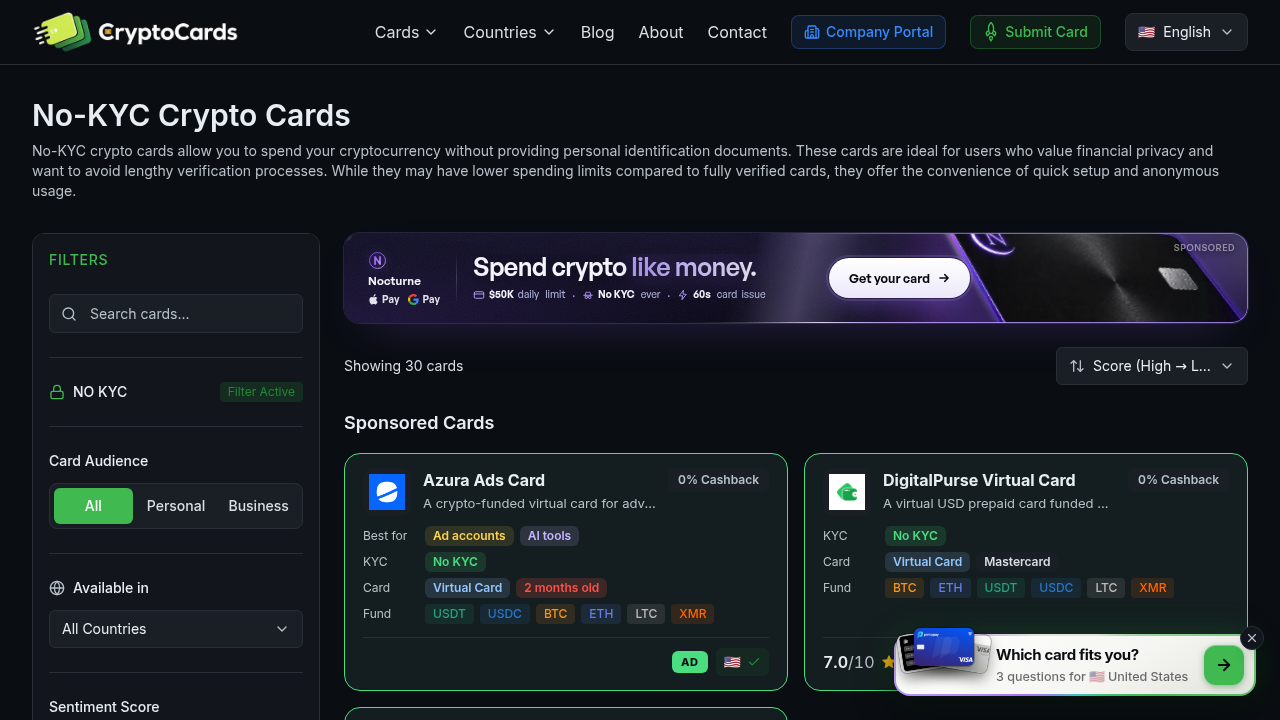
Only three picks are ranked. Many listings in this category are sponsored placements with headline claims (daily limits in the tens of thousands, card issuance in seconds) that we could not tie to verifiable terms. Those were excluded rather than ranked on marketing copy.
Takeaway: argue with the criteria before you argue with the order.
Quick summary
- WaldenPay: email-only virtual prepaid Mastercard, crypto funded. Best for low-friction setup
- DigitalPurse Virtual Card: USD prepaid card with optional KYC and mobile wallets. Best for in-store spending
- 0fiat Crypto Card: non-custodial browser extension for Amazon and Walmart. Best for self-custody purists
At a glance: KYC status check
This table separates what each product is from what it is marketed as.
| Rank | Card | Format | KYC status as stated | Funding or payment method | Where it spends | US fit | Pricing |
|---|---|---|---|---|---|---|---|
| 1 | WaldenPay | Virtual prepaid Mastercard | Email only, no document verification | Crypto, including USDT, USDC, BTC, ETH | Global online spending, ads, subscriptions | Good for online use | See vendor |
| 2 | DigitalPurse Virtual Card | Virtual USD prepaid Mastercard in app | Optional KYC | BTC, ETH, USDT, USDC, LTC, XMR | Online and in-store via Apple Pay and Google Pay | Broadest everyday use | See vendor |
| 3 | 0fiat Crypto Card | Non-custodial browser extension | No KYC | Crypto from your own wallet | Amazon and Walmart | Narrow but direct | See vendor |
Takeaway: format determines scope. An extension cannot do what a wallet-provisioned card does, and optional KYC is not the same as none.
WaldenPay
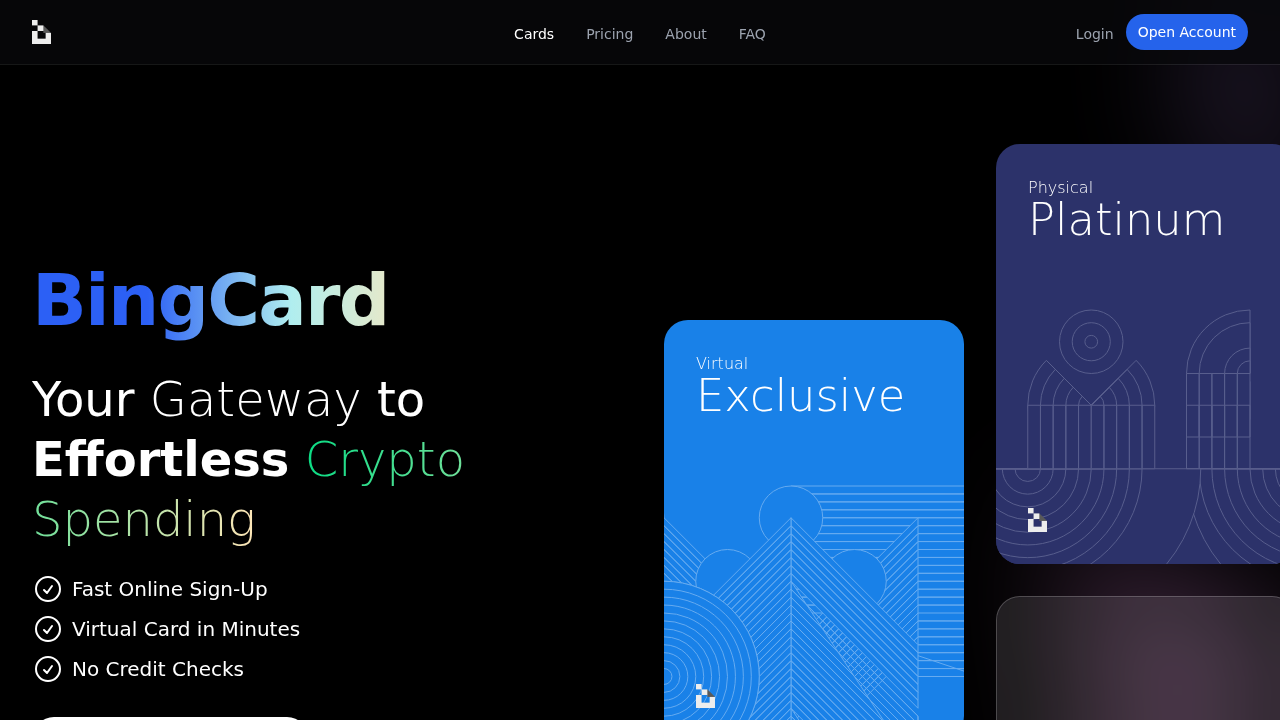
WaldenPay is the closest thing on this list to a pure onboarding-friction product.
What it is. CryptoCards.so lists its Premium Virtual Card as an instantly activated virtual Mastercard designed for global spending, digital advertising and recurring subscriptions.
Key features
- Email-only signup, per the vendor
- Mastercard network
- Wide funding menu, from USDT and USDC to BTC, ETH, SOL and TON
- Positioned for subscriptions and ad accounts
Pricing. See vendor. Issuance and top-up fees should be confirmed directly before funding.
Who it's for. Operators who need a separate card for SaaS tools or ad spend and want to load it from a stablecoin balance without a document upload.
Caveat. The 10-minute and email-only claims come from the vendor. Spending limits, conversion spreads and any later verification triggers must be verified at the vendor before you commit meaningful balance.
Takeaway: lowest stated friction, highest dependency on vendor terms you should read first.
DigitalPurse Virtual Card
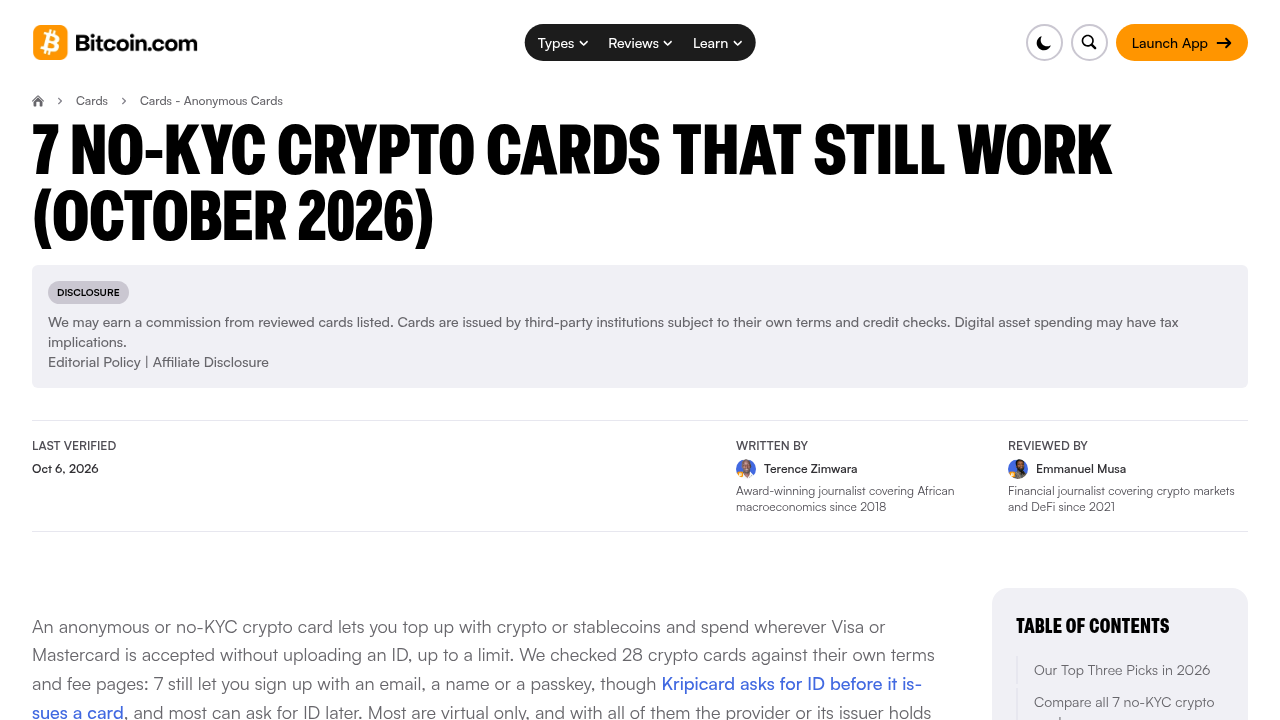
DigitalPurse trades a little privacy for a lot of reach.
What it is. CryptoCards.so describes it as a virtual USD prepaid card funded with crypto and issued in the DigitalPurse app, with optional KYC, usable online and in-store via Apple Pay and Google Pay. It runs on Mastercard.
Key features
- USD-denominated prepaid balance
- Funding in BTC, ETH, USDT, USDC, LTC and XMR
- Apple Pay and Google Pay provisioning for contactless checkout
- App-based card management
Pricing. See vendor.
Who it's for. Users who want a crypto-funded card that behaves like a normal card at a physical terminal, not just in a browser.
Caveat. Optional KYC means the product is not strictly anonymous. The existence of a verification path implies the issuer can request it, and features or limits may differ between verified and unverified users.
Takeaway: the best everyday-spend profile here, with the clearest admission that verification exists.
0fiat Crypto Card
0fiat is not really a card. That is the point.
What it is. CryptoCards.so lists 0fiat as a non-custodial browser extension that pays at Amazon and Walmart without KYC. Funds stay in your own wallet until checkout, which removes the custodial balance that most card programs require.
Key features
- Non-custodial: no prefunded balance held by a third party
- No KYC as stated
- Works at two large US retailers
Pricing. See vendor.
Who it's for. Self-custody users whose spending need is concentrated at Amazon or Walmart and who prefer not to park funds with a card program.
Caveat. It is an extension, not a general-purpose card. There is no tap-to-pay, no arbitrary merchant acceptance, and the scope is limited to supported retailers.
Takeaway: the strongest privacy and custody posture on the list, purchased with the narrowest acceptance.
How to choose

Start with the criterion you will not compromise on. If self-custody is non-negotiable, 0fiat is the only pick that avoids a custodial balance, provided your spending fits its retailer list. If you need to pay at a physical terminal, DigitalPurse's wallet support matters more than its optional KYC. If the goal is a disposable card for subscriptions or ad spend with minimal onboarding, WaldenPay fits.
For any card not on this list, run this checklist:
- Fees. Issuance, top-up, conversion spread, FX and inactivity fees.
- Limits. Per-transaction, daily and lifetime load caps, and what triggers verification.
- Issuer. Which bank or program manager sits behind the network logo.
- Funding assets. Whether stablecoins load directly or are swapped first.
- Refund handling. Where a merchant refund lands, and whether it can be withdrawn.
If identity verification is acceptable, a fully KYC-based product such as the Gnosis Pay card changes the trade-off entirely.
Takeaway: a card's privacy claim is only as durable as its issuer's compliance appetite.
FAQ: Frequently Asked Questions
Are there truly no-KYC crypto cards in the US?
Very few. Visa and Mastercard issuing partners enforce identity verification under banking rules, so most products marketed as no-KYC skip checks only at onboarding or offer verification as optional rather than eliminating it.
What is the difference between no-KYC and optional KYC?
No-KYC means the vendor states no identity check is required to use the product. Optional KYC means you can start without verification, but a verification path exists and the issuer may request it later.
Can I fund a virtual card with stablecoins?
Yes. All three picks accept crypto, and WaldenPay and DigitalPurse list USDT and USDC.
Do no-KYC cards work with Apple Pay and Google Pay?
Some do. DigitalPurse is listed as supporting Apple Pay and Google Pay for in-store use. Browser-extension products such as 0fiat do not provide contactless payments, so check wallet support before funding any card.
What fees should I check before funding a card?
Check issuance fees, top-up fees, the spread on crypto-to-USD conversion, foreign transaction fees and any inactivity charges.
Is a no-KYC card the same as an anonymous card?
No. Skipping document checks does not remove on-chain funding trails, merchant records or the issuer's monitoring. A no-KYC card reduces onboarding disclosure; it does not make transactions untraceable or exempt them from compliance review.
Conclusion
The no-KYC card market is shaped less by crypto vendors than by the banks under them. As long as network partners enforce identity verification, truly anonymous cards will remain rare, and the category will keep splitting into email-only prepaid products, optional-KYC cards and non-card rails like extensions.
The open question is directional. If issuer rules tighten further, does privacy-preserving spend migrate entirely off card networks and onto non-custodial checkout rails, or does it disappear from regulated US commerce altogether?