
For US institutions, the right off-ramp depends on whether funds move through an exchange account, a dedicated payment processor, or B2B API infrastructure that routes fiat over rails such as ACH and RTP. That is the whole decision; the provider follows from it. See also the guide to crypto on-off ramps for business.
How We Ranked These Off-Ramps

Every provider was judged on the same five criteria, in this order of weight:
- US relevance. Whether the provider plausibly serves US institutional flows, or whether coverage must be confirmed first.
- Settlement rails. Which fiat rails the provider documents for payouts (ACH, RTP, wires, card push).
- Institutional fit. API access, B2B orientation and suitability for embedding in a platform or treasury workflow.
- Custody model. Whether assets sit with the provider, in an exchange account, or in a self-custodial wallet.
- Transparency of terms. How clearly the provider describes how funds move.
Pricing is not ranked. Fees, spreads and limits change, and without current vendor terms any number would be stale. Every pricing cell below reads See vendor.
Takeaway: rank providers on rails and custody first; price is a negotiation, architecture is not.
Quick Summary of the Picks
- zerohash: B2B API routing fiat over ACH, RTP, SEPA. Best for Platforms
- Coinbase: exchange account with native fiat withdrawal. Best for Existing Exchange Custody
- Kraken: centralized exchange with native ramps. Best for Active Trading Desks
- MoonPay: dedicated payment processor for ramping flows. Best for Product Integrations
- Ramp Network: wallet-linked buy, sell and swap since 2017. Best for Self-Custody Flows
- Banxa: processor listed on Solana's ramp network. Best for Solana Exposure
At a Glance: Off-Ramp Comparison
| Rank | Provider | Type | Fiat rails or access model | Best for | Pricing | Caveat |
|---|---|---|---|---|---|---|
| 1 | zerohash | B2B API infrastructure | ACH, RTP, SEPA or PSP | Platforms embedding payouts | See vendor | Requires developer integration |
| 2 | Coinbase | Centralized exchange | Native ramp from exchange account | Institutions already custodying there | See vendor | Tied to account terms and limits |
| 3 | Kraken | Centralized exchange | Native ramp from exchange account | Treasuries trading on Kraken | See vendor | Fiat access depends on account terms |
| 4 | MoonPay | Dedicated payment processor | Processor-run ramp | Product integrations | See vendor | Fees and limits vary |
| 5 | Ramp Network | Wallet-linked ramp | Buy, sell, swap via self-custodial wallet | Self-custody workflows | See vendor | Confirm US and institutional terms |
| 6 | Banxa | Payment processor | Listed on Solana ramp network | Solana-native flows | See vendor | Confirm US coverage |
Takeaway: the Type column predicts operational burden better than any feature list.
1. zerohash: API Infrastructure for Fiat Payouts

zerohash is infrastructure, not an interface. Its product page describes a four-step flow: a user initiates a fiat deposit or withdrawal, funds route via ACH, RTP, SEPA or a PSP, assets convert to or from crypto, and balances auto sync.
That structure matters for institutions building products. A broker, neobank or payroll platform does not want its clients leaving for an exchange to cash out. An embedded off-ramp keeps the flow inside the platform and turns settlement into an engineering problem rather than a counterparty problem.
RTP is the notable rail. Real-time payouts change the treasury math for platforms that otherwise pre-fund ACH batches.
- Type: B2B API infrastructure
- Rails: ACH, RTP, SEPA, PSP
- Pricing: See vendor
Caveat: this is a developer integration. A treasury team that only needs to liquidate a position quarterly has no reason to build against an API.
2. Coinbase: Exchange-Based Fiat Withdrawal

Coinbase is listed among centralized exchanges offering native ramps, alongside Kraken and Binance, according to Plasma's ramp explainer. For a US institution, the advantage is path of least resistance: if assets already sit in a Coinbase account, selling and withdrawing to a bank is one venue, one counterparty and one compliance file.
This is the hot-start case. The relationship, KYC and custody already exist, so the marginal cost of off-ramping is close to zero operationally.
- Type: Centralized exchange
- Access model: Sell and withdraw from the exchange account
- Pricing: See vendor
Caveat: the off-ramp is tied to the exchange account. Limits, withdrawal terms and timing follow that account, and moving assets elsewhere first adds steps.
3. Kraken: Exchange-Based Ramp

Kraken sits in the same category as Coinbase: a centralized exchange with native ramps. The logic is identical. Treasuries and trading desks that already execute on Kraken can exit to fiat without introducing a second counterparty.
For desks that rebalance actively, keeping execution and fiat exit on one venue reduces transfer risk and reconciliation work. The trade-off is concentration: liquidity, custody and the fiat exit all depend on one platform.
- Type: Centralized exchange
- Access model: Native ramp from the trading account
- Pricing: See vendor
Caveat: fiat access depends on account type and terms. Confirm current withdrawal methods with Kraken before relying on it for size.
4. MoonPay: Dedicated Payment Processor

Plasma names MoonPay, with Banxa, as a dedicated payment processor for ramping. Processors sit between exchange and infrastructure: more packaged than an API, less tied to a trading account than an exchange.
The fit is product integration. A wallet or application that wants a ready-made ramp without building rail connections itself can route users through a processor. For institutions, that makes MoonPay more relevant to platform builders than to treasurers liquidating balance-sheet holdings.
- Type: Dedicated payment processor
- Pricing: See vendor
Caveat: fees, spreads and limits vary by method and jurisdiction. Get current terms directly before committing volume.
5. Ramp Network: Wallet-Linked On and Off-Ramp
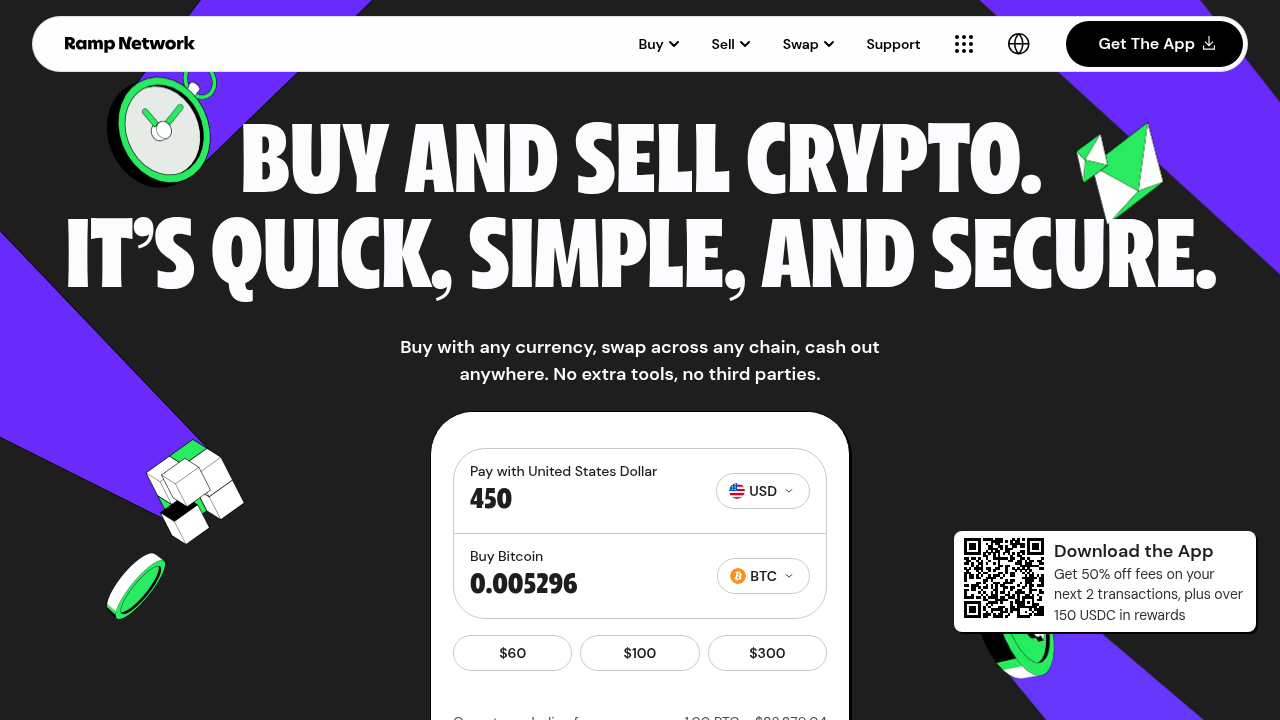
Ramp Network describes itself as a self-custodial Web3 wallet offering on-ramp, off-ramp and swap services since 2017. It supports buy, sell and swap functions in one place.
The custody model is the differentiator. Assets stay in a self-custodial wallet until conversion, which suits operators that keep keys in-house rather than parking balances on an exchange. That is passive versus active supply in custody terms: the institution holds the asset and only touches the ramp at exit.
- Type: Wallet-linked ramp
- Pricing: See vendor
Caveat: US availability and institutional terms must be confirmed with the vendor. Wallet-first products are often designed around retail flows.
6. Banxa: Processor Listed on Solana Ramp Network
Banxa appears on the Solana Foundation's on and off ramp network directory, alongside Transak and Utorg. Banxa's own glossary defines an off-ramp as a service that turns crypto back into money you can spend or withdraw, the reverse of an on-ramp.
For institutions with Solana-native exposure, a ramp listed in that ecosystem directory shortens the path from on-chain balance to fiat, particularly for stablecoins held on Solana.
- Type: Payment processor
- Pricing: See vendor
Caveat: a directory listing is not a coverage guarantee. Confirm US availability and supported rails for your entity before routing flows.
How to Choose an Off-Ramp

Start with rails: if same-day settlement matters, require RTP or wires in writing. Then fix the custody model, since an exchange ramp assumes assets already sit on that exchange while wallet-linked and API models do not. If the off-ramp is part of a product rather than a treasury event, API infrastructure is the only option that scales cleanly. Finally, treat compliance as a gating step: regulated providers run KYC before releasing fiat, and every exit should leave a transaction record your tax and audit teams can reconcile. The same framework applies in reverse to the best crypto on-ramp platforms.
Takeaway: decide the architecture, then shortlist the vendors.
FAQ: Frequently Asked Questions

What does on-ramp mean in crypto?
An on-ramp converts fiat currency such as USD into digital assets. Exchanges like Coinbase and Kraken offer native on-ramps, and processors like MoonPay and Banxa provide them for wallets and applications that integrate ramp services.
What is a crypto off-ramp?
An off-ramp converts crypto back into fiat and pays it out through a bank transfer, card or cash equivalent. It is the reverse of an on-ramp. For a fuller primer, see on-ramps and off-ramps explained.
Can the IRS see your crypto wallet?
Public blockchains are transparent, and regulated exchanges collect identity data and can report activity. Institutions should assume exits are visible and keep complete transaction records for every conversion. Tax treatment questions belong with qualified counsel.
What is an exit strategy in crypto?
An exit strategy defines when and how a position converts back to fiat or stablecoins. For institutions it should specify the venue, the rail, the custody path and the records each exit produces for accounting.
Which rails move fiat out for US users?
ACH is the standard bank rail, RTP enables real-time payouts, and wires remain common for size. Card push payments also exist. Which rails apply depends on the provider and the account type.
Do off-ramps require KYC?
Yes, regulated off-ramps run identity verification before releasing fiat, often with closer checks on larger amounts. Institutions should expect entity-level onboarding, beneficial ownership documentation and ongoing monitoring before payouts are enabled at scale.
Conclusion: Routing Is the Decision

The off-ramp market is splitting into three architectures: exchange accounts, processors and API infrastructure. Exchanges win on hot-start convenience for assets already custodied there. Infrastructure like zerohash wins when the exit is embedded in a product and settles over RTP. For readers following adjacent rails, our review of compliant stablecoin settlement solutions covers the settlement layer underneath.
The open question for 2026: if stablecoins become the default settlement asset, does institutional flow still need an exchange at the exit, or does the off-ramp collapse into a payout API call?