The best crypto credit cards in the US pay rewards in crypto while you spend dollars. The right one depends on rewards caps, tier fees and whether you must hold assets or a membership, so compare effective rates after caps rather than headline percentages. Most roundups rank by sponsor order.
How we ranked these crypto credit cards

A headline rate is a marketing number. The effective rate, after caps, fees and gating, is the economic number.
Every comparison uses the same criteria for every product in the category, including partners. For this category, that means:
- Effective rewards rate after caps. A 4% rate capped at a few hundred dollars of monthly spend behaves like a blended rate far lower for heavy spenders.
- Fees. Annual fees, tier subscription fees and foreign transaction fees all reduce net yield.
- Qualification requirements. Some cards require a paid membership, a token stake or minimum assets on the exchange to reach the top rate.
- Rewards asset flexibility. Whether rewards can be taken in BTC, an exchange token or a broad menu of assets.
- Issuer and network. The bank behind the credit line and the network (Visa, Mastercard, Amex) determine acceptance and card benefits.
The ranking covers genuine credit cards only. Prepaid and debit products sit outside the scope.
Quick summary
Ranked by the criteria above:
- Gemini Credit Card: no annual fee, simple caps, broad asset menu. Best Overall
- Crypto.com Visa Signature Credit Card: tiered rates in BTC or CRO. Best for CRO holders
- Coinbase One Card: Amex-network card for Coinbase members. Best for Coinbase users
- The Venmo Visa Credit Card: rewards that can be routed into crypto. Best for crypto-curious spenders
At a glance: rewards caps, fees and requirements
The table below isolates the variables that change the effective rate. Where an issuer page figure is not available here, the cell reads See vendor.
| Rank | Card | Issuer or network | Headline rate | Cap or tier condition | Annual fee | Requirement |
|---|---|---|---|---|---|---|
| 1 | Gemini Credit Card | WebBank, Mastercard World Elite | Up to 4% | 4% on up to $300/month, then 1% | $0 | None beyond approval |
| 2 | Crypto.com Visa Signature | - | - | - | - | - |
| 3 | Coinbase One Card | - | - | - | - | - |
| 4 | Venmo Visa | Synchrony Bank, Visa | See vendor | See vendor | See vendor | Venmo account |
Takeaway: several of these cards gate their top rate behind something other than spend, such as a subscription, a token position or exchange assets.
Gemini Credit Card
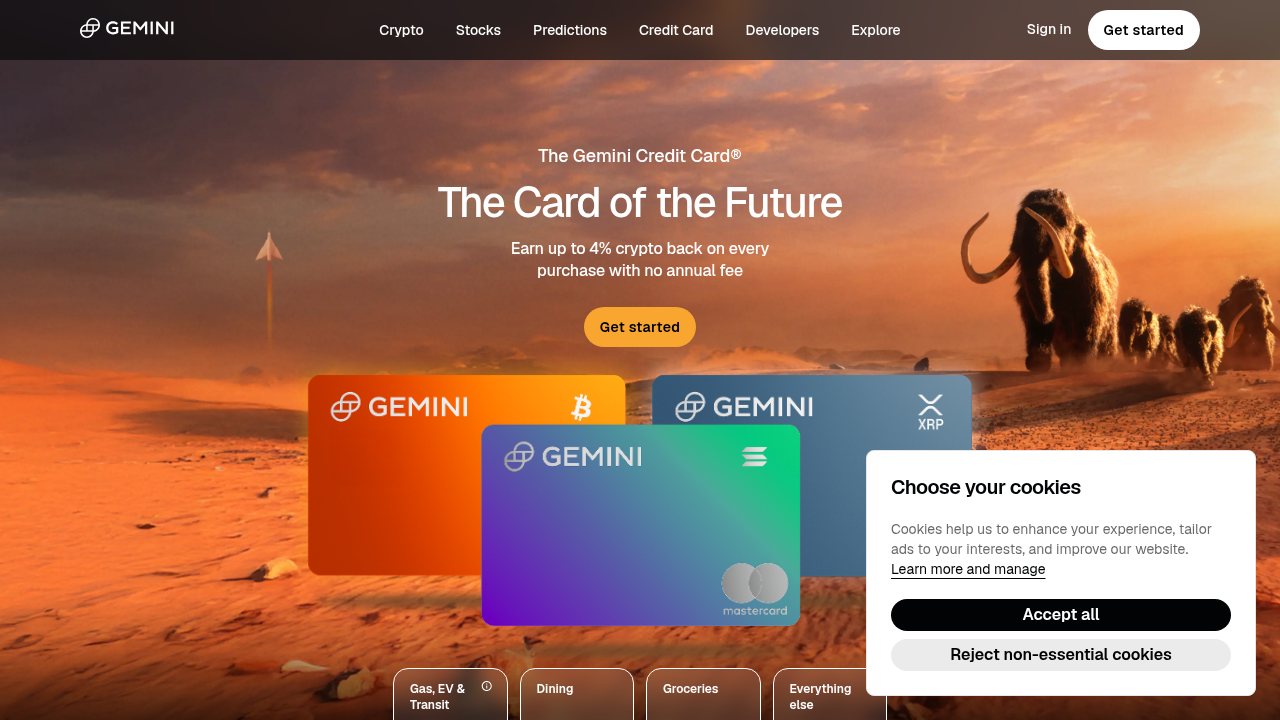
The Gemini card is the cleanest structure in the set. Gemini's page lists it as issued by WebBank on the Mastercard World Elite network, with no annual fee and no foreign transaction fees.
Rewards by category, per Gemini:
- 4% on gas, EV charging and transit, on up to $300 of spend per month, then 1%
- 3% on dining
- 2% on groceries
- 1% on everything else
Rewards can be taken in bitcoin or 50+ other assets available on Gemini, and the asset can be switched as often as the holder wants. The spend cycle resets on the 1st of each month.
Gemini also publishes a vendor claim: bitcoin rewards earned between October 2021 and July 2024 and held for at least a year appreciated an average of 277%. That figure is a function of BTC price over a specific window, not of the card. It says nothing about forward returns.
Caveat: the $300 monthly cap on the top category. Above that, the marginal rate on those purchases falls to 1%.
Crypto.com Visa Signature Credit Card

Crypto.com's structure is a tier ladder bolted onto a credit card. The card itself carries $0 annual credit card fees, but the reward rate depends on the Level Up tier.
| Tier | Access fee | Rewards rate | BTC cap |
|---|---|---|---|
| Midnight | Free | 1.5% | $250/month, then 1.0% |
| Ruby | $4.99/month, $49.90/year or $500 12-month CRO staking | 3.5% | $500/month, then 2.0% |
CRO rewards are uncapped on both tiers. Crypto.com advertises up to 4.5% or 6% back on higher tiers depending on spend. Welcome bonuses are paid in CRO: $100 on Midnight after $1,500 spend in 90 days, $200 on Ruby after $2,000.
The design is a classic exchange-token flywheel. Uncapped rewards are paid in the issuer's own token; BTC rewards are capped. Users who want a neutral reserve asset receive the lower effective rate.
Caveat: tier fees and BTC caps. A yearly tier fee has to be offset by the extra rewards earned, so heavier spenders benefit most.
Coinbase One Card
The Coinbase One Card runs on American Express. CardRates reported it as Coinbase's first true credit card, after earlier debit products, and American Express's first direct crypto credit card following an abandoned 2022 effort with Abra.
According to CNBC Select, the card pays up to 4% back in crypto, with the top rate tied to the amount of assets held on Coinbase, and carries no annual fee. It requires a Coinbase One subscription.
This is cold-start inverted: the card is a retention tool for an existing customer base, not an acquisition product. The reward rate rewards passive supply sitting on the exchange.
Caveat: membership and asset requirements. The card's annual fee is $0, but the membership is a recurring cost, and reaching the top rate means parking assets on one venue.
The Venmo Visa Credit Card
CNBC Select lists the Venmo Visa Credit Card, issued by Synchrony Bank, among its crypto picks. Its crypto angle is optional: cash-back rewards can be used to buy crypto inside Venmo.
That makes it a conventional rewards card with a crypto on-ramp rather than a native crypto rewards product. Check current rates and terms with the issuer.
Caveat: crypto is not the default reward, so the holder takes on a separate purchase step and exposure decision.
How crypto credit card structures differ
"Crypto credit card" covers several unrelated products.
- Crypto rewards credit cards. Spend dollars, repay dollars, earn tokens. All four cards above fall here.
- Collateralized cards. Pledged crypto secures a credit line, and loan-to-value drives the rate and liquidation risk. Our Nexo card review covers one such product.
- Sell-at-swipe and stablecoin-backed cards. Crypto or stablecoins convert to dollars at the point of sale. These are usually debit or prepaid, not credit. See our Ether.fi card review for a DeFi-native example.
The risk profiles differ sharply. A rewards card carries no price risk on the principal; a collateralized card does.
Disclosure: some links on this site are referral links. They do not affect verdicts.
How to choose

Start with monthly spend. If your spend in Gemini's top category sits under $300, its 4% applies in full; above that, blended rates converge toward 1%. If you already hold CRO or will stake it, Crypto.com's Ruby tier pays 3.5% with uncapped CRO, but the tier fee needs to be justified by volume. If your assets already sit on Coinbase and you pay for Coinbase One, the Coinbase card monetizes that position. If you want no subscriptions and no token exposure, Gemini's flat no-fee structure is the default. A self-custody wallet is one option for holding rewards taken in crypto.
FAQ: Frequently Asked Questions
What is a crypto credit card?
It is a credit card that extends a revolving credit line in dollars and pays rewards in crypto. Some products marketed under the name are actually debit, prepaid or collateral-backed cards with different risk.
Do crypto credit cards charge annual fees?
The Gemini, Crypto.com and Coinbase One cards list no annual card fee. Crypto.com's higher tiers carry subscription fees or CRO staking, and Coinbase requires a paid Coinbase One membership, which function as indirect fees.
Are crypto rewards taxable?
Tax treatment of crypto rewards and any later sale or conversion depends on your circumstances and current IRS guidance. Track the value received and any disposal, and consult a qualified tax professional before filing.
Is a crypto credit card the same as a crypto debit card?
No. A credit card lets you borrow and repay later, with interest if you carry a balance. A debit card spends money or crypto you already hold, often converting it at the point of sale.
Do I need to hold crypto to qualify?
Not for every card. Gemini's top rate needs no holdings. Crypto.com's Ruby tier can be reached by subscription or CRO staking, and Coinbase ties its highest rate to assets held on Coinbase.
Which rewards cap matters most?
The cap that binds on your actual spend. Gemini caps its 4% category at $300 monthly; Crypto.com caps BTC rewards at $250 or $500 monthly by tier, while CRO rewards remain uncapped.
Conclusion
Across these four cards, the headline rate is rarely the rate a heavy spender earns. Gemini's 4% compresses above $300 a month; Crypto.com's best uncapped yield is paid in its own token; Coinbase prices its top tier in assets parked on the exchange. We will keep applying the same criteria as terms change. The open question is whether issuers keep subsidizing crypto rewards once the acquisition phase ends, or whether caps and membership gating become the permanent price of a high headline number.