A crypto bank account with a debit card is a deposit account that holds USD, sits at or behind a licensed bank, and issues a debit card. FV Bank offers USD and crypto in one account with a Visa debit card, while Coinbase Card and Nexo are crypto-funded cards rather than bank accounts. That distinction decides what you can actually do with the money: receive payroll, send wires, pay bills from an account number.
How we ranked these

The category is smaller than it looks. Strip out prepaid cards and exchange-issued cards, and very few products are deposit accounts that also handle crypto.
NerdWallet defines a US crypto bank as a licensed financial institution that holds both dollars and crypto.
- Account type. Is it a deposit account with an account number, or a prepaid or credit card funded from a crypto balance?
- Card network and card type. Debit, prepaid debit or credit, and on which network.
- Crypto handling. Can the account hold crypto directly, or is crypto only a reward or a funding source?
- US availability. Which residents can open it, and with what restrictions.
- Fees. What the issuer discloses on spending, maintenance and transfers.
On these criteria, the evidence supports one verified pick. Everything else below is context, not a ranking.
Takeaway: if a product has no account number and no ACH or wire rails, it is a card, not a bank account.
Quick summary
- FV Bank.
The other products discussed here, Quontic, Coinbase Card and Nexo Card, are either a bank with a crypto rewards program or crypto-funded cards. They are compared below by product type, not ranked.
At a glance
| Rank | Tool | Pricing | Best for | Standout |
|---|---|---|---|---|
| 1 | FV Bank | See vendor | Holding USD and crypto in one account | USD depository account with ACH, wires and Visa debit card |
The second lens is product type, which is where most confusion starts:
| Option | Product type | Card | Crypto role | US fit |
|---|---|---|---|---|
| FV Bank | USD depository account, crypto-friendly bank | Visa debit and credit | Held in the same account as USD, convertible to fiat | - |
Takeaway: only the first two rows are bank accounts, and only FV Bank holds crypto inside the account.
FV Bank: USD and crypto in one account
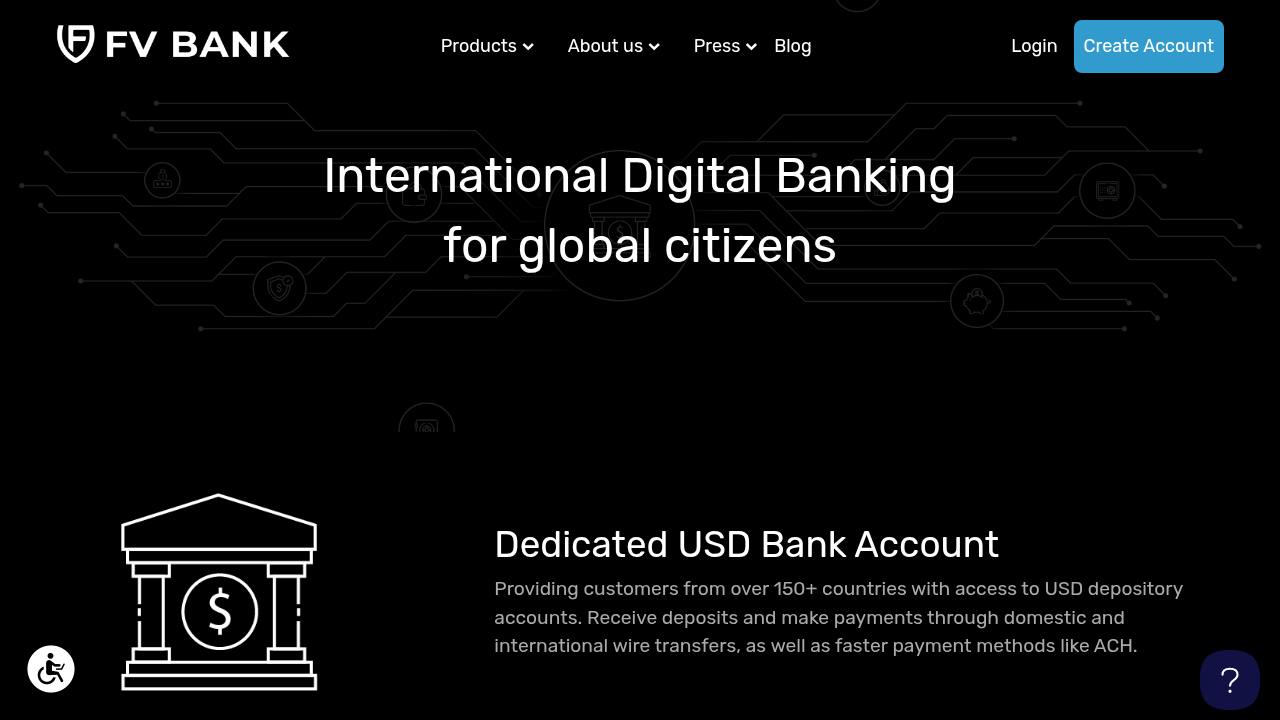
FV Bank is a crypto-friendly bank that pairs a dedicated USD depository account with crypto holdings and Visa cards.
What the account includes
According to FV Bank, the personal account includes:
- A dedicated USD depository account for customers from 150+ countries.
- ACH and wire transfers, both domestic and international, for receiving deposits and making payments.
- USD and crypto in the same account, with conversion of digital assets to fiat.
- Visa debit and credit cards for spending fiat balances globally.
- Cross-border transfers in 10 local currencies without holding foreign currency balances.
- A custody money market account that pays on account balances or stablecoin holdings.
Who it suits
The structure fits users whose flows already cross the fiat and on-chain boundary: someone receiving stablecoins and paying USD invoices, or an internationally based individual who needs a US dollar account with real payment rails. The point is that the off-ramp lives inside the bank, not at an exchange that then wires to a bank.
One caveat
FV Bank is built around international digital banking, and it states that some products and services may not yet be available everywhere. For comparison, see the Revolut review. Eligibility for the USD account and Visa debit card depends on country of residence, and pricing is not something to assume: see the vendor for current fees before moving balances.
Takeaway: FV Bank is the clearest match for the keyword, but confirm residence eligibility first.
Why most crypto cards are not bank accounts

The reason is structural. A card program needs an issuing partner and a funding source; a bank account needs a charter, deposit handling and payment rails.
Prepaid and crypto-funded cards
Coinbase Card is a Visa prepaid debit card. Coinbase converts crypto to US dollars at the point of purchase or ATM withdrawal. It is available to Coinbase customers in the US except Hawaii, and Coinbase states there are no fees for spending USD or crypto, including USDC. Users fund it by linking a bank account, which tells you where the bank account actually sits: elsewhere.
Coinbase also notes that spending crypto other than USD or USDC is a sale, and selling crypto with the card is a taxable transaction.
Nexo Card runs two modes. In credit mode it extends a crypto-backed credit line so the holder spends without selling; in debit mode it spends stablecoins, crypto and Nexo's FiatX assets directly. That is a lending product with a card attached, which is a different risk profile from a deposit.
The distinction matters operationally. A reader asking whether a debit card has a linked bank account to pay bills is asking the right question: prepaid cards typically cannot receive an ACH debit from a biller the way a checking account can.
Crypto-friendly banks and prohibited-industry rules
Quontic sits on the other side. At launch, eligibility was limited to residents of selected states. It is a real checking account, but crypto is a reward stream, not an asset you deposit or hold.
The constraint on the broader market is the banks themselves. Some banks list crypto as a prohibited industry for account opening, and the restriction extends to debit card, ACH and wire transactions involving crypto. A bank account that blocks transfers to an exchange is not a crypto bank account, regardless of its card.
The charter question is moving, too: see our analysis of the PayPal bank charter application for how a payments firm approaches the same boundary.
Takeaway: prepaid cards solve spending, crypto-rewards checking solves accumulation, and only a crypto-friendly bank solves both custody and rails.
How to choose

Start with licensed status: a bank account sits at a licensed institution, and FDIC insurance applies to deposits at insured banks, not to crypto. Then check the card type, because prepaid, debit and crypto-backed credit carry different recourse and tax consequences. Confirm ACH and wire access if you need payroll or bill pay, read the fee schedule on the issuer's own disclosures, and verify residency eligibility before you apply. If a product fails the account-number test, judge it as a card and compare it against other cards.
The implication: the category will be decided by charters, not card programs.
FAQ: Frequently Asked Questions
What is a crypto bank account with a debit card?
It is a deposit account at or behind a licensed bank that holds US dollars, supports crypto in some form, and issues a debit card. FV Bank, which holds USD and crypto in one account, fits this definition.
Is a crypto debit card the same as a bank account?
No. Many crypto debit cards, such as Coinbase Card, are prepaid cards funded from an exchange balance or linked bank. They spend money but usually lack an account number, deposit status and full ACH and wire functionality.
Can I pay bills from a crypto card account?
Usually only by card payment. Billers that require a linked bank account need an account and routing number, which prepaid crypto cards typically do not provide. A deposit account with ACH access handles those payments directly.
Are crypto bank accounts FDIC-insured?
FDIC insurance covers deposits at insured banks, not crypto assets. Quontic's Bitcoin Rewards Checking was launched as an FDIC-insured account, but coverage of any product depends on the institution and what is held. Confirm with the provider.
Can banks restrict crypto transactions?
Yes. Some banks list crypto as a prohibited industry, refusing related account openings and blocking debit card, ACH and wire transactions involving crypto. Check a bank's policy before relying on it for exchange transfers.
Do crypto debit cards trigger taxes?
They can. Spending crypto generally means selling it, which is a taxable event in the US. Coinbase states that spending USD or USDC generally has no tax implications, while other crypto does. Consult a tax advisor.
Conclusion
The crypto card market is crowded; the crypto bank account market is not. Today, FV Bank is the option that holds USD and crypto in one deposit account with a Visa debit card, while Coinbase Card and Nexo operate as cards, and Quontic as a bank paying crypto rewards. The open question is which side closes the gap first: card issuers acquiring charters, or chartered banks deciding crypto is a customer segment rather than a prohibited industry.