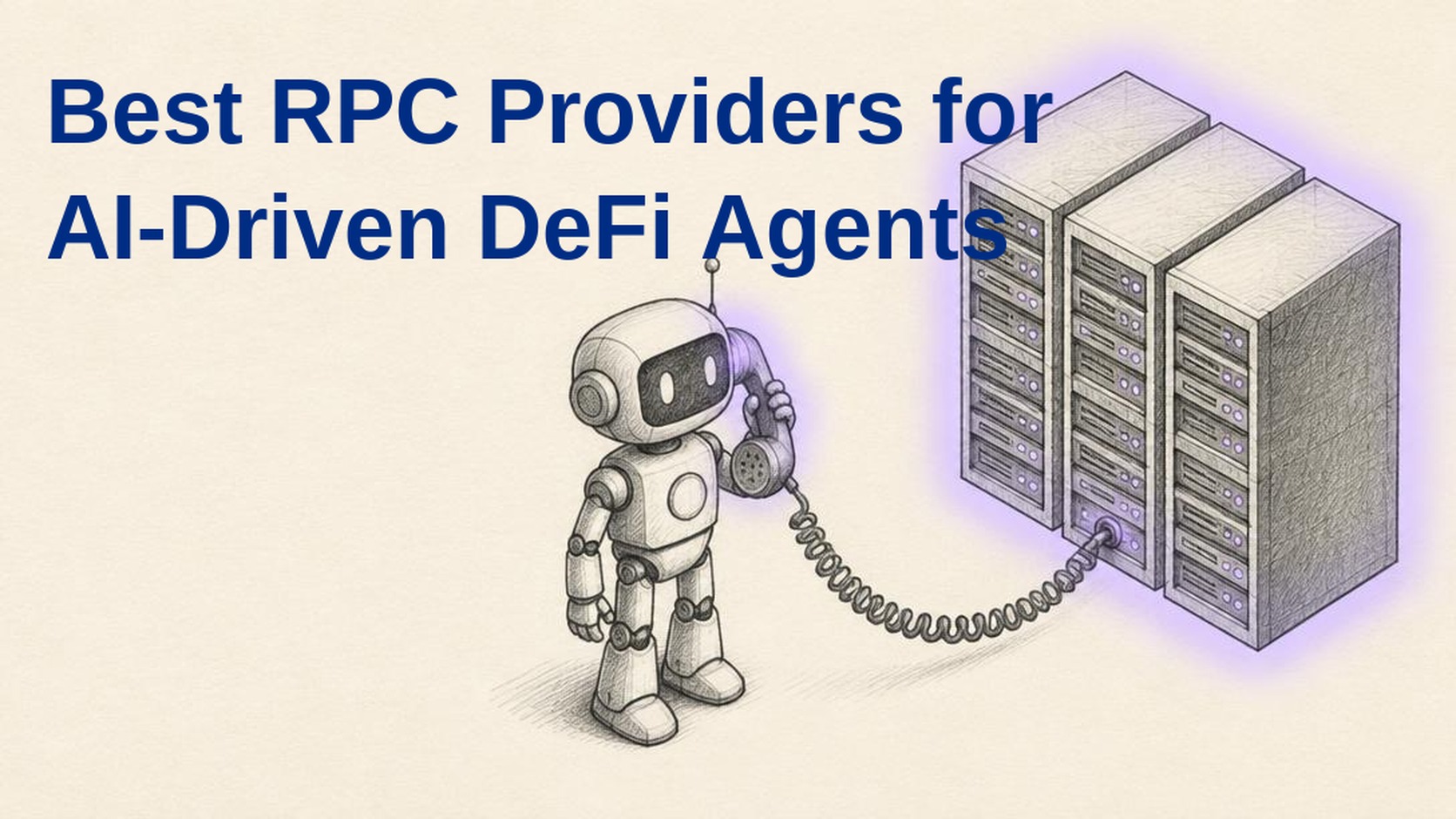
Best RPC Providers for AI-Driven DeFi Agents: Top Options Compared
Best RPC Providers for AI-Driven DeFi Agents: Top Options Compared
TL;DR
Best for teams wanting a purpose-built, official MCP server so an agent can query chains in plain language without custom integration work is a tie between GetBlock, dRPC, and Tatum, the three providers that ship one natively. Best for flat-rate, burst-tolerant pricing that doesn't punish an agent's call volume is Chainstack. Best for Solana-specific agents needing enhanced program-account filtering and MEV protection is Helius. An AI agent's RPC needs differ from a human-driven app's in one concrete way: a moderately complex DeFi agent monitoring pools, calculating routes, and checking approvals can generate 50 to 200 RPC calls in the time a human takes to reach for coffee, and a multi-agent system multiplies that further. Providers priced and rate-limited around human click patterns break under that load in ways that only show up once an agent is actually running.
What actually matters when choosing an RPC provider for AI agents
Native MCP server support. The Model Context Protocol lets an agent query a blockchain in plain language rather than through hand-rolled API calls. GetBlock, dRPC, and Tatum ship official MCP servers specifically for this; most providers don't, and an agent framework has to bridge the gap itself.
Pricing model against burst call volume. Per-request pricing that looked reasonable for a human-driven app can become expensive fast once an agent is making 50-plus calls per decision cycle. Flat-rate or request-unit pricing designed around agent-scale burst traffic, not human click patterns, is the more predictable model.
WebSocket and streaming stability. Event-driven agents watching for liquidity changes or price moves need reliable eth_subscribe-style streaming, not polling. Polling can't keep up with sub-second account and program updates that trading and liquidity-monitoring agents depend on.
Archive and trace access. An agent that needs historical state, full transaction history, or indexing backfills needs archive nodes, which most providers price and provision separately from standard RPC.
Chain specialization versus broad coverage. A Solana-specific agent gains real value from a specialist like Helius; a multi-chain agent needs broad, consistent coverage across many networks instead.
Quick comparison table
| Provider | MCP server | Pricing model | Streaming | Best for |
|---|---|---|---|---|
| GetBlock | Official, native | [more information required: confirm current tier structure directly] | Standard WebSocket support | Teams wanting official MCP support with the broadest general chain coverage |
| dRPC | Official, native | Routes across 50+ independent node operators with an AI-driven load balancer | Standard WebSocket support | Teams wanting decentralized routing plus native MCP support |
| Tatum | Official, native | [more information required: confirm current tier structure directly] | Standard WebSocket support | Teams wanting MCP support bundled with Tatum's broader Web3 development toolkit |
| Chainstack | Not confirmed as native MCP | Flat-rate request-unit pricing, high RPS headroom for burst windows | Stable WebSocket, built for event-driven execution | Teams prioritizing predictable billing under agent-scale burst call volume |
| Helius | Not confirmed as native MCP | [more information required: confirm current pricing tiers] | Enhanced getProgramAccounts filtering, high WebSocket stability ratings |
Solana-specific agents needing enhanced tooling and MEV protection |
Top options compared
GetBlock, dRPC, and Tatum are grouped together here because they share the one feature that most directly answers the "AI-driven" part of this comparison: each ships an official MCP server, letting an agent query a chain in plain language rather than requiring a developer to hand-build that translation layer. dRPC adds a specific architectural advantage on top of that, rather than running its own single cluster, it routes traffic across more than 50 independent node operators and uses an AI-driven load balancer to select the fastest, healthiest endpoint for each request, which matters for an agent that can't afford to wait on a single degraded node. Where they break: [more information required: confirm current pricing tiers and archive-access terms directly for all three before committing to production agent volume].
Chainstack is the strongest pick specifically for cost predictability at agent-scale call volume, with flat-rate request-unit pricing and high RPS headroom built for burst windows rather than steady human-paced traffic, backed by SOC 2 Type II and ISO 27001 certification. Its infrastructure explicitly targets three workload profiles, stablecoin settlement, DeFi indexing, and AI-driven automation, each of which stresses RPC infrastructure differently. Where it breaks: [more information required: confirm whether Chainstack ships a native MCP server or requires a custom integration layer, this comparison could not independently verify that specific detail].
Helius is the right choice for a Solana-specific agent, offering enhanced APIs for SPL tokens and NFTs, webhook infrastructure, and transaction parsing that turns raw on-chain data into structured output an agent can act on directly, plus MEV protection features that reduce sandwich exposure for agent-submitted transactions. Where it breaks: it is not collocated with validators the way some latency-focused specialist providers are, so a Solana agent whose priority is pure microsecond execution over data quality and tooling depth may find a narrower latency-focused provider a better fit for that specific need.
Key differences that actually matter
The real split in this category is between providers that have built specifically for the agent workload pattern, MCP-native support, burst-tolerant pricing, streaming built for event-driven execution, and providers that are simply general-purpose RPC infrastructure an agent framework happens to use. GetBlock, dRPC, and Tatum answer the plain-language query problem directly. Chainstack answers the cost-predictability problem directly. Neither fully solves what the other does, and a production agent stack often ends up using more than one provider for exactly that reason.
When a specialist beats a generalist, and vice versa
A team building a multi-chain agent that needs to reason across many networks in plain language gains more from GetBlock's, dRPC's, or Tatum's native MCP support than from Helius's Solana-specific depth. A team building a Solana-only trading or liquidity-management agent gains more from Helius's enhanced program-account filtering and MEV protection than from a generalist provider's broader but shallower coverage.
FAQs
What is the best RPC provider for AI-driven DeFi agents?
There is no single best provider, it depends on whether plain-language MCP querying or cost-predictable burst handling matters more for your specific agent. GetBlock, dRPC, and Tatum are the three providers that ship official MCP servers. Chainstack is the strongest pick for flat-rate pricing built around agent-scale call volume specifically.
Why do AI agents need different RPC infrastructure than regular apps?
A moderately complex DeFi agent, one that monitors liquidity pools, calculates optimal routes, checks token approvals, and executes a transaction, can generate 50 to 200 RPC calls in the time it takes a human to reach for coffee. A multi-agent system coordinating several specialized sub-agents multiplies that further. RPC infrastructure priced and rate-limited around human click patterns breaks under that load in ways that only surface once an agent is actually running in production.
What is MCP and why does it matter for RPC providers?
The Model Context Protocol lets an AI agent query a blockchain in plain language rather than through hand-rolled API integration. A small number of RPC providers, GetBlock, dRPC, and Tatum among them, now ship official MCP servers specifically for this, removing the need for a developer to build that translation layer themselves.
For the agent products and wallet primitives that actually consume this RPC layer, see Best DeFi AI Agents and Best Agentic Wallets for Crypto DeFi.
Last updated: September 24, 2026 Written by the stablecoin.nyc Editorial Desk