Last updated: October 2026
MEV protection keeps your transaction out of the public mempool so bots cannot frontrun or sandwich it. There are two ways to get it: send transactions through a protected RPC such as MEV Blocker or Flashbots Protect, or trade through an intent-based venue such as CoW Swap, UniswapX or 1inch Fusion, where solvers execute your order privately.
TL;DR
Best protected RPC for most wallets: MEV Blocker, which pays you 90% of any backrun value in the same block and works with any app.
Best for developers and power users: Flashbots Protect, the original private transaction service, with refunds through MEV-Share.
Best venue for protected swaps: CoW Swap, where batch auctions design sandwiches out.
Best inside the Uniswap app: UniswapX, which routes orders to competing fillers when that beats the pool price.
Best multi-chain option: 1inch Fusion, which combines MEV protection with gasless swaps across major EVM chains.
What MEV protection actually protects against
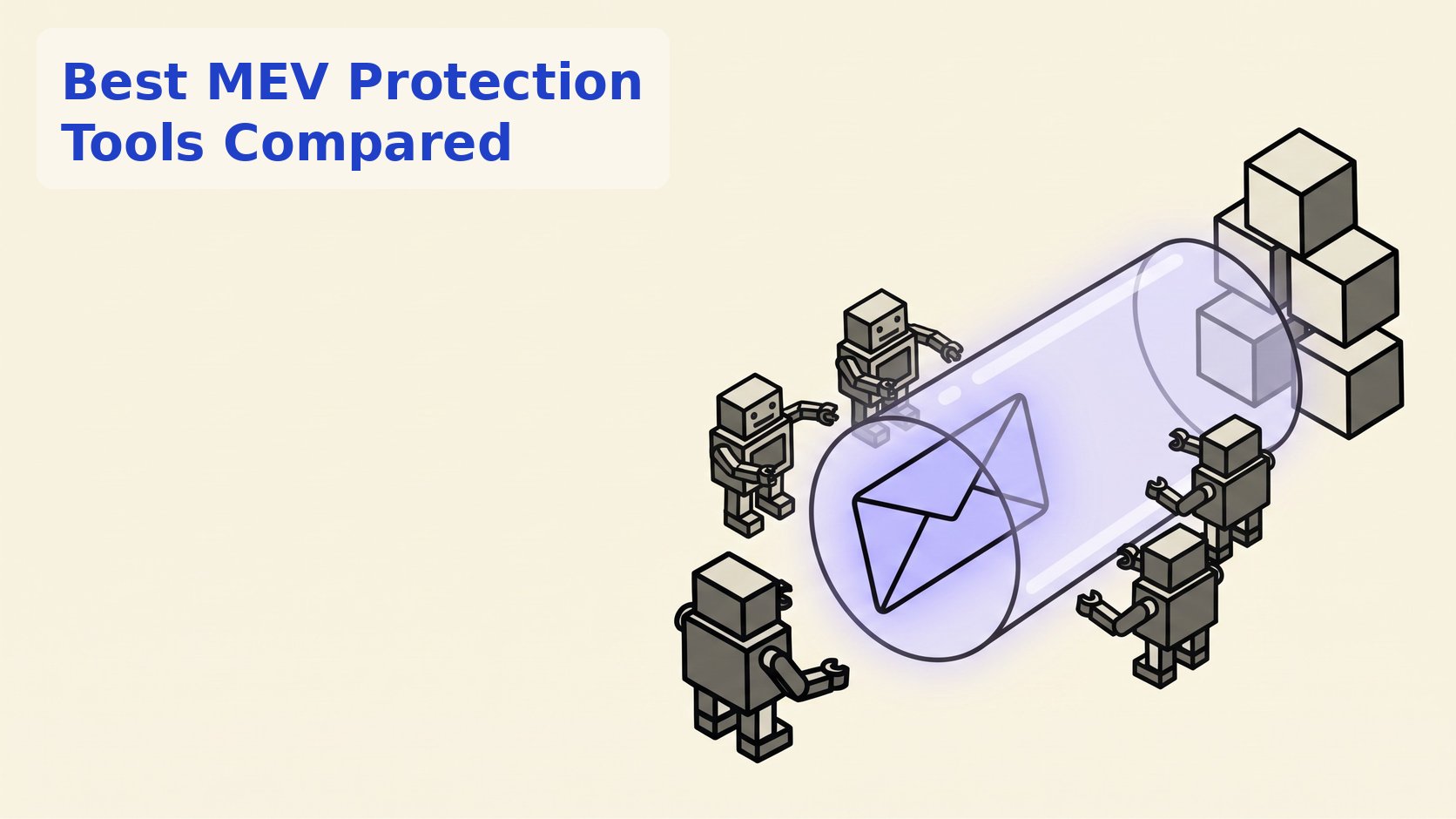
MEV, or maximal extractable value, is the profit available to whoever orders transactions in a block. For a swapper, the harmful version is the sandwich attack: a bot sees your pending swap in the public mempool, buys just before you, lets your trade push the price, then sells just after. You get a worse price; the bot keeps the difference. Our explainer on what MEV is covers the wider picture, including the benign forms such as arbitrage and liquidations.
MEV protection does not remove MEV from the system. It changes who sees your transaction before it lands, and in the better designs it returns some of the value your trade creates back to you.
How does MEV protection work?
On Ethereum, a normal transaction goes from your wallet to an RPC endpoint, which broadcasts it to the public mempool. Searchers run MEV bots that scan pending transactions there, then pay block builders to place their own transactions around yours. Validators propose the block the winning builder assembles. Every step is visible, which is what makes frontrunning possible.
MEV protection intervenes at one of two points:
- At submission. A private RPC sends your transaction straight to trusted block builders instead of the public mempool. Searchers may see a stripped-down version and bid to backrun it, but they cannot place a transaction ahead of yours. Some private RPCs also offer revert protection: if your transaction would fail, it is never included, so you do not pay gas for failed transactions.
- At the order level. An intent-based venue never puts your swap in the mempool at all. You sign an order, and solvers settle it in a way that leaves no ordering gap to exploit.
What types of MEV attacks can protection prevent?
- Frontrunning. A bot copies a profitable pending transaction and pays more gas to land first.
- Sandwich attacks. A bot buys before your swap and sells after it, pocketing the price impact you create. This is the main cost for DEX traders.
- Backrunning. A bot trades right after you to capture the arbitrage your trade opens up. This does not worsen your price, and protected RPCs turn it into a rebate for you.
Protection cannot stop MEV that does not depend on seeing your transaction early, such as arbitrage between pools or liquidations of undercollateralized loans.
What matters when choosing an MEV protection tool
- Coverage. A protected RPC covers every transaction your wallet sends. A protected venue only covers trades placed there.
- Rebates. Some tools pay you a share of backrun value, the harmless arbitrage your trade creates.
- Inclusion speed. Private routing can be slower if few block builders receive your transaction.
- Trust. You trust the RPC operator or the solver network not to leak or exploit your order.
- Chains. Most protected RPCs focus on Ethereum mainnet, where the public mempool is the main threat.
Quick comparison table
| Tool | Type | How it protects you | Rebates | Chains | Best for |
|---|---|---|---|---|---|
| MEV Blocker | Protected RPC | Private routing to many builders; searchers bid only to backrun | 90% of backrun value, same block | Ethereum mainnet | Any wallet, any app |
| Flashbots Protect | Protected RPC | Private mempool with MEV-Share auction | 90% of backrun value | Ethereum mainnet | Developers and power users |
| CoW Swap | Intent-based venue | Batch auctions settled by solvers; orders never hit the mempool | Price improvement goes to you, less a fee | Ethereum and selected EVM chains | Protected swaps |
| UniswapX | Intent-based venue | Signed orders filled by competing fillers | Better fills via filler competition | Ethereum and a growing set of chains | Uniswap users |
| 1inch Fusion | Intent-based venue | Dutch auction among resolvers who bundle fills privately | Better fills via resolver competition | Most major EVM chains | Multi-chain protected swaps |
| Matcha Auto | Intent-based mode | Off-chain fills by private market makers | No slippage on quoted trades | Selected EVM chains | Simple gasless protected swaps |
Checked against each tool's documentation in October 2026.
Top MEV protection tools compared
MEV Blocker
What it does well: MEV Blocker is an RPC endpoint you add to your wallet. It shares your transaction, without its signature, with searchers who may only bid to backrun it, never to front-run it. Per MEV Blocker's site, you receive 90% of the profit your backrun opportunity creates, paid in the same block, and transactions go to all major block builders. MEV Blocker is now owned by Special Mechanisms Group.
Where it breaks: it protects Ethereum mainnet transactions only, and some wallets do not let you set a custom RPC. MEV Blocker's own benchmark ranks it first, which is useful data but not independent.
Best for: anyone who wants protection on every transaction without changing apps.
Flashbots Protect
What it does well: Flashbots Protect launched in 2022 and created the category. An academic benchmark of protected RPCs describes how its builders pay 90% of backrun value to the user through MEV-Share. It offers configurable privacy and refund settings for developers.
Where it breaks: by default it historically favored Flashbots' own builder for inclusion, and a single known operator sits in the path of your transaction.
Best for: developers and users who want fine-grained privacy controls.
CoW Swap
What it does well: CoW Swap turns your swap into a signed order and lets solvers settle orders in batches at a uniform clearing price, so there is no position for a sandwich bot to exploit. Matching opposite orders directly can also avoid pool fees entirely. See our DEX aggregator comparison for fee detail.
Where it breaks: it only protects trades placed on CoW. Its front end was hijacked through a DNS attack on April 14, 2026, as Revoke.cash documented. The contracts were not compromised, but it shows that protocol-level protection does not cover interface risk.
Best for: sizable Ethereum swaps.
UniswapX
What it does well: UniswapX lets you sign an off-chain order that fillers compete to execute, with fillers paying gas. Uniswap's developer changelog shows it went live on Avalanche, Base, BNB Smart Chain and Tempo in June 2026, bringing MEV protection and gasless swaps to those chains through the Uniswap API.
Where it breaks: UniswapX only triggers when it beats the AMM route, so not every Uniswap trade uses it.
Best for: users who already trade in the Uniswap app.
1inch Fusion
What it does well: Fusion runs a Dutch auction among resolvers, who bundle your fill with other transactions for block inclusion, protecting it from sandwiches. 1inch's deep dive also notes that resolvers on its API undergo KYC and AML screening.
Where it breaks: fills wait for the auction and can be partial.
Best for: protected swaps across several EVM chains.
Wallets with built-in MEV protection
Some wallets now route transactions privately by default or behind a toggle, so you do not need to add an RPC by hand. MetaMask documents MEV protection through Infura, Ledger added in-app MEV protection provided by Blink and Merkle, and Trezor Suite offers MEV protection for trades. Check your wallet's settings before adding a separate RPC.
What about Solana?
Solana does not have a public mempool in the Ethereum sense, but sandwich attacks still happen through validators and transaction bundles. Protection there comes from wallet and trading app settings, private transaction routing where your app supports it, and tight slippage. The Ethereum RPCs above do not apply.
Key differences that actually matter
The structural difference is infrastructure versus venue. A protected RPC is a pipe: it protects whatever flows through it, including swaps on plain AMMs, NFT mints and contract calls. An intent-based venue is a marketplace: it protects only its own orders but can also improve the price, because solvers compete to give you more. The strongest setup combines both: a protected RPC in your wallet as the baseline, and an intent-based venue for larger swaps.
Two caveats apply to every tool. Slippage settings still matter; tight slippage limits the damage if anything leaks. And rollups work differently: most rollups today order transactions through a single sequencer rather than a public mempool, which changes the attack surface without removing it.
When the top pick is not the right choice
If your wallet does not support custom RPCs, an RPC tool is not an option; use an intent-based venue instead. If you mostly trade on Solana, Ethereum-focused tools do not apply. If you need protection for non-swap transactions, such as liquidations or mints, only a protected RPC covers you.
The verdict
Add MEV Blocker or Flashbots Protect to your wallet for baseline protection on Ethereum. For larger swaps, trade through CoW Swap, UniswapX or 1inch Fusion. Keep slippage tight either way.
The open question is whether protection moves fully into wallets and order flow auctions, so users never configure anything. That shift is already under way through intent-based trading. If you are building in this space, reach out.
FAQs
Should I turn on MEV protection?
Yes, for most Ethereum mainnet users. Private RPCs such as MEV Blocker and Flashbots Protect are free, block frontrunning and sandwich attacks, and can pay you rebates. The main trade-offs are trusting the RPC operator and occasionally slower inclusion. For large swaps, an intent-based venue adds a second layer.
What does MEV stand for?
MEV stands for maximal extractable value, originally miner extractable value. It is the extra profit a block producer or searcher can earn by including, excluding or reordering transactions within a block, for example by sandwiching a user's swap or capturing arbitrage between decentralized exchanges.
Is an MEV bot illegal?
Running an MEV bot is not illegal in itself in most jurisdictions, and the legal treatment of sandwich attacks is largely untested. Exploits that go beyond ordering have drawn action: US prosecutors brought criminal charges in 2024 over an exploit that tricked other MEV bots. This is not legal advice.
What is MEV protection?
MEV protection is any method that stops bots from seeing and exploiting your pending transaction before it is included in a block. It works either by routing transactions privately through a protected RPC or by trading through intent-based venues where solvers execute orders off the public mempool.
Does MEV protection cost anything?
Protected RPCs such as MEV Blocker and Flashbots Protect are free to use and can pay you rebates of 90% of backrun value. Intent-based venues may charge fees or embed costs in the price, so compare net amounts received rather than assuming protection is free.
Do I need MEV protection on Layer 2s?
The risk is lower but not zero. Most rollups use a single sequencer instead of a public mempool, which limits classic sandwich attacks, but ordering is still controlled by one party. Intent-based venues still help on rollups through better fills and gasless execution.
How do I add MEV protection to MetaMask?
Add a custom network in MetaMask using the RPC URL published by MEV Blocker or Flashbots Protect for Ethereum mainnet, then select it as your active network. Your transactions will then route privately. Always copy the RPC URL from the provider's official site.
Is MEV Blocker or Flashbots Protect better?
Both offer private routing and 90% backrun rebates on Ethereum mainnet. MEV Blocker sends transactions to many builders and suits most wallet users; Flashbots Protect offers more configurable privacy settings for developers. Independent benchmarks find both among the strongest options.