Last updated: October 2026
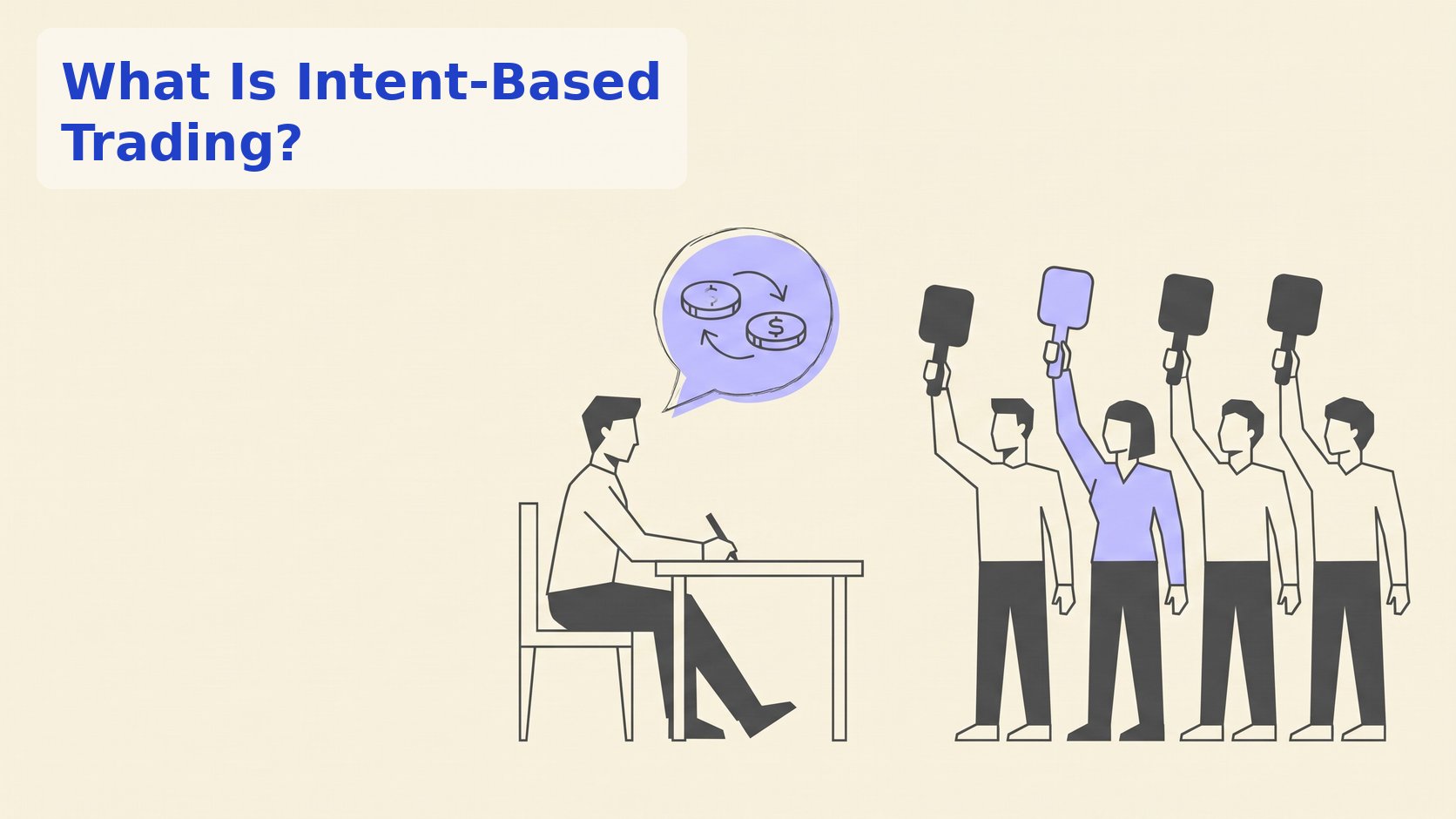
Intent-based trading is a way to trade crypto where you sign the outcome you want, such as "sell 1,000 USDC for at least 0.38 ETH", instead of a transaction that spells out exactly how to get there. Specialist solvers then compete to deliver that outcome, paying gas, choosing the route and absorbing execution risk.
TL;DR
A normal swap is a set of instructions: use this pool, this route, this gas price. An intent is a set of constraints: give me at least this much, by this time. Moving from instructions to outcomes shifts execution from the user to professionals. That shift is why intent-based platforms such as CoW Swap, UniswapX, 1inch Fusion and Across can offer gasless trades, protection from MEV and fast cross-chain transfers. The trade-off is reliance on a small set of solvers.
Intent-based trading: definition and positioning
An intent is a signed message describing a desired end state and the limits you accept. It is not executable on its own. A solver, also called a filler, resolver or relayer depending on the protocol, turns it into an on-chain transaction.
Intents are not a new kind of blockchain or token. They are a new order type layered on top of existing chains and liquidity. They are also not the same as a limit order book: an order book matches buyers with sellers at stated prices, while an intent invites anyone to fill your order by any route, as long as your constraints hold.
The distinction matters because it changes who carries risk. With a transaction, you carry gas cost, failed-transaction risk and exposure to bots in the public mempool. With an intent, the solver does.
How intent-based trading works
- Express. Your wallet creates an order with the sell token, buy token, minimum output and expiry. You sign it off-chain at no cost.
- Broadcast privately. The order goes to the protocol's order flow network, not to the public mempool.
- Compete. Solvers bid to fill it. They may route through DEX pools, use their own inventory, match it against another user's opposite order or source liquidity on another chain.
- Settle. The winning solver submits the on-chain transaction, pays gas and delivers at least your minimum. A settlement contract enforces your constraints, so a solver cannot give you less than you signed for.
- Expire if unfilled. If no solver fills in time, the order lapses and nothing is spent.
The contract-level guarantee is the key. You are trusting solvers for quality of execution, not for safety of funds, because the settlement contract will not release your tokens unless the output condition is met.
The three auction models
| Model | How solvers compete | Examples | Strength |
|---|---|---|---|
| Batch auction | Solvers propose settlements for a batch of orders; the best total outcome wins | CoW Swap | Uniform prices within a batch; peer-to-peer matching |
| Dutch auction | The price starts favorable to you and decays until a solver accepts | UniswapX, 1inch Fusion | Simple, fast price discovery |
| Relayer race | Relayers front funds on the destination chain and settle later | Across, Relay | Cross-chain transfers in seconds |
Intent-based trading in practice
CoW Swap is the purest batch-auction design. Solvers settle groups of orders together, and when two users want opposite sides of a pair, they can trade directly without touching a pool. The protocol settled $9.9 billion of volume in Q2 2026, per CoW DAO's quarterly report, which also notes a growing share of flow coming from embedded B2B integrations.
UniswapX brings intents to Uniswap's distribution. Fillers compete against Uniswap's own pools, so the pool price acts as a floor. Uniswap extended UniswapX to Avalanche, Base, BNB Smart Chain and Tempo in June 2026.
1inch Fusion runs Dutch auctions among a permissioned set of resolvers, who bundle fills privately to avoid sandwich attacks. Fusion+ applies the same model across chains.
Across showed that intents work for bridging. Relayers pay you on the destination chain from their own capital and are reimbursed after verification. Across co-authored ERC-7683 with Uniswap, a shared standard for cross-chain intents, and Eco's analysis reports that ERC-7683 orders make up 88% of Across volume.
The mental model I keep coming back to is the travel agent versus the timetable. A transaction is you reading the timetable and booking each leg yourself. An intent is telling an agent "get me to Lisbon by Friday for under $400" and letting agents compete for the booking. You lose some control over the route; you gain price competition and someone else absorbs the hassle.
Trade-offs and limitations
- Solver concentration. Competition only protects you if enough solvers compete. Eco's analysis of Across reports the top five relayers handling roughly 70% of volume. Concentration can weaken pricing and creates a soft dependency on a few firms.
- Latency and partial fills. Auctions take time, and some protocols fill large orders in parts.
- Permissioned solver sets. Some protocols vet solvers, which improves reliability but reduces openness.
- Interface risk. Intents are signed in a web front end. On April 14, 2026, CoW Swap's domain was hijacked; the contracts were safe, but the signing surface was not.
- Coverage gaps. Obscure tokens may receive no quotes at all.
Intent systems are best understood as moving complexity, not removing it. Routing, gas and MEV are still there; professionals handle them instead of users.
Why it matters for stablecoin payments
Payments are naturally intent-shaped. A business does not care which pool or bridge is used; it cares that a supplier receives a set amount of USDC on a given chain by a given time. Intent rails are becoming the plumbing that lets wallets and payment apps quote one price and guarantee delivery, which is why stablecoin infrastructure providers increasingly integrate intent-based bridges and swaps under the hood.
Related guides: best gasless swap platforms, best MEV protection tools and best cross-chain bridges.
FAQs
What is an intent in crypto?
An intent is a signed message describing the outcome a user wants, such as receiving at least a set amount of one token for another, without specifying how to achieve it. Third-party solvers compete to execute the intent on-chain, and a settlement contract enforces the user's limits.
What is a solver?
A solver is a professional party that finds and executes the best way to fill a user's intent, using DEX liquidity, its own inventory or other users' opposite orders. Protocols call them solvers, fillers, resolvers or relayers. Solvers pay gas and earn the spread between the user's limit and their cost.
Is intent-based trading safer?
For execution, usually yes: orders stay out of the public mempool, which blocks sandwich attacks, and settlement contracts enforce your minimum output. It does not remove smart contract risk or front-end risk, and it depends on enough solvers competing to give good prices.
Which platforms use intent-based trading?
Leading examples include CoW Swap, UniswapX and 1inch Fusion for same-chain swaps, and Across and Relay for cross-chain transfers. ERC-7683, co-authored by Across and Uniswap, is the emerging shared standard for cross-chain intents.
What is the difference between intents and limit orders?
A limit order sits on a book until someone trades at your stated price. An intent invites any solver to fill your order by any route, as long as your minimum is met, and often settles within seconds. Some intent protocols support limit-style orders as one order type.