Last updated: October 2026
The best DEX aggregator depends on how you trade, not on a single league table. 1inch offers the broadest EVM coverage, CoW Swap gives the strongest protection from MEV on Ethereum, Matcha is the simplest option with gasless trading, and Jupiter is the default on Solana.
TL;DR
Best for chain coverage and liquidity depth: 1inch, because its classic router and its intent-based Fusion mode together cover most EVM chains and most order sizes.
Best for MEV-safe execution on Ethereum: CoW Swap, because batch auctions keep your order out of the public mempool and let trades settle against each other.
Best for beginners and gasless trades: Matcha, built by 0x, with one interface across EVM chains and Solana.
Best on Solana: Jupiter, the routing layer most Solana wallets already use.
Best second quote on EVM: Velora (formerly ParaSwap) or KyberSwap, both long-running routers worth checking before large trades.
What is a DEX aggregator?
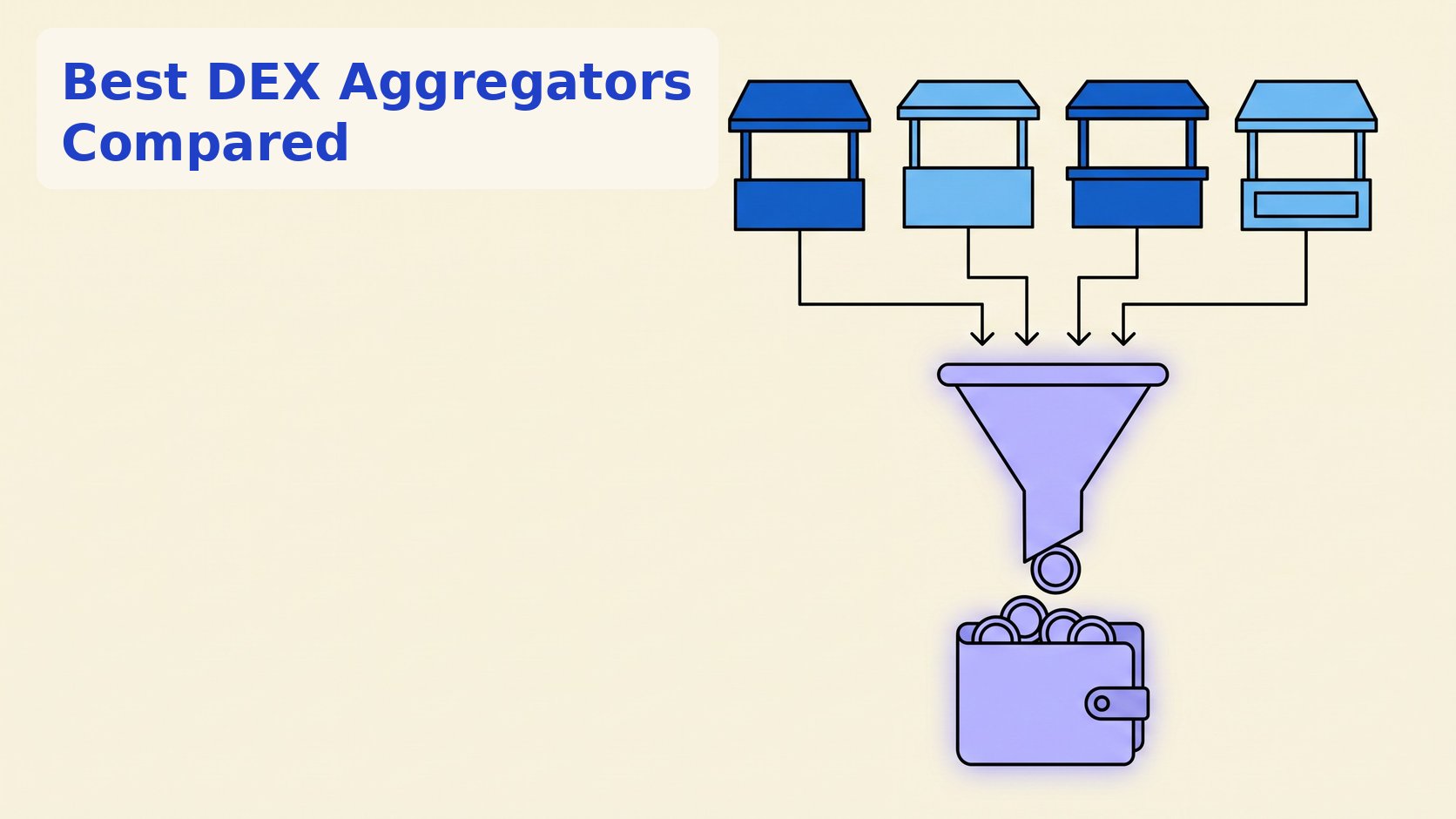
A DEX aggregator is a routing service that checks prices across many decentralized exchanges and liquidity pools, then splits or routes your swap to get the best net output after fees and gas. It does not hold your funds. You sign a transaction or an order from your own wallet, and the aggregator's contracts or solvers execute it.
Liquidity for any given pair is scattered across Uniswap, Curve, Balancer, private market makers and dozens of smaller pools. Without an aggregator, you would check each venue by hand. With one, the comparison happens in milliseconds. This is the on-chain version of smart order routing, the same idea equity brokers have used for two decades.
How does a DEX aggregator work?
- Quote. You enter the tokens and amount. The aggregator queries every liquidity source it connects to, from AMM pools on each decentralized exchange to RFQ quotes from market makers.
- Route. Its algorithm models price impact and slippage in each liquidity pool and finds the best price after gas fees, often splitting the trade across several pools or hopping through an intermediate token.
- Execute. You sign. A smart contract executes every leg of the route atomically, so the whole swap either succeeds at or above your minimum output or reverts.
The result is that a single DEX rarely beats a good aggregator on any trade large enough to move a pool, because the aggregator can draw liquidity from many venues at once.
What are the benefits of using a DEX aggregator?
- Better prices. Splitting a trade across pools reduces price impact, so you typically find the best price available across decentralized finance rather than on one venue.
- Less slippage. Routing around shallow pools keeps execution closer to the quote.
- One interface. You can trade thousands of crypto tokens without opening a separate app for every DEX or blockchain.
- Self-custody. Unlike a centralized crypto exchange, you keep control of your keys throughout.
- Extra protection on some platforms. Intent-based aggregators add MEV protection and gasless trading on top of routing.
What actually matters when choosing a DEX aggregator
Five criteria separate the field:
- Execution model. Classic routers compute a path and you submit the transaction. Intent-based aggregators let you sign an order and have solvers compete to fill it. The second model usually adds MEV protection and gasless trading.
- Chain coverage. EVM-only, Solana-only or both, and whether the aggregator supports cross-chain swaps between blockchains.
- Fees. Some interfaces charge nothing on top of the route, others take a share of price improvement or a small volume fee.
- MEV protection. Whether your trade can be sandwiched by bots watching the public mempool.
- Security record. Contract exploits, approval exploits and front-end hijacks all count.
The framing that matters most: quoted price is not executed price. An aggregator that quotes 0.1% better but leaves you exposed to a sandwich attack can deliver a worse result than a slightly lower quote filled privately.
Quick comparison table
| Aggregator | Execution model | Chains | MEV protection | Gasless option | Best for |
|---|---|---|---|---|---|
| 1inch | Router plus intents (Fusion) | Most major EVM chains, plus cross-chain via Fusion+ | Yes, in Fusion mode | Yes, Fusion | Breadth and large orders |
| CoW Swap | Intents, batch auctions | Ethereum and selected EVM chains | Yes, by design | Yes, gas paid from sell token | MEV-safe Ethereum trades |
| Matcha (0x) | Router plus RFQ and gasless mode | EVM chains and Solana | Yes, in Matcha Auto | Yes, Matcha Auto | Simplicity |
| Jupiter | Router | Solana | Depends on wallet and settings | No | Solana traders |
| Velora (formerly ParaSwap) | Router plus intents | EVM chains | Yes, via intent mode | Yes, via intent mode | An alternative quote source |
| KyberSwap | Router | EVM chains | Depends on RPC | No | Long-tail tokens |
Features checked against each project's documentation in October 2026. Chain lists change often, so confirm in the app before trading.
Top DEX aggregators compared
1inch
What it does well: 1inch combines a classic pathfinding router with Fusion, an intent-based mode where you sign an order off-chain and professional resolvers compete in a Dutch auction to fill it. According to 1inch's developer docs, Fusion is gasless for the user, protects against front-running and sandwich attacks, and works across Ethereum, Base, Polygon, Arbitrum, Optimism, Avalanche, BNB Chain and more. Fusion+ extends the same model to cross-chain swaps.
Where it breaks: Fusion orders can take a short auction period to fill and may fill partially if no resolver takes the full amount. The resolver set is permissioned, which is a trade-off between execution quality and openness.
Best for: users who want one interface for most chains and most order sizes.
CoW Swap
What it does well: CoW Swap batches orders and lets solvers compete to settle them. When two users want opposite sides of the same pair, the trade can settle peer to peer without touching a pool, a "coincidence of wants". Orders never sit in the public mempool, so sandwich attacks are designed out. The protocol settled $9.9 billion of volume in Q2 2026 according to CoW DAO's quarterly report.
Where it breaks: fees are higher than a zero-fee router on some trades. CoW's fee documentation lists a quote improvement fee of 50% of any improvement over your quote, capped at 1% of volume, and DefiLlama's methodology also records a 2 basis point volume fee. The bigger caution is front-end risk: on April 14, 2026, attackers hijacked the cow.fi domain and served a wallet-draining clone. CoW said the smart contracts were not compromised, but users who signed approvals that day were exposed.
Best for: Ethereum mainnet trades above a few thousand dollars, where MEV is the main cost.
Matcha
What it does well: Matcha is the consumer front end of 0x, whose Swap API also powers swaps inside many major wallets. Its Circle partner listing cites aggregated liquidity from 130+ sources and millions of indexed tokens. Matcha added Solana in 2025, so EVM and Solana trading sit in one interface, as The Block reported. Matcha Auto routes trades to private market makers and abstracts gas entirely.
Where it breaks: Matcha Auto charges a small per-trade fee; Matcha's own blog has cited figures between 0.15% and 0.25% over time, so check the quote. Gasless mode is only live on selected chains.
Best for: newer users and anyone who wants EVM and Solana in one place.
Jupiter
What it does well: Jupiter is the dominant routing layer on Solana, integrated into most Solana wallets and apps. It also offers limit orders and dollar-cost averaging tools.
Where it breaks: it is Solana-only for swaps. MEV on Solana works differently from Ethereum, and protection depends on your wallet's transaction settings.
Best for: anyone trading on Solana.
A note on Odos
Odos, once a top-five aggregator known for multi-token swaps, shut down permanently on July 30, 2026 after monthly volume fell 98% from its December 2024 peak, per The Defiant. Older roundups still list it. Its exit is a reminder that a non-custodial front end can disappear even when the contracts remain on-chain, so check that any aggregator you use is still actively maintained.
Velora and KyberSwap
Velora, the rebranded ParaSwap, and KyberSwap are long-running routers worth checking as a second quote. KyberSwap is often strong on long-tail tokens. Note that KyberSwap's separate Elastic AMM product was exploited in November 2023, which is a reminder to revoke stale approvals on any platform you no longer use.
How risky is using a DEX aggregator?
DEX aggregators remove the counterparty risk of a centralized exchange, because your crypto never leaves your wallet until the trade settles. They do not remove DeFi risk. The main risks are smart contract bugs in the router or settlement contract, unlimited token approvals that stay live after you stop using a platform, slippage on thin pairs, MEV on public-mempool trades and front-end attacks like the 2026 CoW Swap hijack. Set a sensible slippage limit, approve only the amount you are trading where the app allows it, and bookmark the official domain.
Key differences that actually matter
The real split is router versus intent. A router gives you a route and you broadcast the transaction yourself, so you carry gas cost, failure risk and mempool exposure. An intent-based aggregator turns that into a signed order and pushes the execution risk onto solvers who compete for it. For small trades on low-fee rollups, the difference is often a few cents. For large Ethereum trades, it can be the whole edge. Our explainer on intent-based trading covers the mechanics.
The second split is where the fee sits. Zero-fee routers monetize elsewhere, through API partners or order flow. Surplus-based models like CoW's only charge when they beat the quote. Neither is wrong, but compare net received amounts, not headline fees.
Market context matters too. CoW's Q2 2026 report noted that DEX aggregator volume fell roughly 18% quarter on quarter sector-wide, while total spot DEX volume fell about 35%, so aggregators held share in a weaker market.
Swapping stablecoins through an aggregator
Stablecoin-to-stablecoin swaps are a special case. Price differences between routes are tiny, so fees and gas dominate. Stableswap pools such as Curve usually provide the core liquidity, and every major aggregator will find them. Some fee schedules treat these pairs differently; CoW, for example, excludes stable-to-stable pairs from its Gnosis Chain volume fee. For moving the same stablecoin between chains, rather than swapping it, see our guide to cross-chain bridges and Circle's CCTP.
When the number one pick is not the right choice
If you trade small amounts on a cheap rollup, MEV protection matters less than speed, so a plain router like 1inch classic, Velora or KyberSwap is fine. If you trade on Solana, none of the EVM-first names compete with Jupiter. If you need to move value across chains in one step, a cross-chain aggregator such as Jumper or Relay fits better than any single-chain DEX aggregator.
The verdict
Use CoW Swap or 1inch Fusion for meaningful Ethereum trades where MEV is the main risk. Use 1inch for breadth across EVM chains, Matcha for simplicity and gasless trading, Jupiter on Solana, and Velora or KyberSwap as a second quote. Check at least two quotes on any trade large enough to matter, and always confirm you are on the correct domain before signing.
The open question for the category is whether intent-based execution becomes the default everywhere. If it does, the aggregator becomes an order-entry screen and the real competition moves to the solver networks behind it. If you are building in this space, we would like to hear from you.
FAQs
What is the best DEX aggregator?
There is no single best DEX aggregator. 1inch has the broadest EVM coverage, CoW Swap has the strongest MEV protection on Ethereum, Matcha is the simplest and supports gasless trading, and Jupiter leads on Solana. Velora and KyberSwap are useful second quotes. Pick based on chain and trade size.
Are DEX aggregators safe?
DEX aggregators are non-custodial, so they do not hold your funds, but they carry smart contract, approval and front-end risk. CoW Swap's domain was hijacked in April 2026. Bookmark official URLs, avoid unlimited approvals where possible and revoke approvals you no longer use.
Do DEX aggregators charge fees?
Some charge nothing beyond the underlying pool fees and gas, while others take a small volume fee or a share of price improvement. CoW Swap charges up to 50% of quote improvement, capped at 1% of volume. Gasless modes embed gas costs in the price. Compare the net amount you receive.
Is 1inch better than CoW Swap?
1inch covers more chains and order types, while CoW Swap is more specialized in MEV-protected Ethereum execution through batch auctions. 1inch's Fusion mode narrows the gap by also using intents. For large mainnet trades, many users quote both and take the better net result.
What is the difference between a DEX and a DEX aggregator?
A DEX is a single venue with its own liquidity pools, such as Uniswap or Curve. A DEX aggregator does not hold liquidity; it compares many DEXs and market makers and routes your trade across them to get the best net price.