What Is MEV? Maximal Extractable Value Explained
Last updated: October 12, 2026
TL;DR
MEV (maximal extractable value) is the profit that can be captured by choosing which transactions go into a block and in what order. Bots and block builders earn it through arbitrage, liquidations and sandwich attacks. Some MEV keeps markets efficient; some is a hidden tax on users' trades. On Ethereum, more than 90% of blocks are built through the MEV-Boost auction, and on Solana most validators run Jito's MEV-aware client.
MEV: definition and positioning
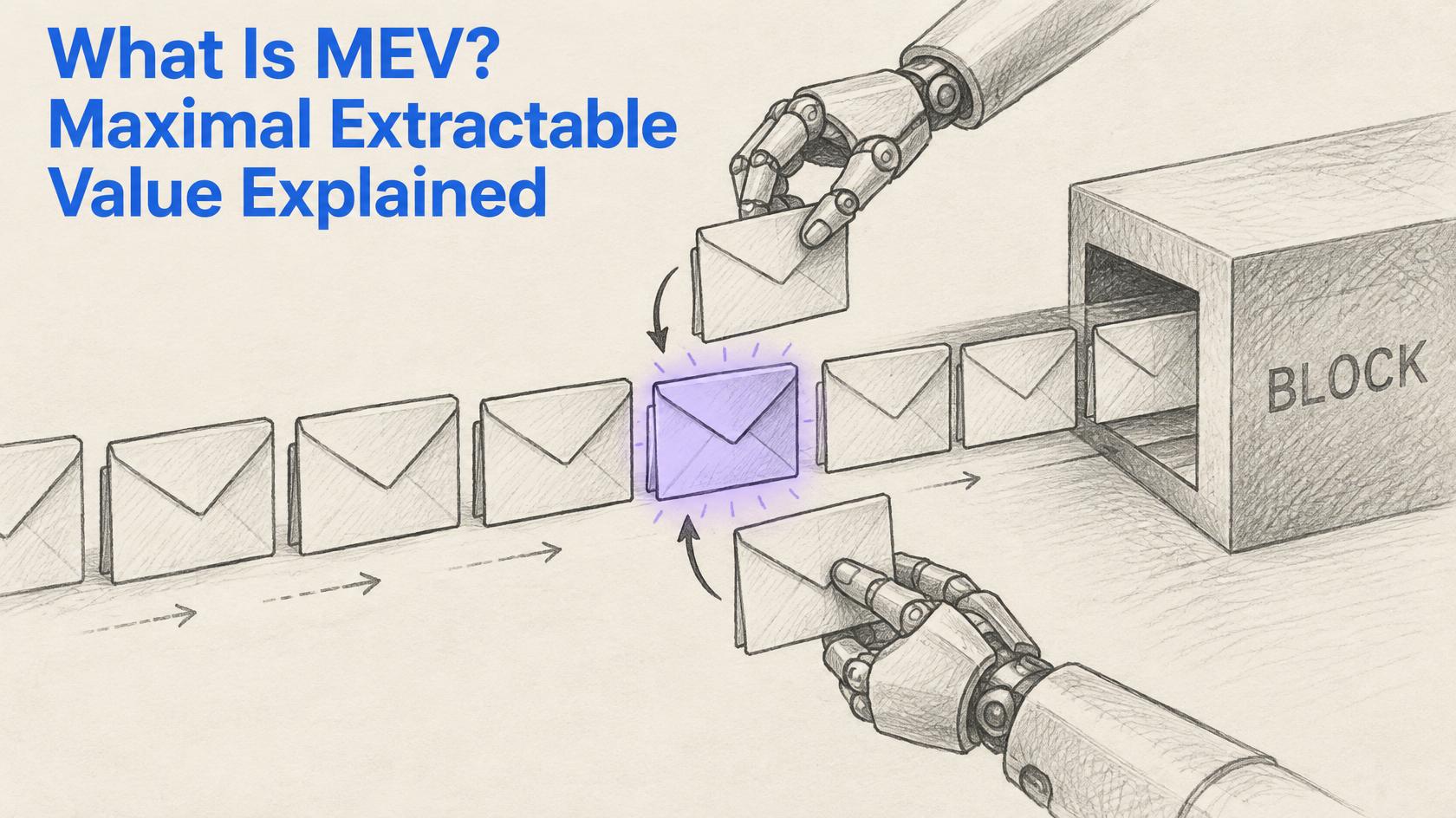
Every blockchain needs someone to decide transaction order. Whoever holds that power can profit from it, and that profit is MEV. The term originally stood for miner extractable value; it became maximal extractable value after Ethereum moved to proof of stake in 2022, because validators and specialized builders, not miners, now do the ordering.
MEV is often confused with gas fees. They are different payments:
| Gas or priority fee | MEV | |
|---|---|---|
| Who pays | The user, explicitly | Often the user, implicitly, through a worse price |
| Visible in your wallet | Yes | Usually not |
| Purpose | Pay for block space and inclusion | Capture value created by transaction order |
| Who receives it | Validators | Searchers, builders and validators |
The framing that matters: gas is the price you see; MEV is the price you often do not.
How MEV works
Modern MEV runs as a supply chain with distinct roles:
- Users submit transactions, such as a swap on a decentralized exchange, which wait briefly in a public queue called the mempool.
- Searchers run bots that scan pending transactions for profit opportunities and package their own transactions into bundles.
- Builders assemble full blocks from user transactions and searcher bundles, ordering them to maximize total value.
- Relays sit between builders and validators on Ethereum, checking blocks and forwarding the highest bid.
- Validators propose the winning block and collect a payment from the builder.
On Ethereum this auction is MEV-Boost, used by more than 90% of validators. It is highly concentrated: a Bitcoin.com analysis of relayscan data found three relays routing roughly 85% to 88% of MEV-Boost blocks, and a single builder, Titan, building more than half.
Types of MEV
| Type | How it works | Good or bad for users |
|---|---|---|
| Arbitrage | Buying on one venue and selling on another to close a price gap | Generally healthy: keeps prices consistent |
| Liquidations | Repaying undercollateralized loans in lending protocols for a bonus | Necessary: keeps lending solvent |
| Sandwich attacks | Buying just before a user's swap and selling just after, so the user gets a worse price | Harmful: a direct cost to the user |
| Front-running | Copying a profitable pending transaction and getting ahead of it | Harmful |
| Back-running | Placing a transaction immediately after a large trade to capture the price move it creates | Mostly neutral |
Sandwich attacks are where users lose money. Industry estimates attribute roughly 30% of cumulative Ethereum MEV to sandwiching, and on Solana researchers from Ghostlogs estimated that sandwich bots extracted between $370 million and $500 million from users over a 16-month period.
MEV in practice: Ethereum vs Solana
Ethereum. MEV-Boost made extraction an open auction, and much of the value now flows to validators rather than staying with bots. The next structural change is enshrined proposer-builder separation (ePBS, EIP-7732), the headline feature of the planned Glamsterdam upgrade, which moves the builder auction into the protocol itself and removes reliance on trusted relays. ePBS changes who runs the auction; it does not eliminate sandwiching on its own, which needs further work such as inclusion lists and encrypted mempools.
Solana. There is no persistent public mempool, but MEV still flows through Jito, whose validator client runs on the large majority of Solana stake. Jito suspended its public mempool in March 2024 to curb sandwiching, at a revenue cost, according to Helius. Sandwiching continued through private channels, which is why routing and slippage settings matter as much on Solana as on Ethereum.
Does MEV affect stablecoin transactions?
The framing I keep coming back to: MEV attacks trades, not transfers. A plain stablecoin payment, sending USDC from one wallet to another, has no price to manipulate, so there is nothing to sandwich. Moving USDC between chains through a burn-and-mint protocol like CCTP is likewise not exposed in the way a swap is.
Exposure starts the moment a stablecoin is swapped for something else. A large USDC-to-ETH swap with loose slippage settings is exactly what sandwich bots look for. Stablecoin-to-stablecoin swaps on pools designed for pegged assets are less attractive targets because prices barely move, but they are not immune. For businesses building payment flows, the practical rule is to keep settlement in transfers and route any conversion through MEV-protected execution.
How to protect yourself from MEV
- Use an MEV-protected route. Private transaction services such as Flashbots Protect or MEV Blocker send your transaction directly to builders instead of the public mempool.
- Trade on venues with built-in protection. CoW Swap uses batch auctions, and aggregators like Jupiter on Solana route with MEV awareness.
- Set tight slippage. Sandwich profit comes from the slippage you allow. Lower tolerance means less to extract, at the cost of more failed transactions in volatile markets.
- Split large trades. Smaller orders move prices less and are less profitable to attack.
- Avoid public RPC endpoints for large swaps on chains where transactions are broadcast openly.
Trade-offs and limitations
MEV is not purely harmful. Arbitrage keeps decentralized exchange prices aligned with the wider market, and liquidation bots keep lending protocols solvent. The costs are a hidden tax on retail trades, centralization pressure as building concentrates in a few firms, and incentives that can tempt validators to reorder blocks for profit. Protection tools reduce exposure but shift trust to the relay or builder that receives your private transaction.
FAQs
What is MEV in crypto?
MEV, or maximal extractable value, is the profit that can be made by deciding which transactions are included in a block and in what order. Bots and block builders capture it through arbitrage, liquidations and sandwich attacks. It was called miner extractable value before Ethereum moved to proof of stake.
What is a sandwich attack?
A sandwich attack is when a bot sees a pending swap, buys the same asset just before it to push the price up, lets the user's trade execute at the worse price, then sells immediately after for a profit. The user pays more than expected, and the difference becomes the attacker's MEV.
Are MEV bots legal?
Running arbitrage and liquidation bots is generally treated as legal market activity. Strategies that cross into deception or exploitation draw legal scrutiny; the US Justice Department charged two brothers accused of exploiting other MEV bots for about $25 million in 2023. The law here is unsettled, so outcomes depend on the conduct and jurisdiction.
How is MEV different from gas fees?
Gas fees are explicit payments a user makes to have a transaction included in a block. MEV is value extracted through transaction order, usually paid implicitly by users through worse prices on their trades. Gas appears in your wallet; MEV typically shows up only as a less favorable execution price.
How can I protect myself from MEV?
Use an MEV-protected transaction route such as Flashbots Protect or MEV Blocker, trade on venues with built-in protection like CoW Swap or Jupiter, keep slippage tolerance tight, and split large trades. These steps keep your transactions out of the public mempool or reduce the profit available to attackers.
Does MEV exist on Bitcoin?
Bitcoin has much less MEV than Ethereum or Solana because it has little on-chain trading or lending to exploit. Transaction ordering by fee still exists, and some MEV-like activity appears around token and inscription protocols, but sandwich attacks and DeFi liquidations are largely features of smart contract chains.
The takeaway
MEV is a permanent feature of any blockchain where ordering has value: the question is who captures it and how much of it comes out of users' pockets. The open question is whether protocol changes like ePBS and encrypted mempools reduce harmful extraction, or mainly redistribute it among builders and validators. If you are building stablecoin payment or swap flows and need MEV-aware execution, reach out.