Crypto credit cards pay rewards in crypto on dollar spending, with headline rates of roughly 1.5% to 6% back. The real return depends on monthly spend caps, tier fees and whether rewards arrive in BTC or a native token. That gap between headline and effective rate is the whole story. Most roundups quote the top number; this one runs the caps.
How We Ranked These Crypto Credit Cards
- Reward rate after caps. The rate you earn on realistic monthly spend, not the promotional ceiling.
- Annual and tier fees. A $0 card fee means little if the useful rate sits behind a subscription or staking requirement.
- Reward currency. BTC is a liquid, widely held asset. A native exchange token adds issuer-specific risk on top of market risk.
- Credit versus collateral model. A true unsecured credit line is a different product from a card backed by your own crypto.
- US availability. A card you cannot get is not a pick.
Takeaway: rank on effective yield net of fees, then adjust for the asset you are paid in.
Quick Summary of the Ranked Picks
- Gemini Credit Card: category rates, no annual fee, choose 50+ assets. Highest effective rate among no-fee cards in the $1,000 example
- Crypto.com Visa Signature Credit Card: tiered BTC or CRO rewards. Best for High Spenders
- Fold Bitcoin Credit Card: flat bitcoin-only rewards, uncapped base rate. Best for Bitcoin Purists
- Coinbase One Card: exchange-linked crypto credit card. Best for Coinbase Users
At a Glance: Rewards and Fees Compared
| Rank | Card | Pricing | Best for | Standout |
|---|---|---|---|---|
| 1 | Gemini Credit Card | $0 annual fee | Fuel, transit and dining spend | 4% on up to $300/month in top category |
| 2 | Crypto.com Visa Signature | - | Users willing to commit to a tier | - |
| 3 | Fold Bitcoin Credit Card | See vendor | Bitcoin-only accumulation | Uncapped 1.5% base, up to 5% with Reserve Boost |
| 4 | Coinbase One Card | See vendor | Existing Coinbase customers | Exchange-integrated rewards |
Takeaway: the cheapest card on paper is not always the highest-yielding one at your spend level.
What $1,000 of Monthly Spend Actually Earns
Caps compress headline rates fast. Take an example cardholder spending $1,000 a month, and assume all spend qualifies at each card's top category rate.
Gemini. According to Gemini, 4% back applies to up to $300 of qualifying spend per month, then 1% on other qualifying purchases that month.
- $300 x 4% = $12
- $700 x 1% = $7
- Total: $19, an effective 1.9%
Crypto.com, base tier, BTC rewards. According to Crypto.com, the free Basic tier earns 1.5%, with BTC rewards on up to $250 a month, then 1.0%.
- $250 x 1.5% = $3.75
- $750 x 1.0% = $7.50
- Total: $11.25, an effective 1.125%
Choosing CRO instead removes the BTC cap on Basic, since Crypto.com lists unlimited CRO at 1.5%, which would yield $15. The trade is asset quality for rate.
| Card (assumed $1,000/mo) | Headline | Earned | Effective rate |
|---|---|---|---|
| Gemini | 4% | $19.00 | 1.9% |
| Crypto.com Basic, BTC | 1.5% | $11.25 | 1.125% |
| Crypto.com Basic, CRO | 1.5% | $15.00 | 1.5% |
| Fold, base rate (no boost) | 1.5% | $15.00 | 1.5% |
| Crypto.com Plus, BTC, after $4.99 monthly fee | 3.5% | $22.51 | 2.25% |
Takeaway: on $1,000 of spend, Gemini's 4% headline behaves like a 1.9% card. That still leads the no-fee options, but Crypto.com Plus pays more, $22.51 after its $4.99 monthly fee. Model your own spend before reading any headline.
Gemini Credit Card
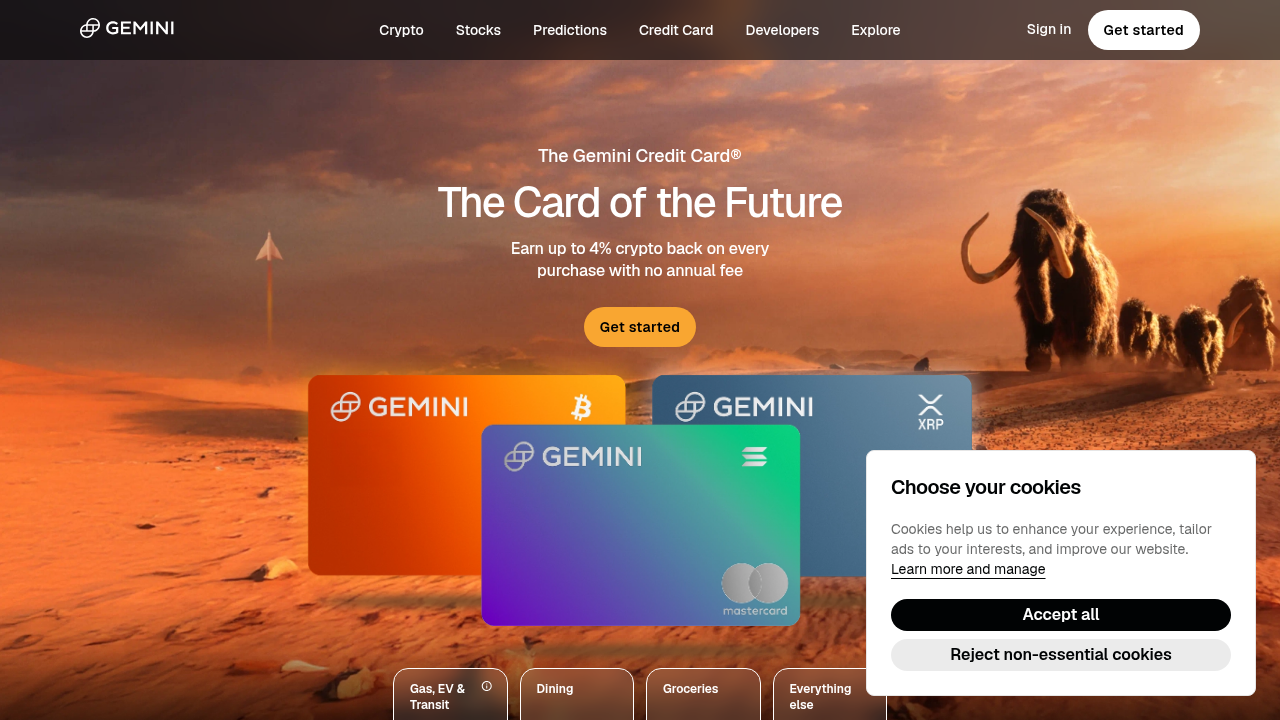
Gemini's card is the cleanest structure in the category. Gemini documents it as a Mastercard World Elite issued by WebBank, with no annual fee and no foreign transaction fees.
Rates. Gemini lists 4% on gas, EV and transit, 3% on dining, 2% on groceries and 1% on everything else. The 4% tier applies to up to $300 of spend per month, and the cycle resets on the 1st.
Reward asset. Holders can earn bitcoin or 50+ other cryptos available on Gemini, and switch as often as they like. Rewards are deposited instantly.
Who it fits. Commuters and drivers whose category spend lands near the $300 cap, and anyone who wants BTC rewards without a staking commitment.
Caveat. The cap. Above $300 of top-category spend, the marginal rate falls to 1%, which is ordinary cashback territory.
Crypto.com Visa Signature Credit Card
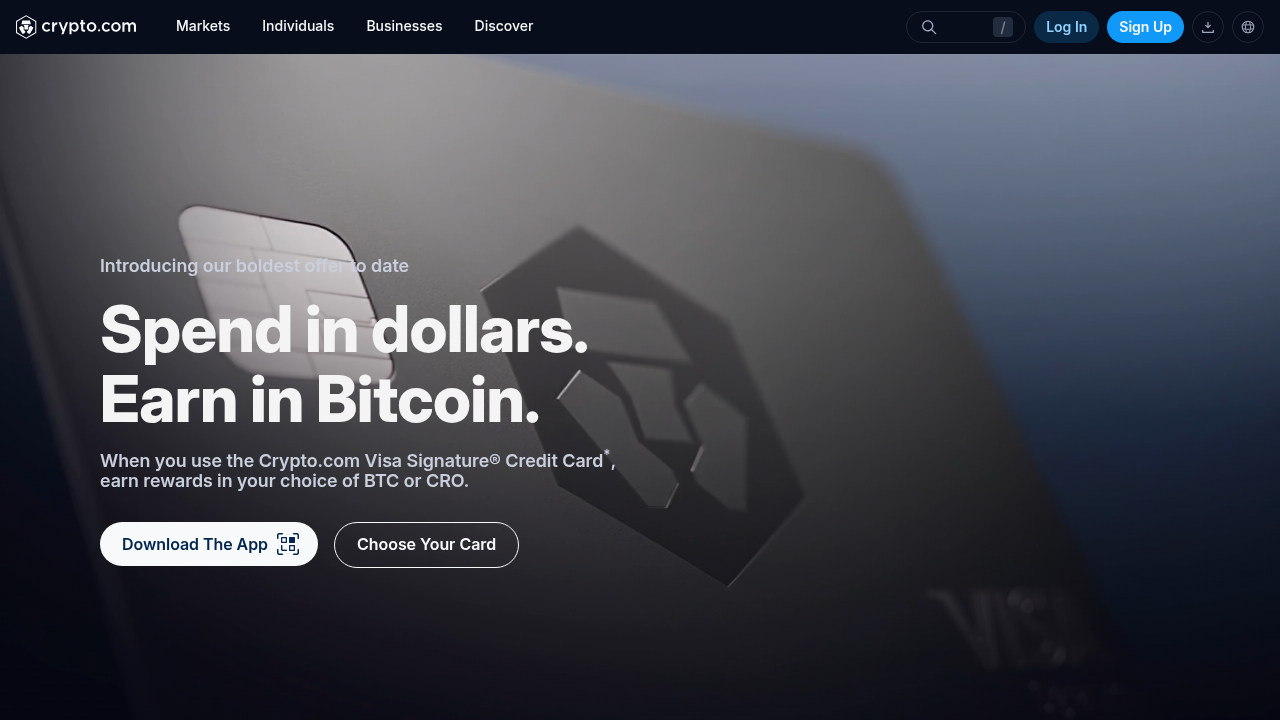
Crypto.com runs the most layered structure here. The card is US only, per the Crypto.com Help Center, and Crypto.com advertises up to 6% back in BTC or CRO.
Tiers. According to Crypto.com, the Basic tier is free and pays 1.5%. The Plus tier costs $4.99 a month, $49.90 a year, or a $500 12-month CRO stake, and pays 3.5%, with BTC rewards on up to $500 a month, then 2.0%. The vendor page also shows 4.5% back on everyday purchases for the Jade tier.
Fees and bonus. Crypto.com lists $0 annual credit card fees. Welcome bonuses are paid in CRO: $100 after $1,500 of spend in the first 90 days on Basic, $200 after $2,000 on Plus.
The tier math. On Plus at $1,000 of monthly spend in BTC, the example cardholder earns $500 x 3.5% = $17.50 plus $500 x 2.0% = $10, or $27.50 before fees, and $22.51 after the $4.99 monthly fee.
Caveat. Higher rates require a tier commitment, either a recurring fee or locked CRO. A CRO stake converts a payments decision into a token position.
Fold Bitcoin Credit Card
Fold is the bitcoin-maximalist design. According to Investing News Network, Fold announced in September 2025 that Stripe Issuing would power the card on the Visa network.
Rates. Fold's current rewards program terms list a 1.5% base rate in bitcoin on all qualifying purchases, with no cap. A Reserve Boost, starting at a $15,000 balance held with Fold, lifts the total rate to as much as 5%, but applies only to the first $5,000 of qualifying purchases each month.
Design choice. Rewards are bitcoin only, with no tokens, staking tiers or exchange lock-ins. In our framework that scores well on reward currency and simplicity.
Who it fits. Bitcoin-only spenders who want an uncapped flat rate with no tier fee. At $1,000 a month, the 1.5% base alone earns $15. Holders with large Fold balances earn more through the boost.
Caveat. Fold changed its rewards structure in September 2026, and the best rates depend on a large balance held with Fold. Confirm current availability and terms directly with Fold before planning around it.
Coinbase One Card and Collateral-Based Alternatives
The Coinbase One Card is reviewed as a crypto credit card, including in a YouTube review titled "Coinbase One Card Review". Its fit depends largely on whether you already use Coinbase; check current rates and membership terms with Coinbase.
Collateral cards are a different product class.
- Oobit describes its card as a credit card that uses your digital assets as collateral, running over the Visa network and settling in local currency.
- Nexo offers Credit Mode and Debit Mode on one card. Nexo lists up to 2% crypto cashback in Credit Mode, with crypto-backed credit lines and no credit checks.
The drawback is structural. See the ether.fi card review for a related card. Collateralized spending is a loan against volatile assets. A drawdown shrinks your borrowing capacity exactly when liquidity matters most, and you remain exposed to the custodian.
Takeaway: an unsecured credit card is a rewards product; a collateral card is a use product. Price them differently.
How to Choose a Crypto Credit Card

Start with spend. If your top-category spend sits near $300 a month, Gemini's cap barely binds. Above roughly $1,000, a paid Crypto.com tier pulls ahead: Plus earns 2% on BTC spend above its $500 threshold, versus 1.5% on Fold's base rate without a boost.
Then fees. Subtract any tier fee from rewards before comparing; a $4.99 subscription costs about $60 a year.
Then the asset. BTC rewards carry market risk. Native token rewards add issuer risk, and staking requirements add lockup and unbonding risk.
Finally, the model. Collateral cards suit holders who refuse to sell; others are better served by unsecured credit.
FAQ: Frequently Asked Questions
Where to buy crypto using a credit card?
Many exchanges accept card purchases, but issuers may treat them as cash advances with fees and interest. Earning crypto rewards on ordinary spending, as these cards do, avoids that cost structure entirely.
Is $100 enough to start crypto?
Yes, most exchanges allow small purchases. A rewards card is another path: crypto accrues from existing spending, so exposure builds gradually without committing a lump sum upfront or timing an entry point.
How to spend crypto?
Use a card that converts at the point of sale. Debit-style cards, like Nexo's Debit Mode, spend your assets directly, while merchants receive local currency through the Visa or Mastercard network as usual.
Are crypto credit card rewards taxable?
Treatment depends on how rewards are classified and when you sell them. Selling or swapping reward crypto can create a taxable event. Consult a qualified tax adviser about your specific situation.
What is the difference between a crypto credit card and a crypto debit card?
A credit card spends borrowed money, repaid later. A debit card spends assets you already hold. Collateral cards like Oobit and Nexo Credit Mode sit between, lending against your crypto holdings.
Do crypto credit cards charge annual fees?
Some do not. Gemini lists no annual fee, and Crypto.com lists $0 annual card fees. Crypto.com's higher reward tiers, however, require a monthly or yearly fee or a CRO stake.
Conclusion
Headline rates are marketing; caps and tiers are the product. On realistic spend, effective rates sit well below headline rates, and the decisive variables become fees and the asset you are paid in. The open question is whether bitcoin-only flat-rate designs pressure tiered, token-linked programs to simplify.