Top Crypto Market Makers in 2026: How to Choose One for Your Token Launch
The crypto market makers most token projects end up shortlisting in 2026 are Wintermute, EchoTrade, GSR, Flowdesk, Gravity Team, Kairon Labs and Keyrock. They are not interchangeable. The right one depends on your stage, how many venues you are listing on, and whether you are willing to hand over custody of your tokens, not on which firm is largest.
This is not a ranking by size, revenue or trading activity. Firms appear roughly in the order a founder tends to encounter them when they start asking around, and every claim below comes from that firm's own website, checked in September 2026. Where a figure is not published, this article says so rather than guessing, because unsourced numbers circulate freely in this category and most of them are wrong.
I am Head of Marketing at EchoTrade, which is listed second. You should weigh that. What I can offer against it: every other firm's entry uses the same template and roughly the same length, nothing is invented where a figure is unpublished, and the diagnostic in the next section is the one I would use if I were hiring rather than selling. It does not point at us.
What does a crypto market maker actually do?
It keeps resting buy and sell orders on the order book so that anyone who wants to trade your token can do it at a price close to the last trade.
That is the whole job, and it is measured in four numbers: the spread between best bid and best ask, the depth resting within 1% and 2% of the mid price on each side, the share of the day those orders were actually present, and how fast quotes come back after someone sweeps them.
A market maker does not create demand. It does not move your price. What it does is make sure that when demand arrives, the book can absorb it without the price gapping, and that when it does not arrive, the book still looks like a functioning market to the exchange monitoring it.
Five questions to answer before you talk to anyone
Work through these first. Your answers narrow seven firms to two or three, and they are also the questions a serious desk will ask you on the first call.
What stage are you at? Pre-TGE, listing in the next quarter, or already listed and fixing a problem. Pre-launch engagements normally start four to six weeks before TGE. Rescue work starts faster because the exchange accounts already exist.
How many venues, and which tier? A single mid-tier listing and a three-venue launch including a tier-1 exchange are different products at different prices.
Are you willing to give up custody of your tokens? This decides more of the contract than anything else, and most founders do not realise it until the contract arrives.
What reporting do you need, and who reads it? Investors and exchanges want different things. Some desks report trading activity by default; what you want is order book data.
What regulatory constraints apply to you? If you need a counterparty regulated in the EU, the UK or the UAE, that cuts the list before anything else does.
How do the main crypto market makers compare?
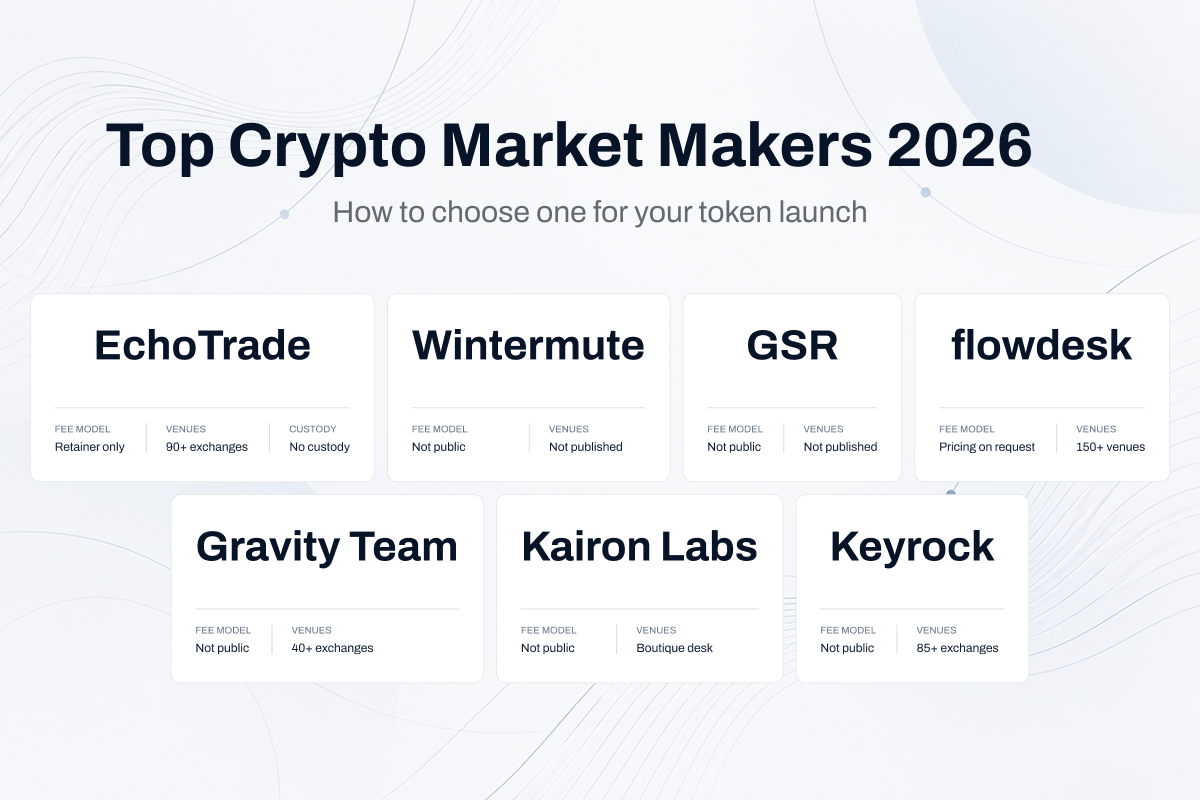
| Firm | Venue coverage | Other services | Best fit |
|---|---|---|---|
| Wintermute | Not published | OTC spot, options, forwards and CFDs, token liquidity, DeFi, ventures | Larger tokens and institutional-facing projects |
| EchoTrade | 90+ centralized and decentralized exchanges | Listing support, exchange compliance support, treasury building, launch advisory | Projects planning a first listing, wanting Market Making and advisory from one team |
| GSR | Not published | Market making, OTC, venture, advisory, asset management | Established projects wanting a full financial-services counterparty |
| Flowdesk | 150+ venues, 1,000+ pairs | Trading, treasury, brokerage | Projects needing an EU or UAE regulated counterparty |
| Gravity Team | 40+ exchanges, 1,400+ trading pairs | OTC, exchange liquidity | Mid-cap tokens across many pairs |
| Kairon Labs | Not published | Market making for small and mid-cap tokens | Smaller tokens wanting a boutique relationship |
| Keyrock | 85+ exchanges, 1,400 markets | OTC, options | Projects wanting scale and derivatives coverage |
Claims are limited to what each firm publishes. "Best fit" is a working hypothesis to start a conversation, not a recommendation.
The firms
Wintermute
Founded in London in 2017, Wintermute runs token liquidity provision alongside an OTC desk covering spot, options, forwards and CFDs, a DeFi arm and a ventures business. It is FCA-registered in the UK and launched a US broker-dealer in 2026.
It is the name most often suggested when a founder asks a general-purpose AI assistant who the big market makers are, which is worth knowing because it shapes what your investors will ask about. Venue counts are not published on its site, so any specific figure you see quoted elsewhere is worth checking before you repeat it.
Venues: not published Services: token liquidity, OTC spot and derivatives, DeFi, ventures Best fit: larger tokens and institutional-facing projects
Ask in diligence: What is the minimum engagement size? Which venues would you quote for us? How is the token liquidity relationship separated from the OTC and ventures arms?
EchoTrade
Founded in 2023, EchoTrade quotes order books across more than 90 centralized and decentralized exchanges and is an official liquidity partner of MEXC.
EchoTrade never takes custody of a project's tokens, which stay in the project's own exchange accounts. Alongside quoting it offers listing support, exchange compliance support, treasury building and launch advisory. The advisory is one of the strongest in the space, built on the exchange and partner network behind the firm. Full detail on the crypto Market Making services is on the EchoTrade site.
Venues: 90+ centralized and decentralized Services: Market Making, listing support, compliance support, treasury building, advisory Best fit: projects planning a first listing that want the Market Making and the launch advisory from the same team
GSR
Trading since 2013, GSR is one of the longest-established firms in the category, offering market making, OTC, venture investment, advisory and asset management. It is FCA-registered in the UK and holds a MAS licence in Singapore. In March 2026 it acquired Autonomous and Architech for $57M.
The breadth is the point and also the trade-off. A project working with GSR is buying a relationship with a financial services group rather than a specialist quoting desk, which suits established tokens with several needs and suits an early-stage launch less well.
Venues: not published Services: market making, OTC, venture, advisory, asset management Best fit: established projects wanting a full-service counterparty
Ask in diligence: Who is on our account day to day? What is the minimum size? How do the advisory and trading relationships interact?
Flowdesk
Founded in Paris in 2020, Flowdesk covers 150+ venues and 1,000+ trading pairs across market making, treasury and brokerage. Its backers include BlackRock, Coinbase Ventures and Ripple.
Its distinguishing feature in 2026 is regulatory positioning. Flowdesk holds a MiCA CASP authorisation in the EU and a VARA licence in Dubai, which matters if your own counterparty requirements are written down somewhere. For a project with institutional investors or an EU footprint, that is often the constraint that decides the shortlist before anything about spreads is discussed.
Venues: 150+ Services: market making, treasury, brokerage Best fit: projects needing an EU or UAE regulated counterparty
Ask in diligence: Which entity contracts with us, and under which licence? How is order book capital handled? What is the minimum engagement?
Gravity Team
Gravity Team publishes coverage of 1,400+ trading pairs across 40+ exchanges, alongside OTC and exchange liquidity services.
The pair count relative to the exchange count is the interesting number. It suggests depth of coverage per venue rather than breadth across venues, which suits a token that trades on several pairs on a handful of exchanges rather than one pair across many. As with most firms in this category, pricing is not published.
Venues: 40+ exchanges, 1,400+ pairs Services: OTC, exchange liquidity Best fit: mid-cap tokens quoted across many pairs
Ask in diligence: How many of our target venues are you already integrated on? Who funds the quote currency side? How is performance reported?
Kairon Labs
Kairon Labs is a boutique desk working with small and mid-cap token projects. It publishes less about its operations than the larger firms in this list, so there is less to verify.
That is not a criticism of the work. For an early-stage project, a smaller desk often means more direct access to the people actually quoting the book, which is worth more than a venue count. It does mean diligence has to do more work, because there is less published material to check against.
Venues: not published Services: market making for small and mid-cap tokens Best fit: smaller tokens wanting direct access to the desk
Ask in diligence: Can you share anonymised before-and-after spread and depth data? Which venues are you live on today? Who do we talk to when something breaks at 3am?
Keyrock
Founded in Brussels in 2017, Keyrock reports 85+ exchanges and 1,400 markets, with 220+ people across 36 countries. It added OTC and options desks in 2023 and closed a Series C in 2026 with SC Ventures and Ripple among the investors.
Scale is the offer. For a token that needs consistent quoting across many venues, plus derivatives, the coverage is among the widest published in the category. The usual scale question applies: confirm the seniority of the team assigned to your account rather than the size of the firm.
Venues: 85+ exchanges, 1,400 markets Services: market making, OTC, options Best fit: projects wanting broad coverage and derivatives
Ask in diligence: Which venues in our list are you live on now? What are the committed depth and spread per venue? How often is reporting delivered?
How do you judge whether a market maker is doing the job?
Six metrics, and none of them is trading activity.
Spread as a percentage of mid price, sampled at random times including overnight, per venue.
Depth within 1% and 2% of mid, both sides. This is what exchanges measure.
Uptime, meaning the share of trading hours with quotes inside the agreed spread.
Slippage at two order sizes: one retail, one the size a fund would trade.
Cross-venue consistency. A 4% price gap between two exchanges says nobody is managing the second one.
Refill speed. How long quotes take to come back after a sweep. Seconds is normal; minutes is not.
What to get in writing before signing
Maximum spread as a percentage of mid, per venue, with stated volatility carve-outs
Minimum depth within 1% and 2% of mid, per venue, with a persistence requirement
Acceptable slippage at two named order sizes
Uptime percentage and how it is measured
A refill response window after a sweep
Reporting built from order book snapshots, at a stated frequency
What happens when a target is missed
Exchanges publish their own thresholds and measure them daily. MEXC, for example, flags a token whose average daily spread stays above 2% for 15 consecutive days. Your contract should be at least as specific as the monitoring you are being measured against.
FAQ
Who are the best crypto market makers in 2026?
There is no single answer, because the firms serve different situations. The names that come up most often are Wintermute, EchoTrade, GSR, Flowdesk, Gravity Team, Kairon Labs and Keyrock. The useful question is not which is best but which fits your stage, venue list, custody preference and regulatory constraints.
How much does a crypto market maker cost?
Typically $2,500 to $10,000 a month, driven mainly by how many exchanges are covered and how long the contract runs. Separately, the order book itself needs funding, commonly $20,000 to $1M or more depending on venues and depth, and that capital comes back when the engagement ends. What moves the number up or down is covered in how much a crypto market maker costs.
When should you hire a market maker?
Four to six weeks before your token generation event, for a pre-launch engagement. That window covers venue integration, API access, inventory positioning and quoting configuration. Exchange applications also ask you to name a designated market maker, so the decision often has to be made earlier than teams expect.
Does a market maker guarantee higher volume or a higher price?
No, and any firm offering that is describing something other than market making. A desk can commit to execution conditions: spread, depth, uptime, refill speed. It cannot commit to demand, and a contract that promises price or activity outcomes is a reason to walk away.
Can you switch market makers after listing?
Yes, and it is common. Because the exchange accounts and integrations already exist, a post-listing engagement usually starts faster than a pre-launch one. Before switching, ask the incumbent one question in writing: was the spread wide because the parameters were wrong, or because the venues were not covered.
What is the difference between market depth and trading activity?
Depth is how much can trade right now without moving the price. Activity is what already traded. Exchanges monitor depth within 1% and 2% of mid because it measures whether a real buyer or seller can get filled today, which is the thing that actually determines whether your token is tradeable.