CBDC vs Stablecoin: Key Differences Explained
Last updated: October 12, 2026
TL;DR
A CBDC is a direct liability of a central bank: digital cash issued by the state. A stablecoin is a private company's token backed by reserves of cash and government debt. The issuer decides everything else, from default risk to privacy. Stablecoins are already a market of about $300 billion; only three countries have fully launched retail CBDCs, while the US has banned one and the euro area targets a digital euro in 2029.
How CBDCs and stablecoins differ
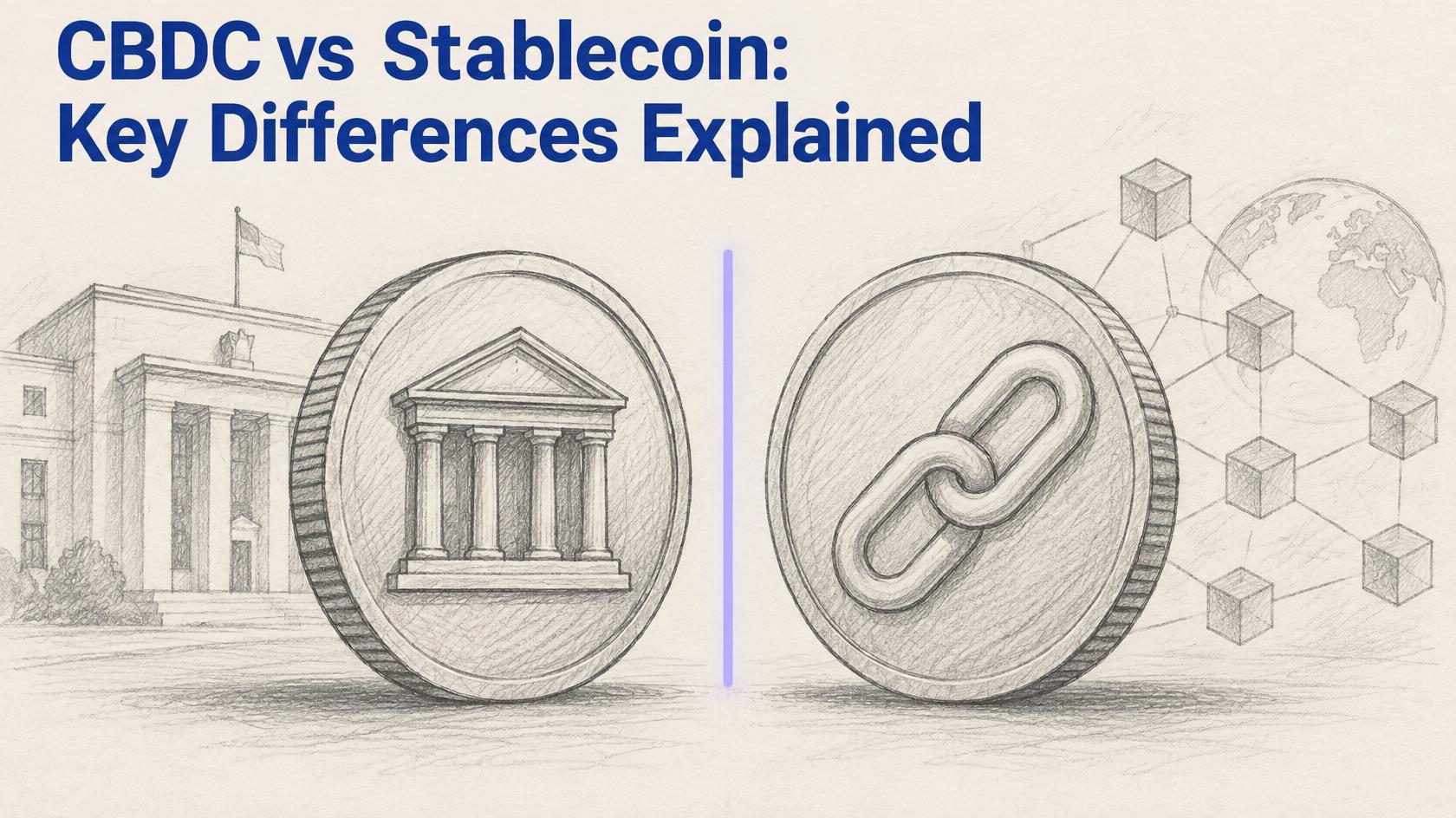
The one-sentence contrast: a CBDC is public money in digital form, a stablecoin is private money pegged to it.
A central bank digital currency is issued by a country's central bank and is legal tender or close to it, like a banknote that lives on a ledger. A stablecoin is issued by a company such as Tether, Circle or Paxos, which holds reserves and promises to redeem each token for one unit of currency. Our CBDC explainer covers the central bank side in depth.
The structural difference that drives everything else: whose balance sheet you are on. With a CBDC, it is the central bank's, which cannot run out of its own currency. With a stablecoin, it is a private issuer's, which can fail if its reserves fail.
The difference that actually matters
Most comparisons list features. The decision comes down to a trade between two kinds of risk.
Stablecoins carry issuer risk. If reserves are impaired, a stablecoin can lose its peg, as USDC briefly did during the Silicon Valley Bank failure in 2023. Regulation such as the US GENIUS Act and the EU's MiCA reduces that risk by mandating high-quality reserves and redemption rights, but cannot remove it.
CBDCs carry state risk. There is no default risk, but the issuer is also the government. Critics argue a retail CBDC could give authorities visibility into every payment and the technical ability to restrict, program or freeze money. That concern is why the US went the other way: a January 2025 executive order bars federal agencies from creating a CBDC, and Congress has advanced the Anti-CBDC Surveillance State Act.
The framing I keep coming back to: the US chose to privatize the digital dollar, and Europe chose to publicize the digital euro. Both are hedges against the other's model.
CBDC vs stablecoin: comparison table
| CBDC | Stablecoin | |
|---|---|---|
| Issuer | Central bank | Private company or bank |
| Legal claim | Direct liability of the central bank | Claim on the issuer's reserves |
| Default risk | None in its own currency | Depends on reserve quality |
| Backing | The central bank itself | Cash, Treasuries, sometimes other assets |
| Network | Usually permissioned, state-run | Mostly public blockchains |
| Privacy | Set by the central bank and law | Pseudonymous onchain; KYC at on and off ramps |
| Programmability | Limited, policy-controlled | Open, works with any smart contract |
| Cross-border use | Restricted by design | Global by default |
| Interest | Typically none, with holding limits proposed | Issuers barred from paying interest under GENIUS and MiCA |
| Current scale | Three full retail launches | About $300 billion in circulation |
Feature and capability comparison
Adoption. Stablecoins have product-market fit in trading, cross-border payments and dollar savings outside the US. CBDCs have struggled. According to the Atlantic Council, only the Bahamas, Jamaica and Nigeria have fully launched retail CBDCs, though 146 countries and monetary unions representing about 98% of global GDP are researching or developing one. China's e-CNY is the largest pilot.
Policy status. The divergence between the US and Europe is now settled policy. The European Parliament approved its negotiating position on the digital euro by 416 votes to 169 in July 2026, opening final talks with EU governments. The ECB has said it aims to be ready for first issuance in 2029, provided legislation is completed by the end of 2026. The US has chosen stablecoins regulated under the GENIUS Act instead.
Privacy and control. Stablecoin transfers are visible on public blockchains under pseudonymous addresses, and issuers can freeze tokens tied to illicit activity. A CBDC's privacy depends entirely on its design and the law around it; the digital euro proposal includes offline payments and limits on data collection to answer that concern.
Programmability and reach. Stablecoins plug into any application on a public chain, which is why they dominate crypto markets and are spreading into payments. CBDCs are typically built to stay inside national rails and limit foreign holdings.
Effect on banks. Both can pull deposits away from commercial banks. Proposed CBDC holding limits exist to prevent that; for stablecoins, the same worry is behind banks' push for tokenized deposits and against stablecoin rewards.
Pros and cons
CBDC pros: no default risk, legal tender status, direct access to central bank money for households, potential to cut payment costs where domestic rails are weak.
CBDC cons: surveillance and control concerns, slow adoption so far, limited programmability, risk of draining bank deposits, political opposition in several large economies.
Stablecoin pros: already widely used, global and always-on, open to developers, regulated in major markets, faster product development by competing issuers.
Stablecoin cons: issuer and reserve risk, depeg history, concentration in two dollar issuers, freezable by issuers, regulatory gaps for synthetic and offshore tokens.
Which should you choose?
Choose a regulated stablecoin if you need to move money across borders, settle on public blockchains, hold dollars outside the US banking system, or build payment products today. It is the only one of the two with real liquidity and developer access.
A CBDC is relevant if you operate in a country that has launched one, or you are a bank or payment provider preparing for the digital euro's planned 2029 rollout. For most businesses, a CBDC is a future integration to plan for, not a product to choose now.
Expect coexistence. Even the ECB frames the digital euro as complementing private money, not replacing it, and euro stablecoins are being built alongside it.
FAQs
What is the main difference between a CBDC and a stablecoin?
The issuer. A CBDC is issued by a central bank and is a direct liability of that bank, like digital cash. A stablecoin is issued by a private company and backed by reserves it holds. That difference determines default risk, privacy, regulation and how each can be used.
Are CBDCs safer than stablecoins?
CBDCs carry no default risk, because a central bank cannot run out of its own currency. Stablecoins depend on the quality of their reserves and can lose their peg if those reserves are impaired. CBDCs raise different concerns, mainly government surveillance and control over how money is used.
Can CBDCs and stablecoins coexist?
Yes, and policy in most regions assumes they will. The European Central Bank describes the planned digital euro as complementing private payment options, while European banks are also launching euro stablecoins. A retail CBDC in the US is blocked by executive order, leaving regulated stablecoins as the digital dollar.
Does the US have a CBDC?
No. A January 2025 executive order prohibits federal agencies from establishing, issuing or promoting a CBDC, and the House has passed anti-CBDC legislation. The US has instead created a federal framework for private stablecoins through the GENIUS Act, signed in July 2025.
Is XRP a CBDC?
No. XRP is the native cryptocurrency of the XRP Ledger, and its price floats freely. It is not issued by a central bank and is not pegged to a currency, so it is neither a CBDC nor a stablecoin. Ripple separately issues a dollar stablecoin, RLUSD, and has worked with central banks on CBDC pilots.
What is the difference between a stablecoin and fiat currency?
Fiat currency is government-issued money, such as dollars in a bank account or banknotes. A stablecoin is a private token designed to track a fiat currency one-for-one, backed by reserves of that currency and short-term government debt. Its value depends on the issuer honoring redemption at par.
The takeaway
CBDCs and stablecoins solve the same problem, digital money on modern rails, with opposite trust models: the state's balance sheet versus a regulated private one. The open question is whether the digital euro gains real usage by 2029, or whether euro stablecoins and tokenized deposits capture the use cases first, as dollar stablecoins already have in the US.