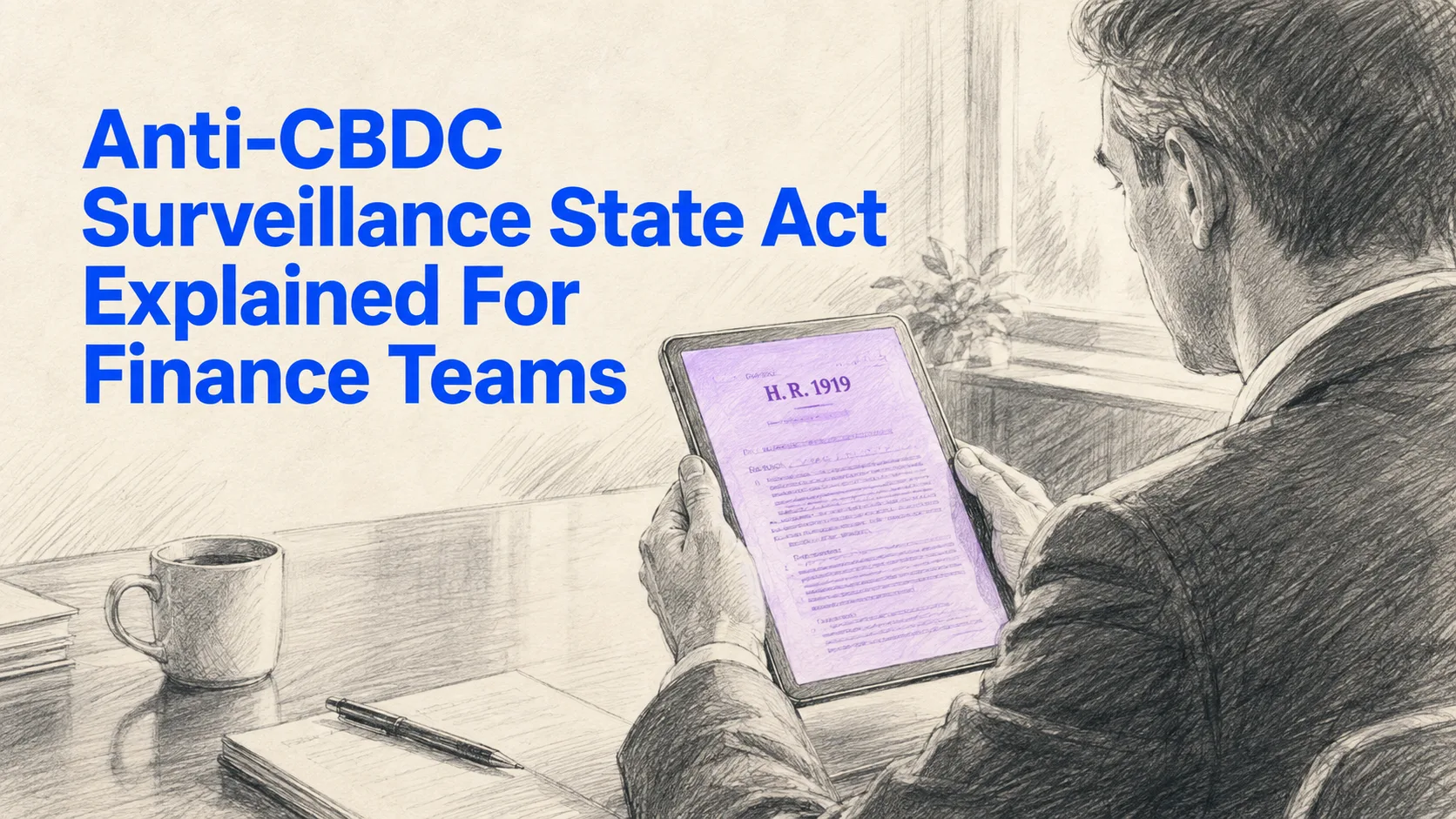
H.R. 1919, the Anti-CBDC Surveillance State Act, passed the U.S. House of Representatives on July 17, 2025, by a vote of 219-210, codifying a statutory prohibition on Federal Reserve-issued retail central bank digital currency. For finance teams, legal counsel, and institutional operators with on-chain exposure, the bill's restrictions on monetary policy use, direct-to-consumer accounts, and foreign CBDC holdings carry immediate operational implications. Stablecoin.nyc tracks the compliance landscape these shifts create for regulated allocators and treasury desks.
Definition: What the Anti-CBDC Surveillance State Act Actually Does
H.R. 1919 amends the Federal Reserve Act to close three separate channels: retail account access at the Fed, monetary-policy transmission through programmable retail money, and U.S. jurisdictional exposure to foreign sovereign digital currency. It is a narrow bill by design, targeting state-issued retail digital money rather than the broader digital asset stack. That precision matters for how institutional operators should read the statute against existing crypto compliance frameworks.
The Core Prohibition
The bill prohibits Federal Reserve banks from offering products or services directly to individual consumers or maintaining accounts on their behalf. It further prohibits the Federal Reserve Board and the Department of Treasury from issuing a CBDC without explicit Congressional authorization, and bars the use of a retail CBDC as a monetary-policy instrument. The last clause is the one commercial banks lobbied hardest to secure, because it forecloses interest-on-CBDC-balances mechanics that would compete with deposits. The bill also reaches persons subject to U.S. jurisdiction, prohibiting them from holding or owning a CBDC issued by a foreign central bank. Coverage of adjacent digital asset policy fundamentals helps frame why each clause was drafted the way it was.
What the Bill Does Not Restrict
H.R. 1919 does not touch existing stablecoin issuance, private digital asset markets, or wholesale interbank settlement research. It does not prohibit tokenized deposits, tokenized money-market funds, or bank-issued digital liabilities operating under existing prudential frameworks. Correspondent banking pilots on distributed ledgers, including the settlement-focused work referenced in Goldman's asset tokenization desk expansion, remain outside the bill's scope. The takeaway: the prohibition is retail, sovereign, and directed at the Fed, not at the private-market digital dollar infrastructure that already exists.
Legislative History and Current Status
The bill has moved on a compressed timeline. Introduction, House passage, and a presidential signing signal all occurred inside a single legislative window in 2025, with committee-level economics work published in parallel. That pace is unusual for financial services legislation and reflects both administration priority and near-uniform commercial banking industry backing.
Sponsor, Cosponsors, and Administration Support
H.R. 1919 was introduced by Majority Whip Tom Emmer (R-MN) with 135 cosponsors in the 119th Congress. The Trump Administration published a Statement of Administration Policy on July 15, 2025, signaling the President's intent to sign the bill in current form. The American Bankers Association issued a support letter on April 2, 2025, citing risks of a retail CBDC to deposit intermediation and lending capacity. That combination, executive branch plus commercial bank lobby, is the same coalition analysts have tracked in adjacent bills such as the stablecoin act's Senate progress.
Key Votes and Senate Pathway
The House vote of 219-210 reflected near-party-line support with limited crossover. The Congressional Budget Office published its cost estimate on June 16, 2025, resolving one procedural prerequisite for Senate consideration. The bill's Senate path remains subject to floor scheduling and to the risk that CBDC provisions get folded into a broader financial services package, an outcome that would extend the timeline and open amendment surface area. For macro-context readers, the more consequential question is not whether H.R. 1919 becomes law but on what vehicle it arrives.
The Privacy and Surveillance Rationale

The bill is framed as a constitutional-liberty statute, not a monetary-policy bill. That framing matters because it shifts the debate from technical central banking questions to civil-liberties territory where opposition is politically costly. The rationale rests on programmable-money concerns and on named international precedents.
Programmatic Money and Spending Controls
Proponents argue that a government-issued CBDC without cash-equivalent privacy protections would allow federal agencies to monitor every transaction, including counterparty, amount, and location. The concern is not theoretical logging but programmable restrictions: expiry dates on stimulus balances, geofenced spending categories, or freeze functions triggered by regulatory action. Emmer's floor remarks positioned this as structural, arguing that state-designed programmable money is incompatible with financial privacy norms. Analysts covering the sovereign-collateral pivot to digital rails have noted the same tension from the collateral side: programmability is either a settlement feature or a surveillance affordance, depending on who holds the keys.
International Precedents Cited in Debate
Emmer's floor remarks specifically cited the Chinese Communist Party's CBDC as a live example of spending surveillance tied to a social-credit apparatus. The 2022 Canadian federal freeze of trucker-protest bank accounts was cited as a democratic-government precedent for financial-system weaponization, a case that resonated with U.S. legislators wary of Executive-branch discretion over payment rails. The ABA's support letter reinforced the concern from the banking side, arguing that a retail CBDC would fundamentally alter the citizen-central bank relationship and concentrate monetary risk inside the Federal Reserve. Comparative data on live pilots is tracked in the global CBDC adoption roadmap.
Operational Implications for Finance Teams

For corporate treasury, digital-asset funds, and fintech legal teams, the bill's operational surface area is narrower than the headline suggests but sharper where it applies. Two areas warrant near-term review: direct treasury custody assumptions and foreign-jurisdiction exposure.
Treasury and Custody Considerations
The prohibition on Federal Reserve consumer accounts removes any hypothetical future scenario where corporate treasury could hold balances directly at the Fed via a digital dollar wallet. Some large-cap treasurers had modeled this as a potential liquidity tool. That path is now foreclosed. The ABA's letter noted that a retail CBDC would have drawn deposits away from commercial banks; the bill's passage stabilizes the commercial bank deposit base as the operative corporate cash-management channel. Legal counsel should review whether any DeFi protocol or fintech partner product could be characterized as providing indirect access to a prohibited instrument, particularly where wrappers or synthetic representations are involved. The SEC's revisited custody rules for digital asset managers provide a parallel framework for how "indirect access" language gets litigated.
Foreign CBDC Exposure and Jurisdictional Scope
The extraterritorial clause is the operational sleeper. Persons subject to U.S. jurisdiction, a category that includes U.S.-domiciled funds, subsidiaries of U.S. parents, and in many interpretations U.S. persons acting abroad, are prohibited from holding or owning a foreign CBDC. Firms with correspondent relationships or clearing exposure in jurisdictions running live CBDC pilots (the Bahamas' Sand Dollar, Nigeria's eNaira, China's e-CNY) will need to determine whether transient holdings, custodial claims, or nostro balances denominated in those instruments trigger the prohibition. The Columbia Law School CLS Blue Sky blog noted on August 11, 2025 that H.R. 1919 and the GENIUS Act stablecoin framework operate in parallel, with the former restricting state-issued digital money and the latter creating a framework for private stablecoins. That parallel-track structure is what finance teams need to internalize.
How H.R. 1919 Interacts With the Broader Stablecoin Regulatory Framework
The bill does not exist in isolation. Its practical effect is a policy choice: state-issued retail digital money is prohibited, and the substitute is a regulated private-stablecoin market operating under federal license.
GENIUS Act Parallel Track
The GENIUS Act, advancing separately in the Senate, would establish a federal licensing and reserve framework for private stablecoin issuers, effectively positioning regulated stablecoins as the U.S. answer to retail digital-dollar functionality. Together, H.R. 1919 and the GENIUS Act define a two-track policy: prohibit state-issued digital money at the retail level while permitting private-sector digital-dollar instruments under a compliance framework. The Columbia Law School analysis argues this dual-track structure leaves open questions about monetary-policy transmission and lender-of-last-resort functions in a stablecoin-dominant environment. Related structural analysis on the decoupling of Treasury-backed on-chain yield helps frame the collateral-side dynamics.
What Fills the CBDC Gap for Institutional Use
Institutional operators should evaluate stablecoin issuers' reserve composition and redemption mechanics as the practical substitute for direct Fed account access that H.R. 1919 forecloses. Wholesale CBDC research, which involves interbank settlement rather than consumer accounts, is not explicitly prohibited by the bill's current text, a distinction relevant for correspondent banking and FX-settlement teams. Reserve quality, redemption cadence, and the underlying dynamics of primary-market tokenized assets become the operative diligence questions. In a two-track regime, the interesting variable is not whether digital dollars exist but who bears the liability and under what redemption promise.
What Finance Teams Should Monitor Next
The bill's disposition is largely political, but the operational preparation is not. Two workstreams should be resourced now, before Senate action clarifies the final text.
Senate Action and Amendment Risk
Amendment risk is real. Finance teams should track whether the foreign-CBDC prohibition is narrowed via de minimis or transient-holding exceptions, and whether the definitions distinguishing "retail" from "wholesale" CBDC are further specified. If those definitions tighten, the perimeter of what counts as prohibited exposure will shift. The ABA's endorsement suggests the commercial-banking lobby will not mount opposition in the Senate; the more consequential variable is whether Senate leadership attaches CBDC provisions to broader financial-services legislation. Analysts have flagged similar procedural risk in the EU MiCA 2.0 pipeline, where umbrella packaging altered the final surface area.
Compliance Preparedness Steps
If signed into law, legal and compliance teams should codify internal policy prohibiting acquisition of foreign CBDC instruments, with clear definitions of what constitutes a sovereign digital currency versus a privately issued stablecoin. Firms with correspondent banking relationships in Bahamas, Nigeria, or Chinese counterparties should assess whether clearing flows involve instruments that would fall under the prohibition. Custody agreements, ISDA-style representations, and prime-brokerage terms may need updated language. Reference material on adjacent compliance and market-structure updates can inform the internal policy draft. The compliance work is dull, but the definitional gaps are where enforcement risk will settle.
Frequently Asked Questions
What does the Anti-CBDC Surveillance State Act prohibit?
H.R. 1919 prohibits Federal Reserve banks from offering retail CBDC products, bars the Fed and Treasury from issuing a CBDC without Congressional authorization, forecloses retail CBDC use in monetary policy, and prohibits U.S.-jurisdiction persons from holding foreign CBDCs.
Did the Anti-CBDC Surveillance State Act pass into law?
Not yet. The House passed H.R. 1919 on July 17, 2025 by a 219-210 vote. The Trump Administration issued a Statement of Administration Policy supporting signature. The bill now sits in the Senate, where floor scheduling and possible amendments remain open variables.
How does H.R. 1919 affect stablecoins?
The bill does not restrict private stablecoin issuance, secondary markets, or existing issuers. It targets state-issued retail digital money only. Private stablecoins are governed separately under the GENIUS Act track, which establishes federal licensing and reserve requirements.
Does the bill ban foreign CBDCs for U.S. companies?
Yes, in current form. Persons subject to U.S. jurisdiction are prohibited from holding or owning a CBDC issued by a foreign central bank. Operational scope covers U.S.-domiciled entities, subsidiaries of U.S. parents, and depending on interpretation, U.S. persons acting abroad.
What is the difference between a CBDC and a stablecoin under this bill?
A CBDC is a direct liability of a central bank issued as sovereign digital money. A stablecoin is a private-sector liability, typically backed by reserve assets. H.R. 1919 targets only the former; private stablecoins remain permitted subject to separate federal legislation.
Why did the American Bankers Association support H.R. 1919?
The ABA argued a retail CBDC would draw deposits from commercial banks into Federal Reserve accounts, weakening bank lending capacity, distorting monetary policy transmission, and concentrating balance-sheet risk at the Fed. The support letter framed prohibition as protecting bank intermediation.
How does the Anti-CBDC Surveillance State Act relate to the GENIUS Act?
The two bills operate as a dual-track policy. H.R. 1919 prohibits state-issued retail digital money. The GENIUS Act creates a licensing and reserve framework for private stablecoin issuers. Together they position regulated private stablecoins as the U.S. digital-dollar answer.
What should corporate treasury teams do in response to H.R. 1919?
Review foreign CBDC exposure in correspondent banking flows, update custody and ISDA language on prohibited instruments, and monitor Senate amendments to retail/wholesale definitions. Direct Fed-account liquidity strategies should be removed from planning models.
Conclusion
H.R. 1919 is narrower than its title suggests and more consequential than its narrowness implies. By foreclosing a retail Fed digital dollar and reaching foreign CBDC holdings, the bill locks in a two-track structure where regulated private stablecoins become the operative digital-dollar rail and sovereign digital money is deliberately absent from the retail stack. For treasury, custody, and legal teams, the near-term work is definitional: what counts as a foreign CBDC, what counts as indirect access, and how correspondent flows are documented. Ongoing coverage at Stablecoin.nyc follows the Senate calendar and the compliance implications as the bill's final text is set.