What Is The Genius Act 2025? Stablecoin Rules Explained
The GENIUS Act, signed into law on July 18, 2025, is the first comprehensive federal regulatory framework for payment stablecoins in the United States. For regulators and policy researchers tracking digital asset governance, the reserve requirements, charter structures, and compliance obligations set a new baseline for how private dollar liabilities move on public ledgers. Stablecoin.nyc tracks this legislation and its implications for issuers, institutions, and allocators sizing exposure to tokenized dollars.
Definition: What the GENIUS Act Is
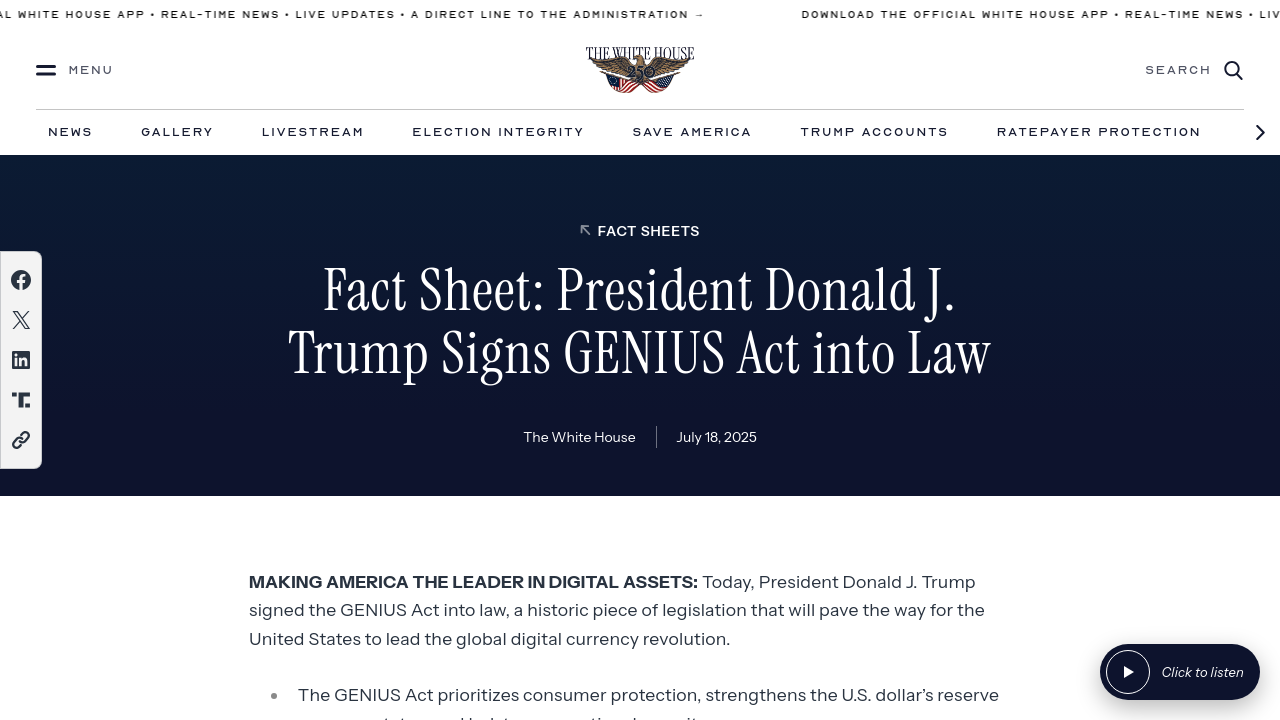
The thesis is narrow and important: Congress has drawn a bright line around payment stablecoins and pulled them out of the securities and commodities perimeter. Everything that follows in the statute flows from that carve-out. For a policy audience, the definition itself is the load-bearing wall of the framework, which we cover in more depth in our stablecoin fundamentals coverage.
The Full Name and Its Meaning
GENIUS stands for Guiding and Establishing National Innovation for U.S. Stablecoins. President Trump signed it as Public Law 119-27 on July 18, 2025, capping a legislative sprint that began earlier that spring. The name is a mouthful, but the framing is deliberate: this is industrial policy for private dollar rails, positioned alongside earlier executive actions on digital collateral and sovereign debt dynamics.
What Counts as a Payment Stablecoin Under the Act
The statute defines a payment stablecoin as a privately issued digital asset that the issuer must redeem for a fixed monetary value. That single mechanical requirement, redeemability at par, is what distinguishes payment stablecoins from securities, commodities, and tokenized deposits. According to the White House fact sheet, issuers are also barred from paying interest or yield to holders, which functionally severs them from deposit-taking institutions and forces a clear separation from the yield-bearing tokenized product set covered in our analysis desk.
Two structural consequences follow. First, payment stablecoins sit outside SEC and CFTC jurisdiction, a "jurisdictional carve-out" that the Oxford Business Law Blog has called the most consequential design choice in the act. Second, tokenized deposits, which inherit FDIC insurance, remain distinct instruments; payment stablecoins do not qualify for that coverage. This split matters for treasurers evaluating counterparty risk across dollar rails, a distinction we explore in macro coverage of tokenized dollars.
Takeaway: The GENIUS Act creates a third category of private dollar liability, redeemable, non-yielding, and non-insured, that fits neither the securities regime nor the deposit regime.
Legislative History: How the GENIUS Act Became Law
The bill moved unusually quickly for financial legislation of this scope. Understanding the vote counts and companion bills matters because the political coalition around GENIUS shapes how implementing rulemaking will be contested. Our running policy coverage tracked the committee negotiations in real time.
Sponsors, Votes, and Timeline
Republican Senator Bill Hagerty introduced the bill as S.1582 on May 21, 2025. The Senate Banking Committee reported it 18-6 on March 13, 2025, and the full Senate passed it 68-30 on June 17, 2025. The House cleared it 308-122 on July 17, 2025, and the President signed it the following day. The bipartisan margins matter: they suggest implementing regulations will face pushback but not wholesale reversal in the near term, a point worth watching for allocators sizing institutional exposure to regulated issuers.
Companion Legislation: The STABLE Act
The House companion bill, the Stablecoin Transparency and Accountability for a Better Ledger Economy Act, shared GENIUS's core goals but diverged on charter details and disclosure cadence. The final law reflects Senate language, with STABLE provisions folded selectively into conference text. Two additional cryptocurrency bills passed the House concurrently and, as of GENIUS's enactment, still awaited Senate action, according to reporting summarized in the Federal Reserve's Richmond Fed overview. The act also delivers on a Trump campaign promise to make the U.S. the "crypto capital of the world," building on earlier executive orders on digital asset leadership and a Strategic Bitcoin Reserve, themes we track in ongoing macro analysis.
Takeaway: GENIUS passed with durable bipartisan support, but the STABLE Act's unadopted provisions and two pending House bills leave meaningful legislative surface area still in play.
Core Rules: Reserve Requirements and Disclosure Obligations

The operational spine of the act is the 1:1 reserve mandate paired with monthly attestation. Policy researchers should read these two provisions together, because the reserve rule without the disclosure regime would be functionally unenforceable. Both are informed by the broader shift toward Treasury-backed collateral we covered in the great decoupling piece.
The 100% Reserve Mandate
Every payment stablecoin issuer must hold high-quality, liquid reserve assets on a 1:1 basis, backed by U.S. dollars, short-term U.S. Treasuries, or equivalents specified by regulators. Rehypothecation is tightly constrained. In an issuer insolvency, the act prioritizes stablecoin holders' claims over all other creditors, providing a statutory backstop that goes beyond ordinary bankruptcy priority. This design links private stablecoin issuance directly to the Treasury market, a dynamic examined in our resources on primary market flows.
Monthly Disclosure and Certification Requirements
Issuers must publish monthly reserve composition reports, and both the CEO and CFO must personally certify those reports. The Richmond Fed notes these attestation practices are modeled on standards already used by regulated financial institutions, which should shorten the ramp for bank-chartered issuers. Issuers are also forbidden from marketing claims that stablecoins are backed by the U.S. government, federally insured, or constitute legal tender, a disclosure discipline that will be tested as marketing scales, as we discussed in analysis of liquidity cycles and de-pegging risk.
Takeaway: The reserve rule creates a mechanical peg; the disclosure regime creates the enforcement surface. Monitor monthly attestations as the primary early-warning signal.
Charter Framework: Who Can Issue Payment Stablecoins
The act creates a tiered charter system rather than a single federal license. This is the provision most likely to shape market structure over the next three to five years, because it determines which incumbents can migrate onto stablecoin rails and on what terms.
Bank vs. Non-Bank Issuer Pathways
Institutions issuing payment stablecoins must be federally or state chartered. Banks must establish a separate subsidiary as the issuer entity, supervised by the bank's primary federal regulator. Non-bank issuers fall under the Office of the Comptroller of the Currency or the appropriate state agency, depending on activity type and size. This mirrors the dual banking system rather than replacing it, and it maps onto the same regulatory geography covered in SEC custody rule analysis.
Size-Based Regulatory Thresholds
Charter options are differentiated by issuer size and complexity, and regulators are required to impose capital, liquidity, and risk management requirements calibrated to each issuer's business model. The act aligns state and federal frameworks explicitly to reduce regulatory arbitrage across jurisdictions, an approach that parallels European work covered in our EU MiCA 2.0 briefing.
The practical result is a two-track market: large bank-affiliated issuers competing on distribution and balance-sheet trust, and specialist non-bank issuers competing on product velocity and integration depth. For policy researchers, the interesting question is how quickly the OCC builds out non-bank supervisory capacity, a question the Stablecoin.nyc partnerships desk has flagged in industry conversations.
Takeaway: Charter tiering, not the reserve rule, will determine which institutions actually issue at scale.
AML, Sanctions, and National Security Provisions

The national security architecture of GENIUS is arguably the most operationally demanding piece of the statute. Compliance costs here will separate serious issuers from opportunistic ones. Our interviews with compliance leads explore the buildout in detail.
- Bank Secrecy Act coverage. All payment stablecoin issuers are explicitly subjected to the BSA, obligating them to establish anti-money laundering and sanctions compliance programs.
- Required BSA elements. Programs must include risk assessments, sanctions list verification, and customer identification programs.
- Freeze, seize, and burn. Every issuer must possess the technical capability to seize, freeze, or burn payment stablecoins when legally required and must comply with lawful orders to do so.
- Treasury coordination. The act enhances Treasury's enforcement capacity against sanctions evasion and money laundering through issuer registration and cross-agency coordination.
- Consumer redress gap. New York Attorney General Letitia James and other prosecutors have argued the act lacks provisions requiring issuers to return stolen funds to fraud victims, a gap that could hinder law enforcement.
The freeze-and-burn requirement is worth flagging for architects. It presumes issuer control over token supply at the contract level, which pushes issuers toward permissioned or upgradable token designs and away from immutable contracts. That trade-off is a live design question in work-with-us conversations we track with builders.
Takeaway: Compliance capability, especially the technical freeze/burn stack, is a hard licensing prerequisite, not a soft expectation.
Criticisms and Ongoing Policy Debates
Signing day is not the end of the debate. Policy researchers should treat GENIUS as a framework whose implementing rules will absorb most of the contested terrain over the next 18 to 24 months. The Federal Register published initial implementation guidance on September 19, 2025, formally opening the rulemaking window, which we track alongside broader liquidity commentary.
Consumer Protection Gaps
Consumer Reports has argued the act does not provide sufficient consumer protection and permits large technology companies to engage in bank-like activities without equivalent regulatory burdens. Brookings Institution analysis notes GENIUS-regulated stablecoins are neither bank deposits nor federally insured, and issuers lack direct Federal Reserve access. That places them in a distinct regulatory category from both capital-market instruments and traditional banking products, a distinction with real implications for allocators comparing ETF-shaped and tokenized products.
Parallels to Free Banking Era
Economists Max Harris and Kenneth Rogoff have drawn parallels between the GENIUS regulatory environment and the 1837-1862 free banking era, citing the risks of fragmented private issuance backed by government paper. The historical parallel is imperfect, since GENIUS mandates federal supervision and uniform reserve standards that antebellum state charters lacked, but the caution about proliferation risk deserves engagement rather than dismissal, as discussed in our macro reserves coverage.
On the other side of the ledger, the dollar-backing requirement is expected to drive incremental demand for U.S. Treasuries, which the White House argues reinforces the dollar's global reserve currency status. Whether that demand meaningfully changes the marginal buyer profile at short-end auctions is an empirical question worth tracking through 2026, one we revisit in ongoing CBDC and reserve coverage.
Takeaway: The unresolved debates, consumer redress, big-tech issuance, and free-banking-style fragmentation, will shape implementing rules more than the statute itself.
Frequently Asked Questions
What does GENIUS stand for in the GENIUS Act?
GENIUS stands for Guiding and Establishing National Innovation for U.S. Stablecoins. The full title reflects the act's dual framing as both a consumer protection statute and an industrial policy instrument aimed at U.S. leadership in digital payment infrastructure.
When was the GENIUS Act signed into law?
President Donald Trump signed the GENIUS Act into law on July 18, 2025, as Public Law 119-27. The Senate had passed it 68-30 on June 17, 2025, and the House cleared it 308-122 the day before the signing.
What assets can stablecoin issuers hold as reserves under the GENIUS Act?
Issuers must hold high-quality, liquid reserve assets backed 1:1, primarily U.S. dollars and short-term U.S. Treasuries. The statute prohibits significant rehypothecation and requires monthly public disclosure of the exact reserve composition, certified by the issuer's CEO and CFO.
Do payment stablecoins under the GENIUS Act have FDIC insurance?
No. Payment stablecoins are not classified as bank deposits and do not qualify for FDIC insurance. Tokenized deposits, which the act treats as a distinct instrument, do inherit deposit insurance, a difference material to counterparty risk analysis for institutional holders.
Can stablecoin issuers pay interest to holders under the GENIUS Act?
No. The act explicitly prohibits payment stablecoin issuers from paying interest or yield to holders. This restriction is what functionally distinguishes payment stablecoins from deposit-taking institutions and from yield-bearing tokenized products regulated under separate authorities.
Who regulates non-bank stablecoin issuers under the GENIUS Act?
Non-bank issuers are supervised by the Office of the Comptroller of the Currency or an appropriate state regulatory agency, depending on the issuer's activity profile and size. Bank-affiliated issuers remain under their bank's primary federal regulator through a required subsidiary structure.
How does the GENIUS Act address money laundering and sanctions compliance?
The act explicitly subjects issuers to the Bank Secrecy Act, requiring formal AML programs, sanctions list verification, and customer identification. Issuers must also have the technical capability to seize, freeze, or burn stablecoins in response to lawful orders from U.S. authorities.
What is the difference between a payment stablecoin and a tokenized deposit under the GENIUS Act?
A payment stablecoin is a privately issued redeemable digital dollar that pays no yield and lacks FDIC coverage. A tokenized deposit is a digital representation of an existing bank deposit that can pay interest and inherits deposit insurance under existing banking authority.
Conclusion
The GENIUS Act is best read as a category-defining statute rather than a comprehensive rulebook. It draws hard lines around what a payment stablecoin is, mandates full reserve backing, imposes bank-grade disclosure, and installs a national security compliance floor, while deliberately leaving charter mechanics, capital calibration, and consumer redress to implementing regulators. For policy researchers and allocators, the next 18 months of rulemaking will determine whether the framework produces a concentrated bank-led market, a competitive non-bank tier, or something in between. Stablecoin.nyc will continue publishing structured analysis, primary-source tracking, and issuer-level data as the implementation phase unfolds.