Some links on this page are referral links. They never affect our verdicts.
TL;DR
Choose Ledger if you want the widest asset and app support, Bluetooth and NFC for phone use, and the best value touchscreen in the Nano Gen5 at $179. Choose Trezor if you want fully open-source firmware you or researchers can verify, with the Safe 5 at $169 as the sweet spot. Both keep keys on a secure chip and both are safe at the device level; the deciding question is ecosystem versus verifiable code.
How Ledger and Trezor differ
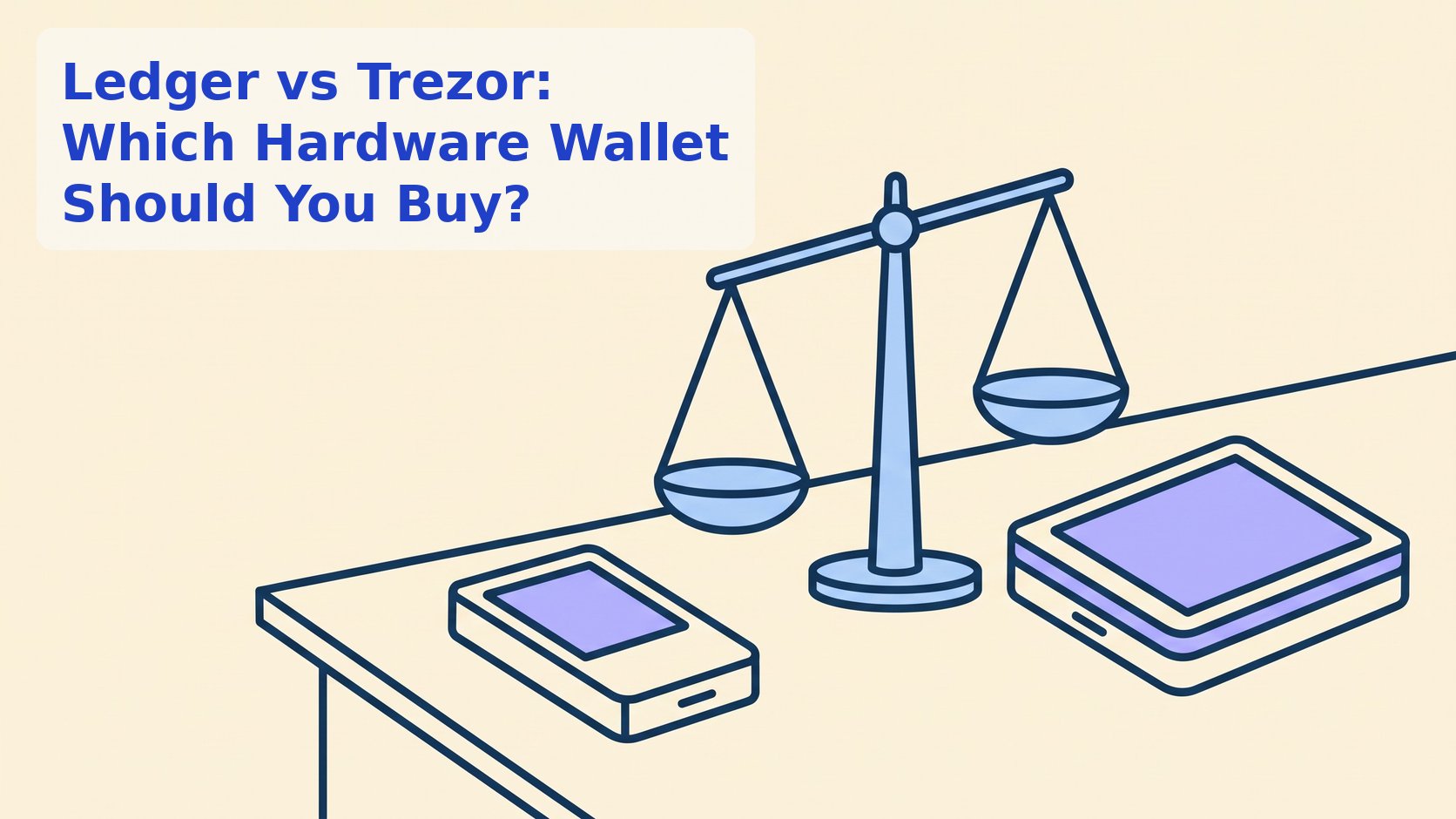
Ledger and Trezor are the two largest hardware wallet makers, and both do the same core job: generate and store your private keys offline and sign transactions on the device, so malware on your computer cannot steal your crypto.
Trezor, from the Czech company SatoshiLabs, built the first consumer hardware wallet in 2014 and has kept its firmware open source from the start. Ledger, a French company founded in 2014, built its business around a certified secure element chip running closed firmware, and now sells the broadest range of devices and app integrations.
The structural difference that drives everything else: Trezor optimizes for transparency, Ledger optimizes for ecosystem.
The difference that actually matters
Open source versus closed secure element. Trezor publishes its firmware, so independent researchers can audit exactly what the device does. Ledger's operating system on the secure element is closed source; you rely on Ledger's audits, certifications, and track record.
For years, that came with a trade-off in the other direction. Older Trezor models, such as the Model One and Model T, had no secure element, and researchers showed that someone with physical access and specialist equipment could extract the seed from them. Ledger's secure element was the answer to that attack. Trezor closed the gap: the Safe 3, Safe 5, and Safe 7 all include a secure element, and the Safe 7 uses an auditable chip, combining open firmware with physical protection.
Ledger's credibility hit came from a different direction. In 2023, Ledger Recover, an optional paid backup service, showed that Ledger firmware can export key material when the user authorizes it. It is opt-in, but it broke the belief that keys could never leave the device. Users who object on principle tend to choose Trezor.
Quick comparison table
| Criteria | Ledger | Trezor |
|---|---|---|
| Current models and prices | Nano S Plus $79, Nano X $149, Nano Gen5 $179, Flex $249, Stax $399 | Safe 3 from about $59, Safe 5 $169, Safe 7 $249 |
| Best value model | Nano Gen5 ($179) | Safe 5 ($169) |
| Firmware | Closed secure element OS; app layer partly open | Fully open source |
| Secure element | Yes, all models | Yes on Safe 3, 5, 7; not on older Model One and Model T |
| Connectivity | USB-C on all; Bluetooth on Nano X, Gen5, Flex, Stax; NFC on Gen5, Flex, Stax | USB-C; Bluetooth on Safe 7 |
| Companion app | Ledger Wallet (formerly Ledger Live) | Trezor Suite |
| Asset and app support | Broader, including more third-party wallet integrations | Strong on major assets; some networks arrive later |
| Backup options | 24-word phrase; optional paid Ledger Recover; Recovery Key card | Standard phrase or Shamir multi-share backup |
| Company incidents | 2020 customer data leak; 2023 Connect Kit library attack | 2024 support portal breach exposing customer contact details |
Prices are manufacturer list prices checked in October 2026. Both brands run frequent promotions.
Feature and capability comparison
Security model. Both store keys in a secure element on current models and require physical confirmation for every transaction. Neither has had its current devices hacked remotely in normal use. Trezor's edge is verifiability; Ledger's is a longer track record with secure elements across its whole line.
Screens and transaction clarity. Ledger's Nano Gen5, Flex, and Stax support Clear Signing, which shows what a transaction does in readable form. Trezor's Safe 5 and Safe 7 have color touchscreens. Budget models on both sides use small screens and buttons that show less detail.
Mobile use. Ledger leads here, with Bluetooth on most models and NFC on the newest. Trezor added Bluetooth only with the Safe 7.
Assets and DeFi. Ledger generally supports more coins, tokens, and third-party wallets out of the box, which matters for active DeFi and multi-chain users. Both support Bitcoin, Ethereum, Solana, and major stablecoins such as USDC and USDT.
Backups. Trezor's Shamir backup splits your recovery into several shares, so no single piece of paper can drain your wallet. Ledger offers a Recovery Key card and the optional Ledger Recover subscription.
Pros and cons
Ledger pros: broadest asset and app support; Bluetooth and NFC; Clear Signing at $179 on the Nano Gen5; secure element across the whole range. Ledger cons: closed-source secure element firmware; Ledger Recover controversy; 2020 data leak fuelled long-running phishing.
Trezor pros: fully open-source firmware; Shamir backup; strong value with the Safe 3 and Safe 5. Trezor cons: older models without a secure element are vulnerable to physical attacks; fewer wireless options; some networks and integrations lag Ledger.
Which should you choose?
Choose Ledger if you hold many assets across chains, use DeFi or mobile wallets often, or want the best value touchscreen with Clear Signing.
Choose Trezor if open-source code matters to you, you mainly hold Bitcoin and major assets, or you want Shamir backup.
Either way, buy only from the official store, set the device up yourself, and never enter your recovery phrase anywhere online. For the full field, including Keystone and Tangem, see our guide to the best cold wallets and our full Ledger wallet review.
FAQs
Is Ledger or Trezor more secure?
Both are secure at the device level on current models, with secure elements and physical confirmation. Trezor's firmware is open source and verifiable; Ledger's secure element firmware is closed. Your habits, especially protecting the recovery phrase, matter more than the brand.
Can I use both Ledger and Trezor?
Yes. Many holders split funds across both brands, or use them together in a multisig wallet so no single device or company is a point of failure.
Which is cheaper, Ledger or Trezor?
Trezor's Safe 3 is the cheapest current model at about $59. At the mid-range, prices are close: Trezor Safe 5 at $169 and Ledger Nano Gen5 at $179. Both top models cost $249, with Ledger's Stax higher at $399.
Do Ledger and Trezor support USDC and USDT?
Yes. Both support USDC and USDT on major networks including Ethereum. Always send to the address for the matching network to avoid losing funds.
Which is better for beginners?
Ledger's Nano Gen5 is easier for most beginners thanks to its touchscreen, Clear Signing, and mobile connectivity. Trezor's Safe 5 is equally approachable for desktop users who prefer open-source software.
Last updated: October 26, 2026.