
On-ramps convert fiat into crypto or stablecoins; off-ramps convert them back into fiat. For US users the right provider is a function of payment rail, fees, off-ramp support and compliance, and on those terms Coinbase, Transak, Ramp Network, MoonPay and Beam fit the market, with Stripe serving builders. Six providers are reviewed against one fixed set of criteria. See also the best crypto on-ramp platforms page for related reading.
How We Ranked These On-Ramp and Off-Ramp Platforms

A ramp is only as good as its exit. Most rankings score global country counts; a US treasurer or allocator needs a dollar path in and a dollar path out. Every provider below was judged on the same five criteria:
- US availability. Can a US user or business actually use it?
- Off-ramp support. Does it return dollars to a bank account or debit card, or only sell crypto in?
- Payment rails. ACH, wire, card, Apple Pay. Rail choice drives both cost and settlement finality.
- Fee transparency. Is the quoted fee the full cost, or is part of it buried in the spread?
- KYC and compliance. Is the provider permitted to operate in your region, with KYC and AML policies in place?
Takeaway: weight criterion 2 heavily. An on-ramp without a matching off-ramp is a one-way door.
Quick Summary of the Picks
- Coinbase: US exchange acting as both on- and off-ramp. Best Overall for US users
- Transak: bank transfer and debit ramp in both directions. Best for Bank Transfer
- Ramp Network: buy, sell and swap with Apple Pay. Best Non-Custodial
- MoonPay: broad consumer reach across cards and wallets. Best for Global Reach
- Beam: stablecoin cash-out to USD. Best for USDC Off-Ramp
- Stripe: embeddable onramp at checkout. Best for Builders
On-Ramp and Off-Ramp Platforms at a Glance
The figures below are drawn from vendor pages or a cited third-party comparison. Where a price could not be confirmed that way, the cell reads See vendor.
| Rank | Tool | On-ramp/Off-ramp | US fit | Rails or fees | Best for |
|---|---|---|---|---|---|
| 1 | Coinbase | Both | US exchange | See vendor | Users who want one regulated venue |
| 2 | Transak | Both | Ramp options listed for US USDC users | Bank transfer, debit; See vendor | Wallet users moving USDC |
| 3 | Ramp Network | On, off, swap | Ramp options listed for US USDC users | Apple Pay, bank transfer; See vendor | Non-custodial wallet holders |
| 4 | MoonPay | Both | Global, includes US | Cards, Apple Pay, bank transfer; See vendor | Consumer apps needing reach |
| 5 | Beam | Off-ramp | Ramp options listed for US USDC users | 1% on stablecoins | Cashing USDC out to USD |
| 6 | Stripe | On-ramp | US-based platform | See vendor | Businesses embedding checkout |
Takeaway: the column that separates these providers is not price. It is direction.
1. Coinbase: Exchange-Based Fiat Ramp
Coinbase is the default US answer because it is a full venue on both sides of the trade. Coinbase describes fiat on-ramps as services that exchange currencies like US dollars for cryptocurrencies, and off-ramps as the reverse, giving users assurance they can exit at any time.
Key features
- Buy and sell in USD inside one account
- Fiat funding and withdrawal through bank rails
- Wide asset coverage as a trading platform
Pricing: See vendor.
Who it suits: individuals and small treasuries that want one counterparty for entry, custody and exit.
Caveat: it is a full exchange, not a lightweight ramp. If you hold assets in a self-custodied wallet, routing through an exchange adds a transfer step in each direction.
2. Transak: Bank Transfer and Debit Ramp
Transak is a two-way ramp that plugs into wallets rather than asking users to open an exchange account. Altcoinbuzz lists it among US USDC ramp options, comparing quotes on Ethereum and Avalanche and noting off-ramp delivery by bank transfer or debit.
In that comparison, $100 bought $94.19 USDC on Ethereum via bank transfer, while selling $100 USDC returned $93.40 via debit card. Those are point-in-time quotes inclusive of network and processing fees, not a rate card.
Pricing: See vendor.
Who it suits: wallet users who want to move between USD and USDC without an exchange account.
Caveat: the round-trip cost on a $100 ticket was material in that sample, so small, frequent conversions erode quickly.
3. Ramp Network: Apple Pay and Bank Transfer
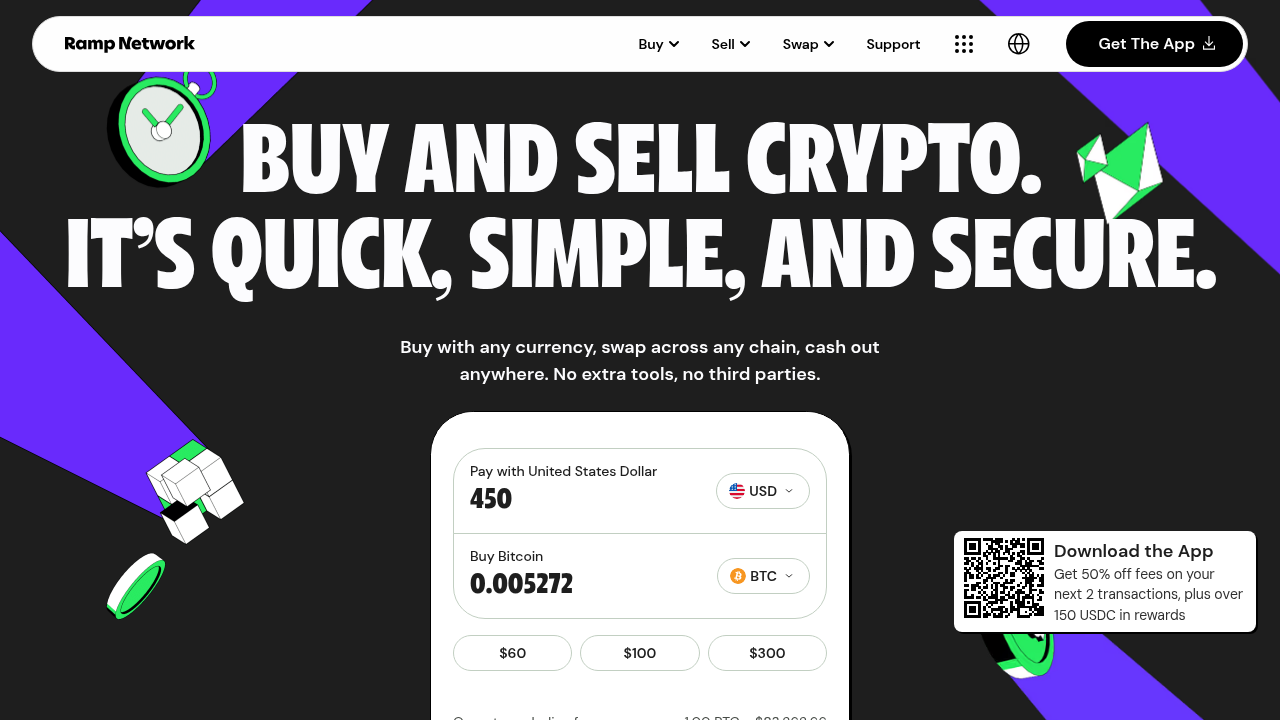
Ramp Network positions itself around three functions: onramp, offramp and swap. Its site describes buying with any currency, swapping across chains and cashing out, alongside a non-custodial wallet app. Treat those as vendor claims.
The Altcoinbuzz comparison offers an outside data point. On Ethereum, $100 bought $93.70 USDC via Apple Pay, while selling $100 USDC returned $98.10 via bank transfer. On Avalanche the buy improved to $96.10 and the sell held near $98.09.
The pattern is instructive: the card-like rail cost more on entry, the bank rail cost less on exit, and chain choice moved the on-ramp number more than the off-ramp number.
Pricing: See vendor.
Who it suits: self-custody users who want buy, sell and swap from one interface.
Caveat: headline fees vary by rail and chain, so a single quoted percentage understates the spread across scenarios.
4. MoonPay: Broad Consumer Reach

MoonPay is built for distribution. SeamlessChex lists it as covering 160+ countries and supporting cards plus Apple and Google Pay; Altcoinbuzz also quotes an off-ramp for MoonPay in its comparison.
Altcoinbuzz quoted $100 via debit card buying $93.14 USDC on Ethereum and $96.06 on Polygon, with $100 USDC selling for $95.01 on both chains.
Pricing: See vendor.
Who it suits: consumer apps and users who value payment-method breadth over the lowest cost.
Caveat: card payments cost more than bank transfers. Card transactions can be reversed and crypto cannot, so the provider prices in chargeback risk.
5. Beam: USDC Cash-Out to USD
Beam is a narrow tool, which is the point. Altcoinbuzz describes it as converting stablecoins into USD sent to a bank account or debit card, at 1% on stablecoins.
Worked example: assume a $10,000 USDC position. At 1%, the stated fee is $100, leaving $9,900 before any network cost to move USDC into the service. Compare that with the $100 samples above, where round-trip friction ran several dollars per $100 on some providers.
Who it suits: holders who already have USDC and need dollars in a US account.
Caveat: it is an off-ramp. You still need a separate on-ramp to acquire the stablecoins.
6. Stripe: Embedded Onramp for Businesses
Stripe is not a destination for individual buyers. Stripe documents a fiat-to-crypto onramp that lets a platform's customers purchase and exchange cryptocurrencies directly at checkout.
This is the hot-start model of ramp distribution: instead of sending users to a third-party venue, the platform inherits Stripe's existing payments relationship and KYC flow. For product teams, the conversion question shifts from "which exchange" to "which embedded provider."
Pricing: See vendor.
Who it suits: wallets, marketplaces and fintechs embedding crypto purchase flows.
Caveat: it is a builder tool. End users cannot simply sign up and cash out.
How to Choose an On-Ramp or Off-Ramp

Start from the exit, not the entry. Decide where dollars need to land, then work backward to the rail and the provider. The three checks below map directly to the ranking criteria.
Match rail to size
Cards and Apple Pay are fast and costly because the provider absorbs reversal risk. Bank transfers are slower and usually cheaper. For larger tickets, ACH or wire economics dominate; for a first $100, convenience may be worth the premium.
Check off-ramp and KYC
Confirm the provider can return USD to your bank or card, and that it is permitted to operate in your state with KYC and AML controls in place. A missing off-ramp turns a liquidity position into a stranded one.
Compare spread, not only fee
The quoted fee is rarely the full cost. Compare the dollar amount delivered against the amount sent, as the $100 samples above do. That net figure absorbs fees, network costs and spread in one number.
Takeaway: the cheapest provider on paper is often not the cheapest round trip.
FAQ: Frequently Asked Questions

What is an on-ramp and off-ramp in crypto?
An on-ramp converts fiat into crypto or stablecoins; an off-ramp converts them back to fiat using bank accounts, cards or digital wallets, according to Mastercard. See on-ramps and off-ramps explained.
What is the difference between an on-ramp and an exchange?
An on-ramp is a fiat-to-crypto doorway, often embedded in a wallet or app. An exchange is a full trading marketplace with order books and custody. They overlap, and Coinbase functions as both.
How do I get my money out of onchain?
Use an off-ramp. Send stablecoins or crypto to a provider such as Beam, Transak, Ramp Network or Coinbase, sell for USD, and receive funds by bank transfer or debit card after KYC.
Is an on-ramp safe to use?
Safety depends on the provider. Check that it is licensed or permitted to operate in your region, runs KYC and AML policies, and has an established operating history before sending funds.
Why do cards cost more than bank transfers?
Card payments can be reversed through chargebacks, while crypto transfers cannot. Providers price that fraud and reversal risk into card transactions, so bank rails like ACH typically deliver more crypto per dollar.
Do I need KYC to use an on-ramp?
Generally yes for regulated providers. Identity verification is part of the standard purchase flow, because ramps connect to banks and card networks that require customer identification and anti-money-laundering controls.
Can businesses embed an on-ramp?
Yes. Stripe documents an embeddable fiat-to-crypto onramp that lets a platform's customers buy cryptocurrency directly at checkout, so users never leave the product to acquire assets.
Conclusion: The Exit Is the Product

The US ramp market is converging on stablecoins as the settlement layer, and the differentiation is moving to the edges: which rail, which chain, which direction. Coinbase wins on breadth, Beam on a clean USDC exit, Stripe on distribution. The open question for treasurers is whether embedded ramps compress spreads enough that standalone ramps become a commodity, or whether off-ramp access remains the scarce asset.