What Is World Liberty Financial? USD1 Stablecoin Explained
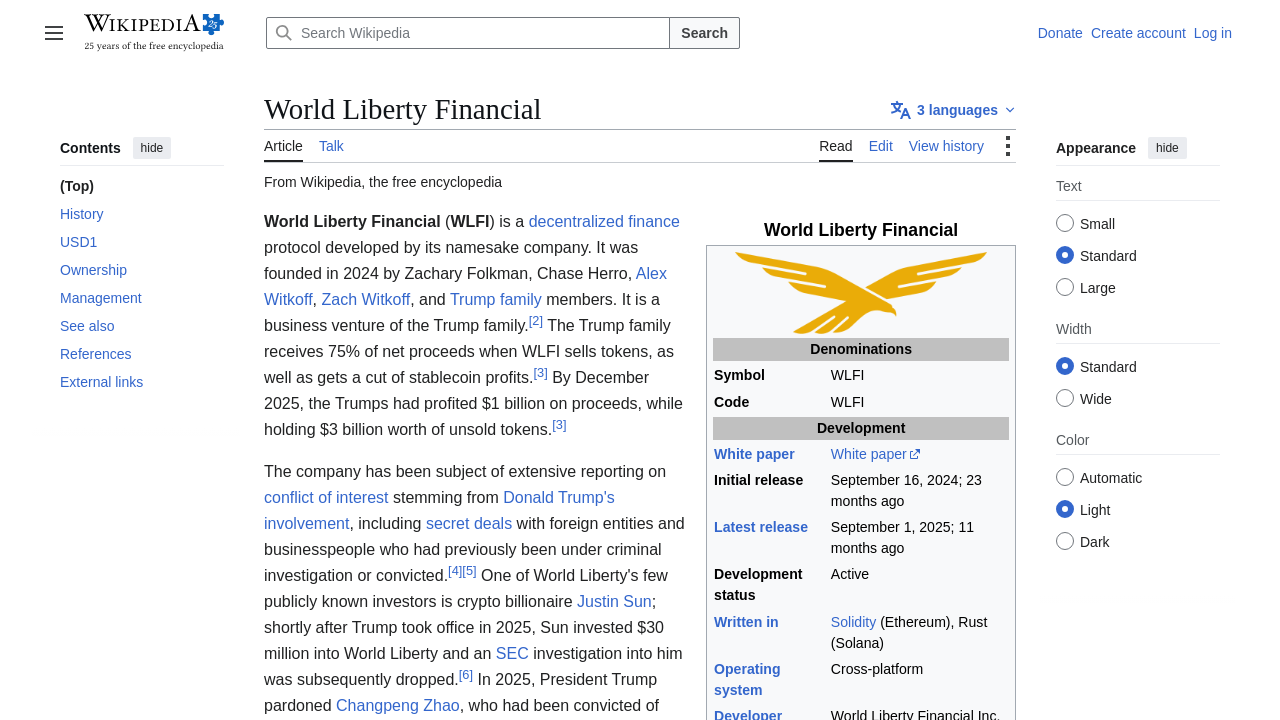
World Liberty Financial (WLFI) is a decentralized finance protocol launched in 2024 as a business venture of the Trump family, aiming to bridge traditional banking with blockchain-based financial services. Its flagship product, USD1, is a dollar-pegged stablecoin backed by U.S. Treasuries and cash equivalents. For anyone tracking the stablecoin landscape, Stablecoin.nyc offers context on how WLFI fits into the broader market of fiat-referenced digital dollars.
Definition: What Is World Liberty Financial?
World Liberty Financial is a multi-chain DeFi protocol operated by World Liberty Financial Inc. It ships two distinct on-chain instruments: WLFI, the governance token, and USD1, a fully reserved dollar stablecoin. The protocol positions itself at the intersection of traditional finance and public blockchains, targeting both institutional settlement and retail lending flows. This dual product design mirrors a pattern our stablecoin fundamentals coverage has tracked across newer issuers.
Origins and Founding Team
WLFI was founded in 2024 by Zachary Folkman, Chase Herro, Alex Witkoff, Zach Witkoff, and members of the Trump family. The protocol is written in Solidity on Ethereum and Rust on Solana, with additional deployment on BNB Smart Chain, giving it a cross-ecosystem footprint from launch rather than the single-chain start most stablecoin issuers begin with. That multi-chain design is a deliberate liquidity choice, and one that our analysis desk has flagged as increasingly standard for post-2024 issuers.
The WLFI Token
Total WLFI supply is capped at 100 billion tokens, with roughly 24.67 billion in circulation as of September 2025 per Wikipedia's protocol page. The Trump family receives 75% of net proceeds from WLFI token sales plus a share of stablecoin profits. By December 2025, Trump-affiliated entities had booked roughly $1 billion in token-sale profits while holding an estimated $3 billion in unsold WLFI, a distribution schedule readers of our institutional coverage will recognize as unusually concentrated for a self-described DeFi protocol.
Takeaway: WLFI is not a community-launched token. Ownership economics sit with a small founding group, and that shapes every downstream governance claim.
How World Liberty Financial Works
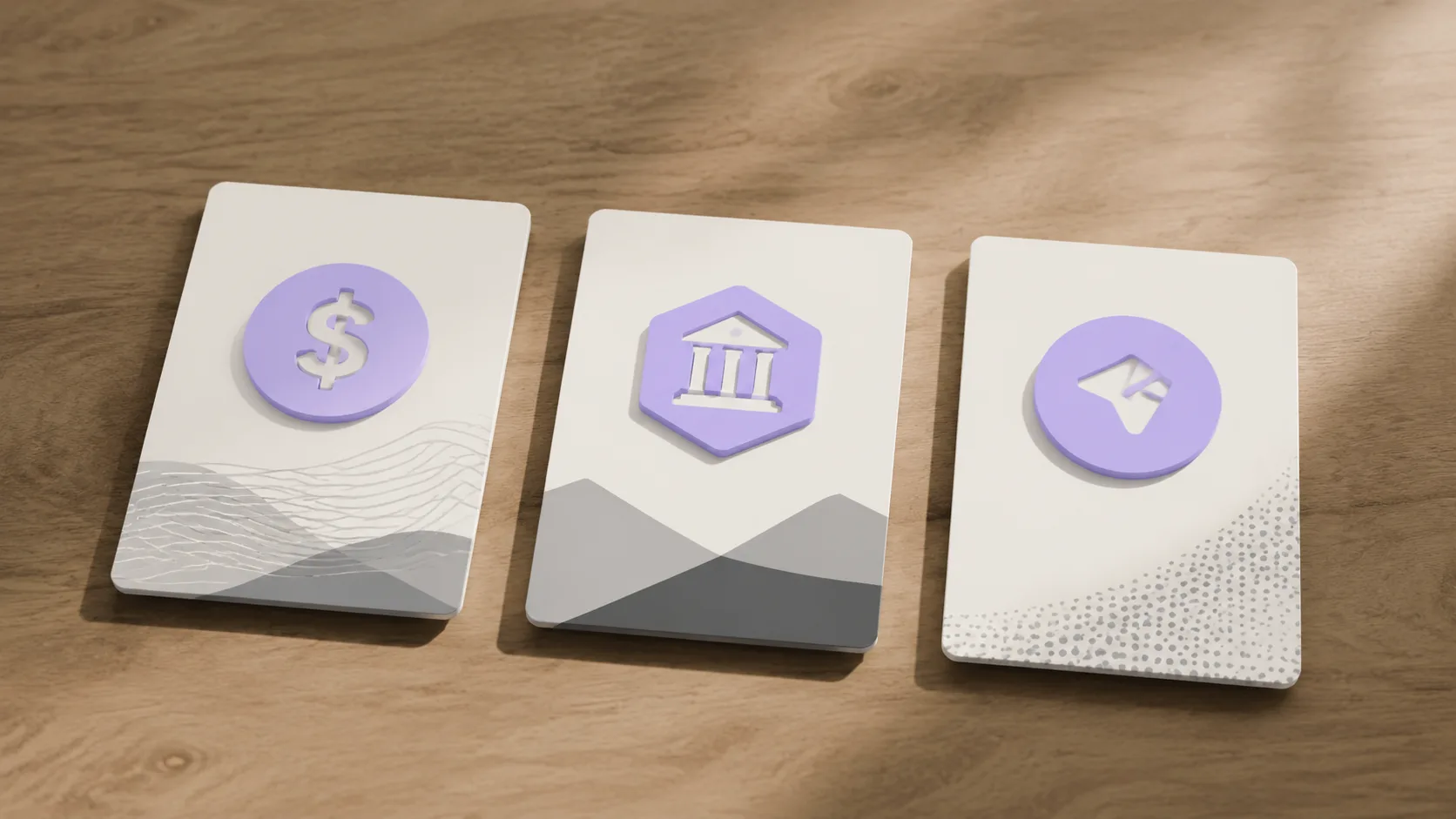
The protocol stack has three externally facing products plus a governance layer. Each product targets a distinct customer: USD1 for holders, WLFI Markets for on-chain credit, and AgentPay for programmatic payments. The broader macro context around dollar-denominated on-chain settlement helps explain why these three surfaces were prioritized in that order.
Core Products: USD1, WLFI Markets, and AgentPay
- USD1 is the dollar stablecoin, backed by short-term U.S. Treasuries, cash, and cash equivalents. It is the revenue engine of the protocol.
- WLFI Markets is a lending and borrowing venue powered by Dolomite. Users supply assets for potential rewards or borrow against collateral, similar in shape to established money markets covered in our work on yield stalling.
- AgentPay SDK targets an emerging category: AI agents that hold funds, pay counterparties, and move value across chains. It ships with per-transaction limits, daily and weekly caps, and a manual-approval threshold, closer to a treasury policy engine than a wallet.
Governance and Token Holder Voting
WLFI holders propose, review, and vote on protocol decisions. In August 2026, USD1 was announced as natively issued on Canton Network, a permissioned chain built for institutional finance with privacy and compliance controls at the base layer. That decision, and the accompanying tokenization market dynamics, extend USD1's reach beyond public L1s into settlement rails used by regulated counterparties.
Takeaway: WLFI's three products map cleanly onto three revenue models: reserve yield (USD1), spread income (Markets), and metered transaction volume (AgentPay).
USD1 Stablecoin: Design, Backing, and Use Cases
USD1 is the piece most treasurers and allocators care about. It is pegged 1:1 to the U.S. dollar and structured to look, on paper, like a standard fully reserved stablecoin. The commercial question is where USD1 sits on the Treasury-backed yield spectrum that has redefined what a dollar token can pay out.
What Backs USD1?
Reserves consist of short-duration U.S. Treasuries, cash deposits, and cash equivalents. The model follows the pattern set by other fully reserved stablecoins, with attestation and transparency layered on top. In 2025, a firm associated with the Abu Dhabi government purchased $2 billion of USD1, one of the largest single stablecoin transactions on record according to Wikipedia. That single trade materially changed USD1's float and shifted its distribution profile, a dynamic our readers know from the de-pegging paradox.
Where USD1 Is Used
USD1 is available on Ethereum, BNB Smart Chain, Solana, and Canton Network, with more integrations ongoing. Its usage surfaces across:
- Cross-chain payment routes via the WLFI bridge
- Real-world asset (RWA) vaults, including a USD1 vault launched with Concrete
- Perpetuals trading pairs on venues such as Aster DEX
- Institutional settlement flows on Canton Network
Binance ran a rewards campaign in August 2026 offering up to 5.8% estimated boosted yield (variable) on USD1 holdings, according to Binance's announcement. Distinguishing between yield on the underlying reserves and campaign-based rewards is a distinction we cover in our custody rules coverage.
Takeaway: USD1's design is conventional; its distribution deals are not. The interesting variable is who buys the float, not what backs it.
Political Connections and Controversies

Any research brief on WLFI has to address the political overlay. The protocol is inseparable from its ownership structure, and material regulatory decisions have moved alongside private commercial transactions. Readers tracking policy risk should compare this to the Stablecoin Act's Senate path to see how far the federal framework has and has not moved.
Conflicts of Interest and Foreign Deals
Crypto billionaire Justin Sun invested at least $75 million in WLFI tokens and was named a platform advisor. Shortly after Trump took office in 2025, an SEC investigation into Sun's companies was dropped, according to Wikipedia. Separately, an Abu Dhabi-linked firm secretly acquired a 49% stake in World Liberty Financial for approximately $500 million; the Trump administration subsequently approved a plan to route hundreds of thousands of advanced computer chips to that UAE firm despite national security concerns. Legal experts cited by Wikipedia have described the UAE transaction as a potential violation of the emoluments clause of the U.S. Constitution, and our macro desk has written about similar sovereign-adjacent flows in digital collateral.
Regulatory and Legal Scrutiny
President Trump pardoned Changpeng Zhao, who had been convicted of anti-money-laundering compliance failures, after Binance had helped enrich World Liberty Financial, according to Wikipedia. In August 2026, the Office of the Comptroller of the Currency granted preliminary conditional approval for WLFI to operate as a trust bank, as reported by the Wall Street Journal. That charter approval, if finalized, changes WLFI's regulatory perimeter and is worth reading alongside our note on sovereign debt and digital collateral.
Takeaway: The political footprint is the story, not a footnote. Every operational milestone for WLFI has an accompanying policy action. Treat them as one dataset.
Common Misconceptions About World Liberty Financial
Because WLFI sits at the intersection of a political brand and a DeFi protocol, coverage tends to conflate categories. Three misconceptions are worth clearing up before allocating capital or building on top of USD1. For a taxonomy of the underlying distinctions, our fundamentals hub is the reference point.
Misconception: WLFI Is a Registered Security / Reality: Its Legal Status Remains Contested
WLFI tokens are governance tokens, not equity. Holders vote on protocol decisions but do not hold ownership stakes in World Liberty Financial Inc. The token's legal classification remains contested and jurisdiction-dependent, and our interview series has covered how counsel treats similar cases.
Misconception: USD1 Is the Same as WLFI / Reality: They Are Separate Instruments
USD1 is the stablecoin product; WLFI is the governance token. They serve entirely different functions and carry entirely different risk profiles. USD1 tracks reserve quality and redemption plumbing. WLFI tracks token supply schedule, revenue capture, and governance participation. Confusing the two produces confusing portfolio decisions, a point our analysis category has reinforced.
Misconception: The Platform Is Fully Decentralized / Reality: Governance Has Centralized Elements
The Trump family's 75% revenue share and effective majority ownership introduce meaningful centralized control. USD1 is not issued by a U.S. bank and is not FDIC-insured; it carries the counterparty and reserve risks common to privately issued stablecoins. WLFI's market price has declined significantly since becoming publicly traded, illustrating that governance token value is distinct from stablecoin peg stability. Readers evaluating on-chain credit exposures should revisit arbitrage loops in AMMs to see how these risks compound across venues.
Takeaway: WLFI and USD1 are two products with two very different underwriting questions. Underwrite them separately.
How to Get Started With USD1 and WLFI
The mechanics of accessing either token are straightforward, but the sequencing matters. Start with the stablecoin if the goal is payment or settlement; start with the governance token only if the goal is exposure to protocol revenue capture. For readers who want the broader tooling map, our resources page collects the primary references.
Acquiring USD1
USD1 can be obtained through the World Liberty Financial platform via conversion from other cryptocurrencies or by bridging from supported networks. It is listed on major venues and available cross-chain via the WLFI bridge across Ethereum, BNB Smart Chain, Solana, and Canton Network. Comparisons with other Treasury-backed stablecoin flows, including spot ETF volumes, give a sense of relative distribution scale.
Participating in WLFI Governance and Markets
WLFI tokens became tradable following a community governance vote and are listed on major exchanges including Binance, with a live price tracked on CoinMarketCap. Holders can:
- Supply assets to WLFI Markets (powered by Dolomite) to earn potential rewards
- Borrow against crypto collateral at variable rates
- Vote in protocol governance proposals via the WLFI forum
- Bridge USD1 and WLFI between integrated networks
The WLFI App, currently listed as coming soon, is intended to let users spend crypto via wallet or bank account by accessing on-demand liquidity. Builders exploring integrations can also read our partnerships page for context on how issuers work with distribution partners.
Takeaway: Access is not the constraint. The constraint is deciding which of the two tokens matches the mandate, and sizing accordingly.
Frequently Asked Questions
What is World Liberty Financial and who owns it?
World Liberty Financial is a DeFi protocol founded in 2024 by Zachary Folkman, Chase Herro, Alex Witkoff, Zach Witkoff, and Trump family members. A Trump business entity receives 75% of net proceeds from WLFI token sales plus a share of stablecoin revenue.
What is the USD1 stablecoin and how is it backed?
USD1 is a dollar-pegged stablecoin backed by short-term U.S. Treasuries, cash deposits, and cash equivalents. It follows a fully reserved model, is issued on multiple chains including Canton Network, and targets both institutional settlement and retail payment use cases.
Is WLFI a good investment?
That depends on mandate. WLFI is a governance token whose market price has declined significantly since becoming publicly traded. Revenue capture accrues heavily to founding entities, so treat it as a concentrated venture bet rather than a diversified DeFi position.
What is the difference between WLFI token and USD1?
WLFI is the governance token used for voting on protocol decisions and participating in rewards programs. USD1 is the dollar stablecoin used for payments and settlement. They share a brand but serve entirely different functions and carry different risks.
Is World Liberty Financial regulated?
Partly. USD1 is a privately issued stablecoin, not FDIC-insured. In August 2026, the OCC granted WLFI preliminary conditional approval to operate as a trust bank, as reported by the Wall Street Journal. Full regulatory perimeter remains under construction.
How does USD1 compare to USDT and USDC?
USD1 uses a similar reserve model to USDC, holding Treasuries and cash equivalents, and targets institutional settlement more aggressively than USDT. Its distinguishing feature is native issuance on Canton Network and integration with WLFI Markets and AgentPay.
What controversies surround World Liberty Financial?
Reporting has focused on the Trump family's 75% revenue share, a $2 billion USD1 purchase and 49% equity stake by an Abu Dhabi-linked firm, Justin Sun's $75 million investment coinciding with a dropped SEC probe, and the pardon of former Binance CEO Changpeng Zhao.
How can I buy USD1 or WLFI tokens?
USD1 is available via conversion inside the WLFI platform, cross-chain bridging, and supported exchanges. WLFI is listed on major venues including Binance and can be tracked on CoinMarketCap. Consult a licensed advisor before allocating capital to either instrument.
Conclusion
World Liberty Financial is best read as two overlapping businesses: a conventional Treasury-backed stablecoin issuer and a governance-token vehicle with concentrated economics. USD1 competes on distribution and institutional rails; WLFI competes on political and narrative optionality. Both carry risks that do not resolve to a single number on a chart, and both deserve to be underwritten independently. For continuing coverage of how USD1 and WLFI shape the wider stablecoin market, Stablecoin.nyc's editorial team will keep tracking reserves, regulation, and revenue capture as the protocol evolves.