Institutional DeFi is reshaping how banks, asset managers, and clearinghouses interact with decentralized finance infrastructure, combining the efficiency of on-chain protocols with the compliance guardrails that regulated entities require. For asset managers navigating tokenization, permissioned liquidity, and real-world asset markets, understanding this model is no longer optional. Stablecoin.nyc publishes analysis and primers to help institutions move from concept to confident deployment.
Definition: What Institutional DeFi Actually Means
Institutional DeFi is a narrower category than most retail commentary suggests. It is not "banks doing crypto." It is a specific overlay of compliance controls on top of tokenized real-world assets, executed on programmable ledgers. The definition matters because it draws a hard line between activity that regulated balance sheets can hold and activity they cannot. Our ongoing coverage of institutional adoption treats that line as the analytical starting point.
The J.P. Morgan / Oliver Wyman Definition
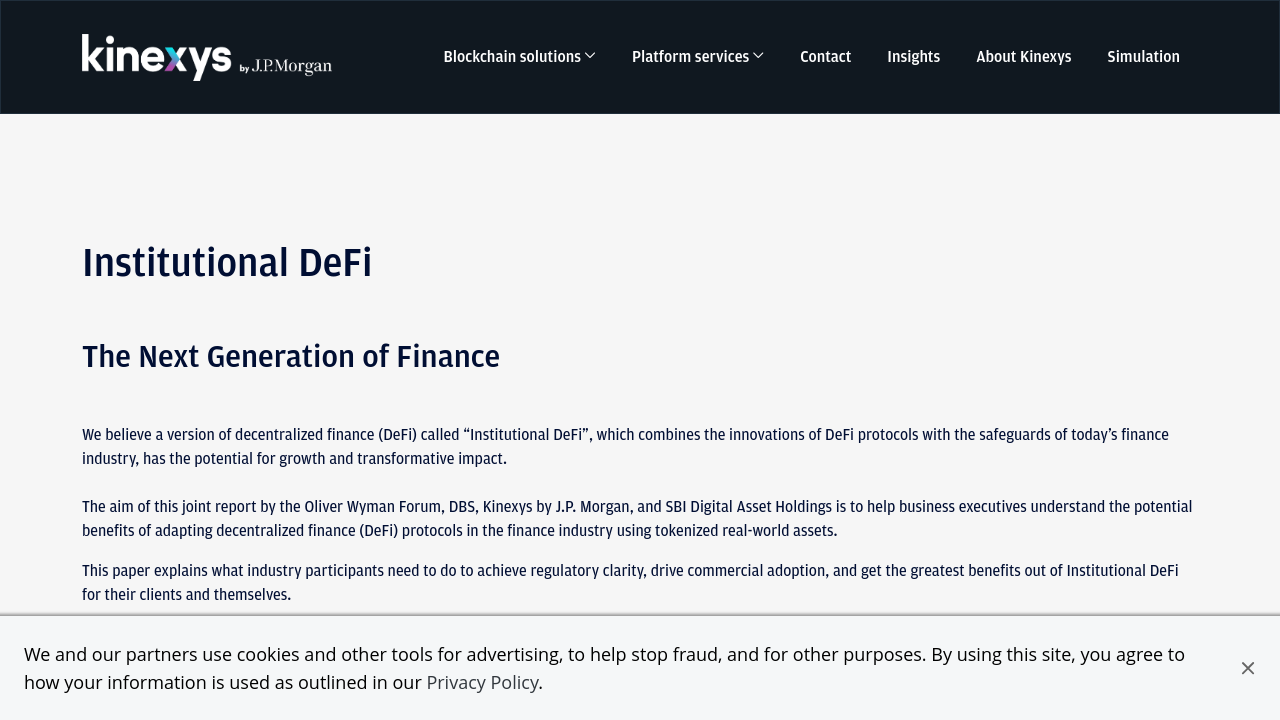
The most cited working definition comes from a joint report by J.P. Morgan's Kinexys team, the Oliver Wyman Forum, DBS, and SBI Digital Asset Holdings. They frame institutional DeFi as "the application of DeFi protocols to tokenized real-world assets, combined with appropriate safeguards to ensure financial integrity, regulatory compliance, and customer protection." The framing is deliberately narrow. It centers tokenized RWAs as the underlying and treats compliance as an in-protocol requirement, not an off-chain wrapper. For deeper context on how tokenized instruments enter primary markets, see our RWA primary market dynamics piece.
What It Excludes: Crypto DeFi vs. Institutional DeFi
The definition explicitly excludes institutional participation in permissionless crypto DeFi, even when the underlying chain is shared. Retail DeFi is pseudonymous and open; anyone with a wallet can supply liquidity or borrow. Institutional DeFi restricts access via verified identity frameworks, KYC, and AML allow lists, per Chainlink's retail-versus-institutional analysis. Cobo's institutional documentation phrases it as "decentralized finance infrastructure specifically designed for regulated entities." The distinction is not aesthetic; it determines whether an activity clears internal risk committees. Our fundamentals hub breaks down the mechanics for readers new to the taxonomy.
Takeaway: Institutional DeFi is defined by what it excludes as much as by what it includes. If the counterparties are not verified and the underlying is not a tokenized regulated instrument, it is crypto DeFi, not institutional DeFi.
How Institutional DeFi Works: Core Mechanisms
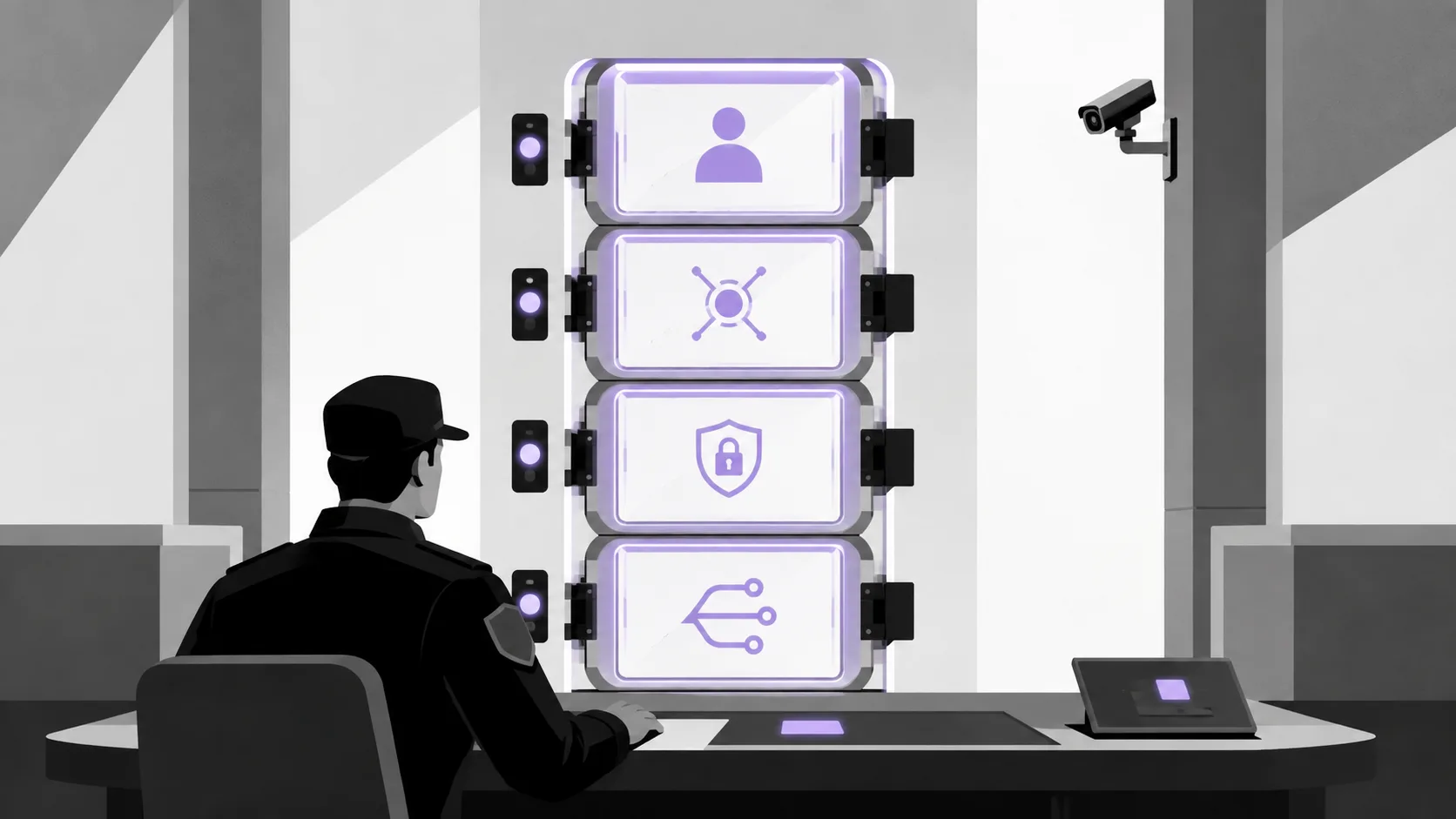
The mechanics diverge from retail DeFi at four layers: access, custody, privacy, and integration. Each layer is a compliance surface that regulated participants cannot skip. Our analysis section tracks how these layers are being productized by infrastructure vendors.
Permissioned Smart Contracts and Allow Lists
Institutional platforms embed allow lists directly in smart contracts, so only KYC/AML-verified counterparties can interact with a given liquidity pool or lending market. The check happens at the contract level, not at a front-end. That matters because it makes compliance provable to a supervisor, not merely asserted. Recent SEC custody rule revisions push in the same direction: verifiable controls over who touches what.
Custody, Multisig, and Key Management
Institutions manage billions in client assets, so single-key browser wallets are not viable. The standard is multisig and threshold-signature schemes bound to internal governance workflows, often with hardware-backed key shards distributed across roles. This is a structural break from retail practice, where security depends on individual hygiene. For a broader treatment of the custody stack, our institutions coverage tracks how custodians are integrating with tokenization venues.
Privacy Standards and On-Chain Compliance
Public blockchains are transparent by default, which is incompatible with institutional trade secrecy. Chainlink's privacy standard, for example, lets institutions execute transactions privately while publishing cryptographic proofs on-chain, shielding client identity and strategy from the public ledger. Middleware such as the Chainlink Runtime Environment (CRE) connects existing bank backends to blockchain networks without a full-stack rebuild. Settlement compresses from T+2 toward near-real-time because smart contracts clear atomically, without a central counterparty in the middle. The mechanics behind that compression are covered in our arbitrage loops in AMMs piece, which touches on atomic settlement design.
Takeaway: The core primitives (allow lists, multisig, privacy proofs, secure middleware) are all designed to make on-chain execution legible to compliance teams and supervisors.
Key Use Cases for Asset Managers

Three use cases carry most of the near-term balance-sheet impact. All three are already live in some form, and each has measurable revenue or funding implications.
Tokenized Real-World Assets (RWAs)
Banks and asset managers are tokenizing traditional instruments (equities, bonds, money market funds) so they become composable inside DeFi protocols. Franklin Templeton and BlackRock have issued tokenized money market funds on public blockchain architecture, demonstrating live institutional RWA deployment rather than a sandbox proof-of-concept. This is where treasury-grade yield meets programmable settlement, a theme covered in the great decoupling analysis.
Repo Settlement and Intra-Day Liquidity
J.P. Morgan's Kinexys Digital Assets platform is being used for intra-day repo settlement, and Citi projects tokenized repo settlements could reach $1 trillion in coming years. The economic case is simple: intra-day mobility of collateral reduces trapped liquidity and funding costs. For a related view on how digital collateral is shifting sovereign funding patterns, see sovereign debt and the silent pivot.
On-Chain Lending and Yield Generation
Institutional DeFi allows lending and borrowing against tokenized collateral, offering yield without the counterparty opacity of traditional OTC markets. Forbes' 2025 survey of the institutional DeFi landscape identifies RWA tokenization and on-chain repo as the two use cases with the clearest, measurable balance-sheet benefit. Yield dynamics in this segment are less speculative than in crypto DeFi; they track the underlying instrument. Our liquidity trap analysis unpacks why on-chain yields are converging with off-chain benchmarks.
Takeaway: For asset managers, the highest-signal use cases are RWA issuance, repo, and secured lending. Each has a live institutional reference deployment.
Regulatory Landscape and Compliance Requirements

Regulation is the primary constraint, not the technology. Progress is slow and cautious by design.
Current Regulatory Frameworks and Gaps
IOSCO's Final Report with Policy Recommendations for Decentralized Finance and the Crypto Council for Innovation's Key Elements of an Effective DeFi Framework both propose structures balancing innovation and investor protection. Deutsche Bank's 2024 white paper "The Road to Institutional DeFi" notes that most implementations to date sit in retail or sandbox settings, with the regulatory perimeter still being drawn. KYC on DeFi remains contested: a late Biden-era ruling requiring DeFi platforms to implement KYC checks met resistance from crypto-native operators. Our stablecoin act coverage tracks the US legislative side; the EU MiCA 2.0 piece covers the European perimeter for funds.
Project Guardian and Sandbox Initiatives
The Monetary Authority of Singapore (MAS) leads Project Guardian, a collaborative initiative with J.P. Morgan's Kinexys team, DBS, and SBI Digital Asset Holdings to explore tokenized asset use cases, including tokenized deposits on public blockchains. Deutsche Bank's roadmap places broader regulatory clarity on a one-to-three-year horizon. For a global view of how central banks are approaching related infrastructure, see the CBDC adoption roadmap.
Takeaway: The near-term compliance path is sandbox participation plus engagement with jurisdictions (Singapore, EU, select US programs) that have codified DeFi frameworks.
Common Misconceptions About Institutional DeFi
Three misconceptions surface repeatedly in investment committees. Each distorts the actual opportunity set. Our macro coverage frames the broader context in which these misconceptions arise.
Misconception: It Is Just Permissioned Blockchain / Reality: It Uses Public Infrastructure Too
Some institutions equate institutional DeFi with private permissioned chains. In practice, BlackRock and Franklin Templeton issue tokenized funds on public architecture. Permissioning happens at the asset and access layers, not necessarily at the base chain. Goldman Sachs' recent tokenization desk expansion reinforces the direction: public rails with compliant overlays.
Misconception: It Replaces TradFi / Reality: It Extends TradFi Rails
Institutional DeFi does not remove intermediaries; it re-architects their roles. Custodians, compliance providers, and oracles remain load-bearing infrastructure. The change is that many of their functions become programmable rather than procedural. Our ETF volume analysis shows how existing TradFi products absorb, rather than resist, on-chain flow.
Misconception: It Is Only for Crypto-Native Firms / Reality: Traditional Banks Are Already Participating
J.P. Morgan, DBS, and Deutsche Bank are active participants, so a crypto-native origin is not required for entry. Sygnum's 2025 analysis argues that many DeFi protocols are no longer experimental; the technology is proven, and the remaining gap is institutional adoption frameworks. For a market-psychology view of why adoption is accelerating in this cycle, see the psychology of the bull.
Takeaway: The barriers are organizational and regulatory, not technological. That has direct implications for where a program owner should spend time.
How to Get Started With Institutional DeFi
A practical entry sequence has three steps. Each is a discrete workstream with a defined output. Our resources page collects the primers, frameworks, and templates most useful at each stage.
Assess Custody and Key Management Infrastructure
Audit existing custody to confirm it supports multisig governance, role-based approvals, and institutional-grade private key management. If the current setup is single-key or hot-wallet dominant, that is the first remediation. Firms should model a formal segregation-of-duties matrix before touching a testnet. Related regulatory context is in the SEC custody rules update.
Identify a Regulatory-Compliant Entry Point
Asset managers with existing regulatory registrations should target permissioned DeFi venues that accept KYC/AML-verified participants. This reduces onboarding friction versus starting from a permissionless protocol and retrofitting controls. Fireblocks documents a $60 billion surge in DeFi activity processed through institutional custodians, indicating enterprise-grade entry infrastructure already exists at scale. Sandbox participation, such as MAS Project Guardian, is a lower-risk staging ground. Our interviews section captures how program leads at incumbent firms sequenced their first deployments.
Choose Tokenization and Protocol Partners
Select tokenization partners with documented regulatory engagement and oracles with institutional-grade data feeds. Vendor selection at this stage materially reduces integration and compliance risk downstream. Diligence questions should cover legal wrappers, redemption mechanics, oracle sourcing, and incident history. For firms scoping this workstream, our partnerships page outlines how we work alongside program teams.
Takeaway: Custody first, compliant venue second, partners third. Attempting these in parallel usually produces rework.
Frequently Asked Questions
What is the difference between institutional DeFi and retail DeFi?
Retail DeFi is permissionless and pseudonymous: any wallet can access any protocol. Institutional DeFi restricts access through KYC/AML allow lists, uses multisig custody, and requires privacy controls suitable for regulated counterparties handling client assets.
What are real-world assets (RWAs) in the context of institutional DeFi?
RWAs are tokenized representations of traditional financial instruments such as money market funds, bonds, equities, or repo positions. They serve as the underlying collateral that lets DeFi protocols carry regulated exposures rather than pure crypto risk.
Which banks and financial institutions are already using institutional DeFi?
J.P. Morgan (via Kinexys), DBS, Deutsche Bank, SBI Digital Asset Holdings, Franklin Templeton, and BlackRock are among the active participants. Each is executing on live tokenization, repo, or fund issuance workflows on public or permissioned blockchain infrastructure.
How do KYC and AML requirements work in institutional DeFi protocols?
Verified identities are bound to on-chain addresses, and allow lists inside smart contracts restrict interactions to those addresses. The compliance check is enforced at the contract layer, making it provable to supervisors rather than reliant on off-chain assertions.
Is institutional DeFi regulated?
Regulation is fragmented. IOSCO has issued policy recommendations, jurisdictions such as Singapore and the EU have clearer frameworks, and US rulemaking is evolving. Deutsche Bank projects broader clarity within a one-to-three-year horizon, with sandboxes bridging the current gap.
What is Project Guardian and why does it matter for asset managers?
Project Guardian is a MAS-led initiative with J.P. Morgan, DBS, and SBI exploring tokenized asset use cases including deposits on public blockchains. It matters because it offers a regulated staging environment for asset managers to test institutional DeFi strategies before full deployment.
What risks do asset managers face when entering institutional DeFi?
Key risks include smart contract vulnerabilities, oracle failure, custody compromise, regulatory reclassification, and liquidity gaps in early tokenized markets. Program design should include incident response, insurance where available, and clear redemption paths for tokenized collateral.
How does institutional DeFi differ from a private permissioned blockchain?
A private permissioned blockchain is a closed network run by a consortium. Institutional DeFi can run on public infrastructure with permissioning applied at the asset and access layers, preserving composability with the broader ecosystem while enforcing compliance where it matters.
Conclusion
Institutional DeFi is a narrow, well-defined overlay on top of tokenized real-world assets, not a rebrand of crypto DeFi. The mechanics are proven, the reference deployments are live at J.P. Morgan, BlackRock, Franklin Templeton, and DBS, and the remaining constraint is regulatory sequencing rather than technology. Asset managers who audit custody, pick a compliant entry point, and choose partners with regulatory pedigree will find the on-ramp materially shorter than it looked two years ago. For ongoing analysis and program-level primers, Stablecoin.nyc's about page explains how we cover this beat and where to go next.