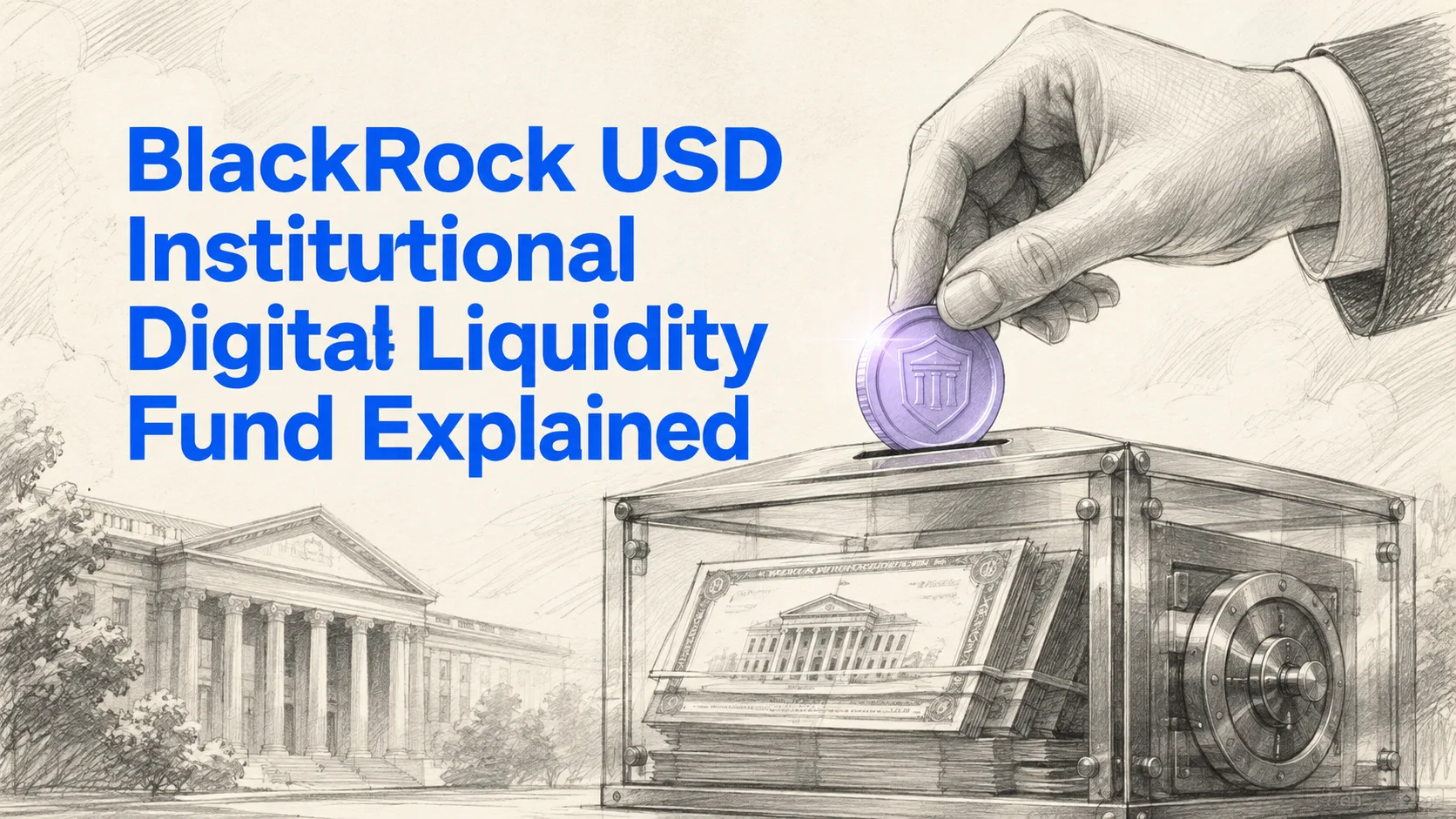
The BlackRock USD Institutional Digital Liquidity Fund, ticker BUIDL, is a tokenized money-market fund that brings institutional-grade US Treasury exposure onto public blockchains. Launched in March 2024 in partnership with Securitize, it stands as one of the largest entries of traditional asset management into on-chain finance. Stablecoin.nyc tracks BUIDL and the broader tokenized-asset landscape for crypto-native finance professionals evaluating yield-bearing digital instruments.
Definition: What Is the BlackRock USD Institutional Digital Liquidity Fund
BUIDL is a tokenized fund domiciled in the British Virgin Islands, managed by BlackRock Financial Management, with Securitize acting as transfer agent and placement agent. Each token is pegged to $1.00 NAV and represents a fractional ownership interest in a portfolio of cash, short-term US Treasury bills, and repurchase agreements. The mandate mirrors a traditional government money-market fund: current income consistent with liquidity and stability of principal. For readers new to the wrapper, our fundamentals coverage unpacks the base primitives.
BUIDL in Plain English
In plain English, BUIDL is a share of a T-bill fund that lives as an ERC-20-style token on public chains. The token does not float in price; it accrues yield through monthly token distributions rather than price appreciation, similar to how a money-market fund distributes dividends. That structural choice is what enables treasury-backed on-chain yield to look and behave like a stablecoin without being one.
Legal and Regulatory Structure
The offering is restricted to qualified institutional investors and accredited investors, with a $5 million minimum subscription. Separately, BlackRock filed DLT Shares of its Treasury Trust Fund with the SEC in April 2025, a structure in which shares are purchasable only through BNY Mellon acting under a contractual relationship with a third-party technical platform, per the SEC prospectus filing. That parallel filing matters because it extends blockchain-native share classes into a US-registered '40 Act wrapper, complementing BUIDL's BVI domicile. See our institutions coverage for how allocators are treating both wrappers.
Takeaway: BUIDL is a permissioned security, not a payment token, and its regulatory perimeter is deliberately narrow.
How BUIDL Works: Mechanism and Portfolio Composition

The fund's mechanics resemble a conventional prime money-market fund with a blockchain settlement layer bolted on. Understanding the split between the asset side and the token side is the fastest way to reason about its risk and utility, a point we return to often in our analysis desk.
Underlying Asset Basket
BUIDL holds three categories of assets: US Treasury bills, cash deposits, and overnight repurchase agreements collateralized by Treasuries. Repos provide the intraday liquidity that supports 24/7 redemption commitments, a standard money-market technique now embedded in an on-chain wrapper. This mirrors the plumbing of the broader tokenized primary market, where the underlying collateral basket determines both duration risk and settlement cadence.
Token Issuance and Redemption
Securitize serves as the on-chain transfer agent, handling minting and burning. Coinbase Custody, BNY Mellon, and Anchorage Digital provide custodial and banking infrastructure across fiat and crypto rails. Redemptions can settle in USDC near-instantly through a $100 million USDC liquidity facility provided by Circle, enabling exit outside standard settlement windows. That facility functionally papers over the T+1 cycle of the underlying Treasuries, an operational innovation worth reading alongside our note on SEC custody rules.
BUIDL is issued on Ethereum, Aptos, Avalanche, Optimism, Polygon, and Solana. Multi-chain issuance widens the collateral surface for DeFi protocols but concentrates operational risk in Securitize's whitelisting and bridging processes. The de-pegging paradox framework is a useful lens here: liquidity facilities work until they don't, and cross-chain expansion multiplies the number of venues that can strain them.
Dividend Accrual and Distribution
Dividends accrue daily and are paid out monthly as new BUIDL tokens, keeping the $1.00 NAV stable while compounding the position. As of mid-2025, BUIDL's market capitalization exceeded $2.8 billion according to third-party price aggregators tracking the token, with market data reflected on Kraken's BUIDL price page. By that measure it is the largest tokenized Treasury fund by AUM, a datapoint we contextualize in our macro coverage.
Takeaway: BUIDL's design separates yield accrual from price behavior, which is what lets it function as near-cash collateral on-chain.
Why It Matters: BUIDL's Role in Tokenized Real-World Assets

BUIDL is a proof-point, not just a product. It demonstrated that a top-five global asset manager could deploy a regulated, audited fund on public blockchains without waiting for a purpose-built institutional chain, validating the tokenized real-world asset (RWA) category at institutional scale. Our interviews with builders in the RWA sector consistently cite the launch as a before-and-after moment.
Bridging TradFi and DeFi
DeFi protocols can use BUIDL as yield-bearing collateral in place of idle stablecoins, allowing on-chain treasuries and market-neutral funds to earn T-bill yields without leaving the blockchain environment. The 24/7 settlement capability addresses a structural limitation of traditional money markets, where redemptions are constrained to business-day windows. This is the same dynamic driving sovereign debt onto digital collateral rails at a broader level.
Use Cases for Institutional Investors
Ondo Finance and other RWA protocols have integrated BUIDL as a backing asset, illustrating how the fund functions as composable on-chain collateral beyond its standalone yield product role. For DAOs and crypto-native funds holding nine-figure stablecoin treasuries, BUIDL offers a way to convert idle balances into yielding positions without off-ramping. The same treasurers who watched spot ETF volumes hit record highs now have a symmetric on-chain vehicle for their cash sleeve.
BlackRock's entry also signaled to institutional compliance and risk teams that on-chain funds can satisfy existing regulatory and AML/KYC frameworks, reducing the perceived adoption risk that had kept larger allocators sidelined. That sign-off effect is arguably worth more than the AUM itself; more context in our Goldman tokenization desk note.
Takeaway: BUIDL's institutional-grade wrapper is the credential that unlocks conservative allocators, not just its yield.
Common Misconceptions About BUIDL

Crypto-native readers routinely miscategorize BUIDL because it looks and quotes like a stablecoin. The distinctions below matter for legal, tax, and portfolio purposes. Our resources hub collects the reference material for each.
Misconception: BUIDL Is a Stablecoin / Reality: It Is a Security
BUIDL is classified as a security under US law. While its price holds at $1.00, ownership represents a regulated fund interest, not a redeemable payment instrument. A stablecoin issuer promises par redemption in fiat; BUIDL delivers fund shares that happen to be denominated at $1.00 NAV. The distinction is not academic, as our stablecoin regulation tracking makes clear.
Misconception: Anyone Can Buy BUIDL / Reality: Institutional Access Only
Eligible investors must meet the $5 million minimum and qualify as accredited investors or qualified purchasers. Retail participation is explicitly excluded by the offering documents. Non-qualifying users occasionally see BUIDL quoted on price aggregators and assume it is buyable spot; it is not. For a comparable retail-accessible framing, our MiCA 2.0 note covers how eligibility tiers work in the EU.
Misconception: BUIDL Trades on Public Exchanges / Reality: Transfer Restrictions Apply
BUIDL tokens are not freely tradable. Transfers are permissioned at the contract level and require KYC/AML verification through Securitize's investor onboarding platform. The $1.00 price shown on CoinGecko, Kraken, and Coinbase reflects the stable NAV, not a market-clearing price from open trading. Yield accrues through new token distributions, not price appreciation, so the token price does not rise above $1.00 even as returns compound. This is a familiar pattern for readers of our arbitrage loop analysis, where the "price" you see is not always the price you can trade at.
Takeaway: Treat BUIDL as a fund share with a wallet-native distribution layer, not as a stablecoin with fancier disclosures.
Related Concepts in Tokenized Finance
BUIDL sits inside a fast-growing product category. Mapping the neighbors clarifies its position and constraints.
BlackRock DLT Shares (Treasury Trust Fund)
BlackRock's April 2025 DLT Shares filing extends blockchain-based fund access to a US-registered '40 Act structure, alongside the BVI-domiciled BUIDL. The DLT Shares are purchasable through BNY Mellon acting under a contractual relationship with a third-party technical platform. This is a materially different distribution model than BUIDL's Securitize-fronted whitelist, and one worth reading against our liquidity trap analysis as bank-intermediated tokenization scales.
Competing Tokenized Treasury Products
Franklin Templeton's BENJI fund runs on Stellar and Polygon; Ondo Finance's OUSG offers a lower minimum entry; Superstate's USTB targets qualified purchasers with a Delaware trust structure. Each product differs on chain support, minimum size, and redemption plumbing. The category is still small enough that the wrapper choices matter as much as the yield, a point echoed in the psychology-of-the-bull framing around institutional entry.
The Broader RWA Market
The tokenized Treasury sector reached over $5 billion in total AUM across all providers by early 2025 per third-party trackers, with BUIDL accounting for the largest single share. Repurchase agreements used within BUIDL's portfolio provide overnight liquidity, a standard money-market technique now embedded in an on-chain fund wrapper at material scale for the first time. The sector's growth is closely tied to sustained high interest rates: as Treasury yields compress, the relative attractiveness of tokenized T-bill funds versus on-chain lending rates shifts, an interplay tracked in our CBDC adoption roadmap.
Comparative Snapshot
| Product | Issuer | Domicile | Minimum | Chains |
|---|---|---|---|---|
| BUIDL | BlackRock / Securitize | BVI | $5,000,000 | ETH, SOL, AVAX, POLY, APT, OP |
| BENJI | Franklin Templeton | US ('40 Act) | Retail | Stellar, Polygon |
| OUSG | Ondo Finance | BVI feeder | $5,000 | ETH, POLY, SOL |
| USTB | Superstate | US (Delaware trust) | Qualified purchaser | Ethereum |
Takeaway: BUIDL is the institutional benchmark; the competitive frontier is at lower entry thresholds and richer composability.
How to Get Started with BUIDL or Equivalent On-Chain Yield
Access to BUIDL is gated, but the broader category has retail-accessible entry points. The path depends on which side of the qualification line you sit. Our partnerships program works with allocators on both sides.
Qualifying and Onboarding
Institutional investors begin by applying through Securitize's investor portal, completing KYC/AML documentation, and meeting the $5 million minimum subscription. Once onboarded, investors select a supported blockchain (Ethereum, Solana, Avalanche, Polygon, Aptos, or Optimism) and receive BUIDL tokens directly to a whitelisted wallet address. Redemptions route through the USDC liquidity facility or, at larger sizes, standard bank wire. For diligence on the operational stack, our work-with-us page covers how research engagements are scoped.
DeFi Alternatives for Non-Institutional Participants
Non-qualifying participants can access similar T-bill yield exposure through retail-accessible products such as Ondo's OUSG (minimum $5,000) or Franklin Templeton's BENJI. DeFi users seeking yield without direct fund access can deposit into protocols that use BUIDL as collateral, gaining indirect exposure to Treasury returns through structured on-chain products. The trade-off is added smart-contract and protocol risk on top of the underlying fund risk, a stack we routinely deconstruct in analysis pieces.
Takeaway: BUIDL itself is not a retail product, but the yield curve it prices is now reachable through several on-chain wrappers at different eligibility tiers.
Frequently Asked Questions
What is the BUIDL token and how does it maintain its $1.00 price?
BUIDL is a tokenized share of a BlackRock money-market fund. It maintains a $1.00 NAV by holding cash, short-term Treasury bills, and repos, and distributes accrued yield monthly as new tokens rather than through price appreciation.
Who can invest in the BlackRock USD Institutional Digital Liquidity Fund?
Only qualified institutional investors and accredited investors who meet the $5 million minimum subscription and complete Securitize's KYC and AML onboarding can invest. Retail investors are explicitly excluded by the fund's offering documents and permissioned transfer contract.
What assets does BUIDL hold in its portfolio?
BUIDL holds a portfolio of US Treasury bills, cash deposits, and overnight repurchase agreements collateralized by Treasuries. The mix mirrors a conventional government money-market fund and is designed to prioritize principal stability, liquidity, and current income for holders.
Which blockchains is BUIDL available on?
BUIDL is currently issued natively on Ethereum, Aptos, Avalanche, Optimism, Polygon, and Solana. Multi-chain issuance is coordinated by Securitize as transfer agent, with each chain deployment subject to the same whitelisting, KYC, and permissioned transfer requirements at the smart-contract layer.
How is BUIDL different from a stablecoin like USDC?
USDC is a payment stablecoin promising par fiat redemption. BUIDL is a regulated fund security whose token represents a share interest at $1.00 NAV. BUIDL pays yield through monthly token distributions; USDC pays none to holders and is freely transferable.
How do investors redeem BUIDL tokens?
Investors redeem through Securitize, either receiving USDC near-instantly via a $100 million Circle-provided liquidity facility or receiving bank-wired dollars on standard settlement cycles. Both paths require the redeeming wallet to remain on the fund's whitelisted investor register.
What is the minimum investment for the BlackRock BUIDL fund?
The minimum subscription is $5 million. This threshold, combined with accredited investor or qualified purchaser status, is designed to restrict access to institutional allocators, family offices, DAOs treated as institutions, and crypto-native funds with sufficient balance sheets.
How does BUIDL compare to other tokenized Treasury funds like Franklin Templeton BENJI or Ondo OUSG?
BUIDL is the largest by AUM but has the highest minimum. BENJI is retail-accessible on Stellar and Polygon under a US '40 Act wrapper. OUSG offers a $5,000 minimum on multiple chains. Each differs on domicile, chains, and redemption plumbing.
Conclusion
BUIDL is the reference implementation for institutional tokenized cash: a permissioned, security-classified fund share with 24/7 on-chain settlement and a T-bill yield engine underneath. Its significance is less about the AUM and more about the precedent, which is now being copied and extended by every major asset manager building on-chain distribution. For crypto-native treasurers, allocators, and builders, the practical question is no longer whether tokenized Treasuries belong in the stack but which wrapper fits the mandate. Stablecoin.nyc will continue tracking the wrappers, the yields, and the plumbing as the category compounds.