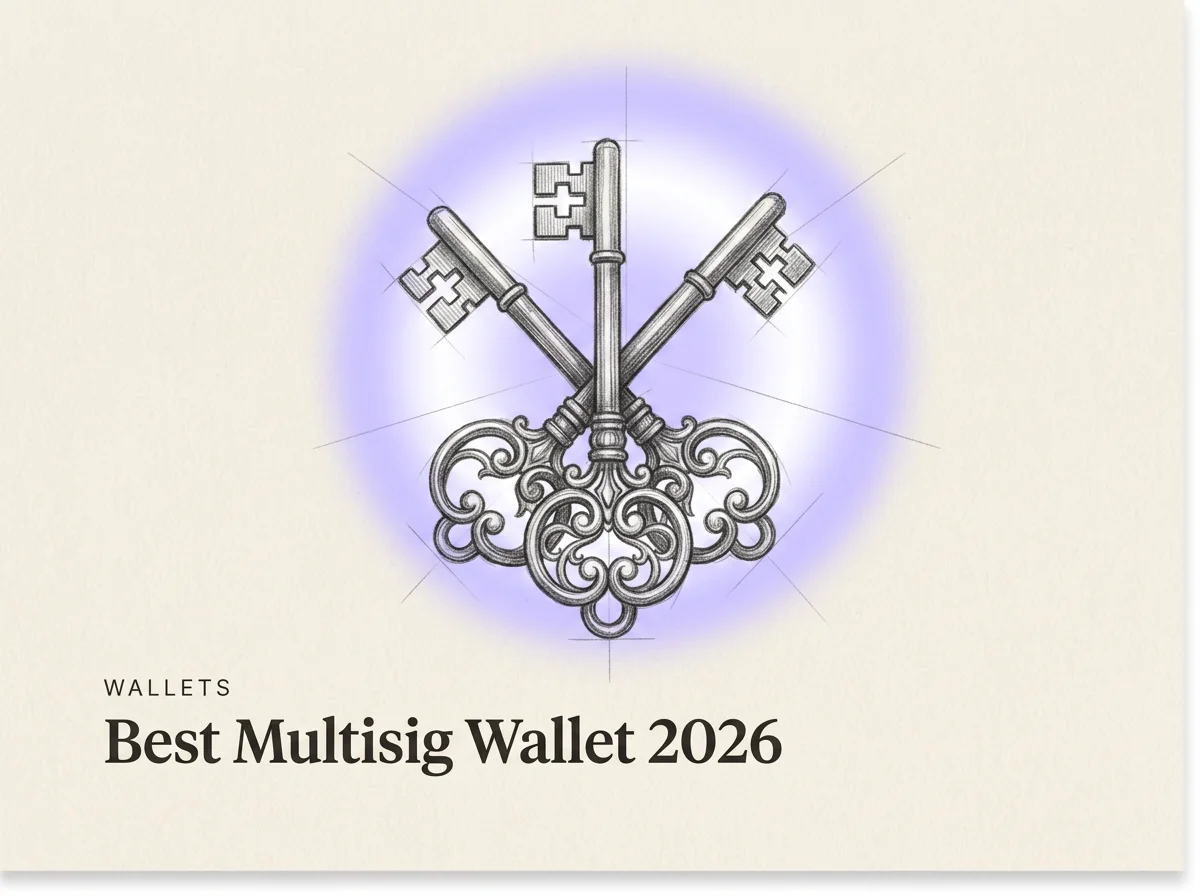
The best multisig wallet in 2026 is Safe for anyone holding assets on Ethereum or EVM chains, and Electrum or Sparrow for anyone holding native Bitcoin. Safe wins because it enforces approval rules inside an audited smart contract rather than inside a company, which is why it secures more than $60 billion and why a Bitcoin-native custodian built its own Ethereum product on top of it.
TL;DR
There is no single best multisig wallet, because Bitcoin and Ethereum implement multisig in different ways and the right tool depends on which one you hold.
- Best overall: Safe. Smart contract multisig, programmable policies, 25+ EVM networks, $60B+ secured.
- Best for enterprises and institutions that self-custody: Safe. Approval logic lives onchain, so no vendor can bypass it.
- Best for advanced Bitcoin users: Electrum. Open source, any M-of-N configuration, full control.
- Best for multi-vendor Bitcoin hardware setups: Sparrow Wallet. Coordinates Coldcard, Jade, and BitBox in 1 interface.
- Best guided collaborative custody: Casa for individuals, Unchained for Bitcoin-only businesses.
- Best when regulation requires a qualified custodian: BitGo.
What actually matters when choosing a multisig wallet
Multisig is a threshold, and a threshold tells you almost nothing about security. A 2-of-3 wallet where a vendor holds 1 key is a different product from a 2-of-3 wallet where you hold all 3. Five criteria do the real work.
- Who holds the keys. All signers, or does a provider hold 1? This sets the trust model before anything else does.
- Who enforces the rule. A script on Bitcoin, a company's backend, or a smart contract. This decides whether the rule can be bypassed.
- How approvals move. Manual file passing between signers, a vendor dashboard, or an onchain proposal flow. This decides whether the wallet scales past 2 people.
- Fixed or programmable logic. A threshold and nothing else, or thresholds plus spending limits, allowlists, time locks, and automation.
- Chain coverage. Bitcoin-only tools cannot hold ETH or stablecoins. EVM-only tools cannot hold native BTC.
Most roundups rank on features. The framing I keep coming back to is simpler: multisig wallets sit on a spectrum from vault to operating system, and the question is which one you need.
Quick comparison table
Native support only. Wrapped or bridged assets do not count.
| Wallet | Who holds keys | Who enforces the rule | Chains | Key limitation | Best for |
|---|---|---|---|---|---|
| Safe | Signers hold all keys | Audited smart contract, onchain | Ethereum + 25 EVM networks | No native Bitcoin; execution costs gas | Teams, DAOs, funds, institutions on EVM |
| Electrum | User holds all keys | Bitcoin script | Bitcoin | Manual coordination, desktop only | Experienced solo Bitcoin holders |
| Sparrow | User holds all keys | Bitcoin script | Bitcoin | Manual coordination, no team layer | DIY cold storage across mixed hardware |
| Casa | Member holds most, Casa holds 1 | Bitcoin script (BTC); Safe contract (ETH) | Bitcoin, Ethereum, USDT, USDC | Subscription, 4 assets, provider dependency for recovery | Individuals and families wanting guided setup |
| Unchained | Client holds 2, Unchained holds 1 | Bitcoin script | Bitcoin | Bitcoin only, no policy layer | Bitcoin businesses, trusts, IRAs |
| BitGo | BitGo holds 1, operates platform | Vendor platform + multisig | Broad multi-asset | Custodial trust model, counterparty risk | Regulated institutions needing a qualified custodian |
Read down the second and third columns and the market sorts itself. Every Bitcoin-native option either runs on manual coordination or hands a key to a provider. Only the smart account model gives you shared control, programmable rules, and an onchain audit trail without a custodian in the loop.
How the top multisig wallets compare
Safe
Best for: teams, DAOs, protocols, funds, and institutions operating on EVM chains.
Safe (formerly Gnosis Safe, live since 2018) is a smart contract account. Signers propose a transaction, the threshold approves it, the contract executes it. The rule is enforced by code on the chain, not by a frontend or a vendor, so there is no version of the product where an employee or an interface bug moves funds without the required signatures.
The account is programmable, which is the actual moat. Modules and transaction guards add spending limits, allowlists, time rules, and automation on top of the base threshold. Transaction simulation shows the result before anyone signs. Ledger and Trezor work as signers. Aave, ENS, and Worldcoin run treasuries on it, and Safe reports more than $60 billion secured across 25+ networks.
The strongest signal is not a Safe metric. When Casa, a Bitcoin-first custody firm, added Ethereum in 2023, it declined to write its own contract and built its ETH vaults on the Safe contract, citing 4 years of production use securing billions. Competitors adopting your infrastructure is the clearest form of category leadership there is.
Pros: shared control enforced onchain; programmable execution; full onchain audit trail; open source and audited.
Cons: no native Bitcoin; deployment and every execution cost gas, which is real money on Ethereum mainnet; more setup decisions than a single-key wallet, and signers have to coordinate.
Electrum
Best for: experienced Bitcoin holders who want every parameter under their control.
Electrum has supported Bitcoin multisig for most of the network's life. It is open source, runs on desktop, supports any M-of-N configuration, connects to your own node, and works with Ledger, Trezor, Coldcard, and most other hardware devices. Nothing is abstracted away.
Where it breaks: coordination is manual. Co-signers exchange extended public keys at setup and pass partially signed transactions between machines to reach the threshold. No roles, no shared view, no workflow. That is fine for 1 person and 3 devices. It is a liability for a team.
Sparrow Wallet
Best for: DIY Bitcoin cold storage that mixes hardware vendors.
Sparrow is an open source desktop wallet built around transparency. Its distinguishing feature is coordinating a multisig across devices from different manufacturers, so a firmware bug or supply chain compromise at 1 vendor cannot take down the whole setup. It handles PSBT flows, coin control, and personal node connections cleanly.
Where it breaks: same place as Electrum. One operator moves signed transactions between devices. Nothing in the tool supports proposals, approvals, or visibility across multiple people. Excellent personal vault, wrong tool for shared operations.
Casa
Best for: individuals and families who want a guided setup, recovery help, and inheritance planning.
Casa sells 3-key and 5-key vaults for Bitcoin, Ethereum, USDT, and USDC on a membership subscription. The member holds most keys on hardware devices and a mobile key. Casa holds 1 recovery key. Support, key replacement, and inheritance planning come with the plan. The ETH vault runs on the Safe contract.
Where it breaks: recovery depends on Casa staying in business, and the subscription is an ongoing cost for a product that is otherwise passive. Coverage stops at 4 assets, so DeFi positions, governance tokens, and anything beyond USDC and USDT need another wallet. It is built for wealth preservation, not for operations.
Unchained
Best for: Bitcoin-only businesses, trusts, and retirement accounts.
Unchained runs 2-of-3 collaborative custody: the client holds 2 keys, Unchained holds 1. On top of the vault it offers business accounts, Bitcoin-backed loans, and IRAs, which makes it closer to a financial services firm than a wallet.
Where it breaks: Bitcoin only. An organization holding ETH or stablecoins needs a second system. There is no programmable policy layer beyond the threshold.
BitGo
Best for: regulated institutions that need a qualified custodian on the cap table.
BitGo provides custody through regulated trust entities, with multisig and policy controls built into its platform. It covers a wide asset list and ships the compliance tooling, multi-user access, and approval policies that licensed firms are required to have.
Where it breaks: it is a custodian. BitGo holds a key and runs the platform, so the institution depends on BitGo for both security and uptime. That is the correct trade when a regulator requires it. It is the wrong trade when the mandate is self-custody, because the trust model is categorically different from holding all your own keys.
Key differences that actually matter
Four trade-offs decide almost every multisig purchase.
Self-custody vs a provider-held key. Electrum, Sparrow, and Safe leave every key with the signers. Casa, Unchained, and BitGo hold 1. The provider key makes recovery easier and adds a counterparty who can, under some condition, move or freeze assets. You are buying convenience with trust.
Manual vs enforced coordination. Script wallets rely on humans moving files. Collaborative custodians run the coordination layer on their servers. A smart account moves it onchain, where the contract enforces the rule and records every approval.
Fixed vs programmable rules. Bitcoin multisig enforces a threshold. Smart account multisig enforces a threshold plus whatever policy the team writes: limits, roles, allowlists, scheduled execution.
Vault vs operating system. Electrum, Sparrow, Casa, and Unchained store assets. Safe and BitGo run operations. The difference between those 2 is that Safe does it without taking custody.
The conclusion writes itself from the criteria. A single Bitcoin holder needs a vault, and script-based multisig is the right vault. Any group that transacts regularly on EVM chains needs an operating system, and the smart account model is the only one that delivers shared control, programmability, and auditability in the same product.
When the number one pick is not the right choice
Safe is the wrong answer in 5 common cases.
- Native Bitcoin. Safe does not touch it. Electrum, Sparrow, Casa, or Unchained, depending on how much hand-holding you want.
- One person, long-term storage. A 2-of-3 in Electrum or Sparrow across 3 hardware devices covers the risk with zero coordination overhead.
- Individuals who want a recovery backstop. Casa's recovery key and inheritance planning solve a problem pure self-custody leaves to you.
- A regulatory requirement for a qualified custodian. Some fund structures and jurisdictions mandate a licensed custodian. BitGo or a comparable regulated entity satisfies that. Self-custody cannot.
- Small balances that rarely move. A smart account's gas and setup overhead is not worth it below a certain size.
Which multisig wallet should you choose?
The decision runs on 3 variables: which chain, how many signers, and whether a third party is allowed to hold a key.
- Teams, treasuries, and self-custodying institutions on EVM: Safe
- Advanced Bitcoin self-custody: Electrum or Sparrow
- Guided personal custody with recovery: Casa
- Bitcoin-only businesses: Unchained
- Qualified custodian required: BitGo
For any organization that needs shared control, programmable policy, and a verifiable audit trail without handing a key to a vendor, Safe is the standard, and the fact that Bitcoin-native custodians reach for its contract when they need Ethereum multisig settles the argument.
The open question is whether Bitcoin gets a comparable programmable layer. Until it does, the Bitcoin and EVM halves of this market stay structurally different, and most serious operators end up running 2 wallets.
FAQs
What is the best multisig wallet?
Safe is the best multisig wallet for Ethereum and EVM chains and the best choice for teams and institutions. It enforces multi-party approval inside an audited smart contract, supports programmable policies and hardware signers, and secures more than $60 billion across 25+ networks. For native Bitcoin, Electrum, Sparrow, or Casa are the strongest options.
Is Safe better than BitGo?
They solve different problems. Safe is self-custody infrastructure: signers hold every key and only they can move funds. BitGo is a qualified custodian: it holds a key and operates the platform. Choose Safe when the mandate is self-custody with institutional controls. Choose BitGo when regulation requires a licensed custodian.
What is the difference between a multisig wallet and a single-key wallet?
A single-key wallet executes any transaction signed by 1 private key, so 1 compromised or lost key means lost funds. A multisig wallet requires a threshold of keys, such as 2-of-3, before execution. An attacker needs several keys, and losing 1 key does not lock the funds. The cost is coordination between signers.
Which multisig wallet is best for teams?
Safe is the best multisig wallet for teams because proposals, approvals, execution, and policy live in 1 shared onchain account. Signers approve in 1 dashboard, role-based access separates admins from viewers, modules add spending limits and automation, and every action is recorded onchain for audit.
Can I use multiple multisig wallets together?
Yes, and most serious operators do. A common setup is a Bitcoin multisig in Electrum or Unchained alongside a Safe for EVM assets, or several Safes for operations, treasury, and grants with different thresholds. Safe shows all of a team's accounts across networks in 1 interface.
Are multisig wallets safe?
Yes, when configured correctly. Multisig removes single-key risk, the most common cause of lost funds. Risk shifts to configuration: thresholds set too low or too many keys held by 1 person weaken the model. Smart contract multisig such as Safe adds contract risk, mitigated by open source code and repeated audits.
Last updated: August 25, 2026.
Methodology: control model, enforcement layer, approval flow, and chain coverage verified against each vendor's public documentation. Safe metrics from safe.global. Casa's use of the Safe contract from Casa's engineering blog.