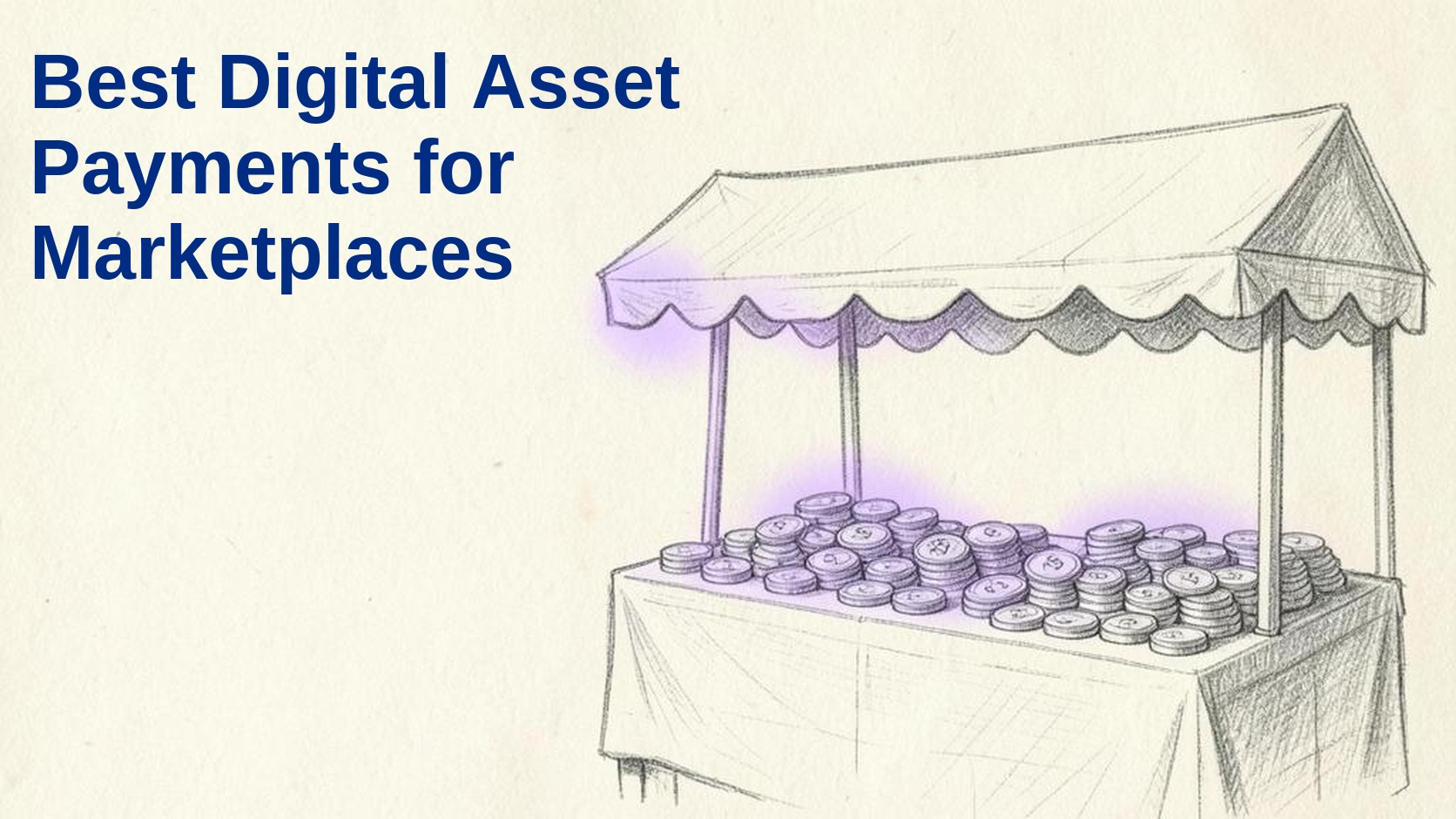
Best Digital Asset Payments for Marketplaces (2026)
Best Digital Asset Payment Platforms for Marketplaces
TL;DR
Best for marketplaces needing split payments and mass payouts to many sellers is BVNK, on the strength of its broader enterprise settlement infrastructure. Best for marketplaces embedding stablecoin acceptance and conversion invisibly behind their own checkout is Zero Hash. Best for marketplaces automating recurring seller payout conversion to fiat is Sphere. A marketplace's core requirement differs from a single-merchant business: it needs to handle payment splitting across many sellers, mass payouts, and often multi-currency seller bases simultaneously, which is a different infrastructure problem than accepting payment for one entity.
What actually matters for a marketplace specifically
Split payment and mass payout support. A marketplace collects from buyers and distributes to many sellers, often with a platform fee taken in the middle. Confirm the platform supports this splitting natively rather than requiring the marketplace to build settlement logic itself.
Seller-side KYB at scale. Onboarding many individual sellers for compliance purposes is a different operational challenge than a single merchant's own KYB. Confirm how the platform handles seller-level verification at volume.
Multi-currency seller payout. A global marketplace's sellers are often in different countries wanting payout in different local currencies. This is closer to the cross-border payment problem than a simple domestic payout.
Redeemability and price stability as the buyer-facing pitch. Stablecoins are attractive specifically at marketplaces due to their redeemability and price stability compared to volatile cryptocurrencies, and their lower cost relative to card payment rails, which is the buyer-facing value proposition worth stating plainly to a marketplace evaluating whether to add this payment method at all.
Quick comparison table
| Platform | Split payments | Mass payout | Multi-currency seller payout | Best for |
|---|---|---|---|---|
| BVNK | Not independently verified as a native marketplace feature; confirm directly | Enterprise-scale, via broader settlement infrastructure | Strong, via 130+ country licensing | Marketplaces needing broad seller payout coverage in one contract |
| Zero Hash | Not independently verified as a native marketplace feature; confirm directly | Built for embedding at scale | Not independently verified; Zero Hash's disclosed licensing spans 51 US states plus Canada, Australia, Bermuda, Argentina, and 2026 MiCA/EMI authorization in the EU, though marketplace-specific payout coverage needs direct confirmation | Marketplaces embedding stablecoin acceptance behind their own checkout |
| Sphere | Not independently verified as a native marketplace feature; its documented strength is single-destination conversion rather than confirmed multi-seller splitting | Automated via Offloader Wallets API | Not independently verified; confirm directly | Marketplaces automating recurring seller payout conversion |
Top options compared
BVNK brings the broadest licensing footprint to the seller-payout problem specifically, with more than 25 licenses and approvals across over 130 countries, meaning a marketplace with a genuinely global seller base has one relationship covering the most jurisdictions. Where it breaks: this comparison found strong evidence for BVNK's general settlement infrastructure but could not independently verify marketplace-specific split-payment and mass-payout tooling, confirm feature depth directly rather than assuming it from general platform strength.
Zero Hash fits a marketplace wanting stablecoin acceptance and seller payout to happen entirely behind its own checkout and seller dashboard, with documentation notably explicit about exception handling, useful once a marketplace is processing payout failures at meaningful seller volume, and backed by one of the broader regulatory footprints in this comparison. Where it breaks: multi-currency seller payout coverage and native split-payment support were not independently verifiable for this comparison, confirm both directly before assuming parity with BVNK's broader settlement infrastructure.
Sphere offers the clearest documented fit for the automated payout-conversion leg specifically, with its Offloader Wallets API giving programmatic control over converting stablecoin seller payouts to fiat at predefined destinations. Where it breaks: its documented strength is single-destination conversion, not confirmed multi-seller splitting, so a marketplace needing native split-payment logic across many sellers simultaneously should confirm this specific capability directly rather than assume it from the conversion API alone.
Key differences that actually matter
None of the three platforms compared here have marketplace-specific, independently verified split-payment feature documentation as clear as their general settlement or conversion capabilities. A marketplace evaluating this category should treat split-payment and mass-payout support as the specific question to verify directly with each vendor, rather than assuming general settlement platform strength automatically implies marketplace-specific tooling.
For related coverage, see our comparisons of Best Recurring Conversion Platforms, and Digital Asset Payments.
FAQs
Why are stablecoins attractive for marketplaces specifically?
Stablecoins offer redeemability and price stability compared to volatile cryptocurrencies, combined with lower transaction costs than credit and debit card rails, along with fast settlement and transaction transparency, making them a genuine alternative payment rail for marketplace transactions specifically.
Do these platforms handle payment splitting between the marketplace and its sellers natively?
This varies and was not independently verifiable to the same depth as general settlement capability for any of the three platforms compared here. Confirm native split-payment and platform-fee-deduction support directly with each vendor before assuming it is included.
What is the difference between a marketplace payment platform and a general merchant payment platform for stablecoins?
A marketplace needs to handle payment collection from many buyers, splitting between the platform and many individual sellers, mass payout to those sellers often across multiple currencies, and seller-level compliance verification at scale. A general merchant platform handles payment collection and settlement for a single entity, a simpler problem.
Last updated: September 8, 2026 Written by the stablecoin.nyc Editorial Desk