Cross-Border Payments to Brazil: Rails Compared
Cross-Border Payments to Brazil: Rails Compared
TL;DR
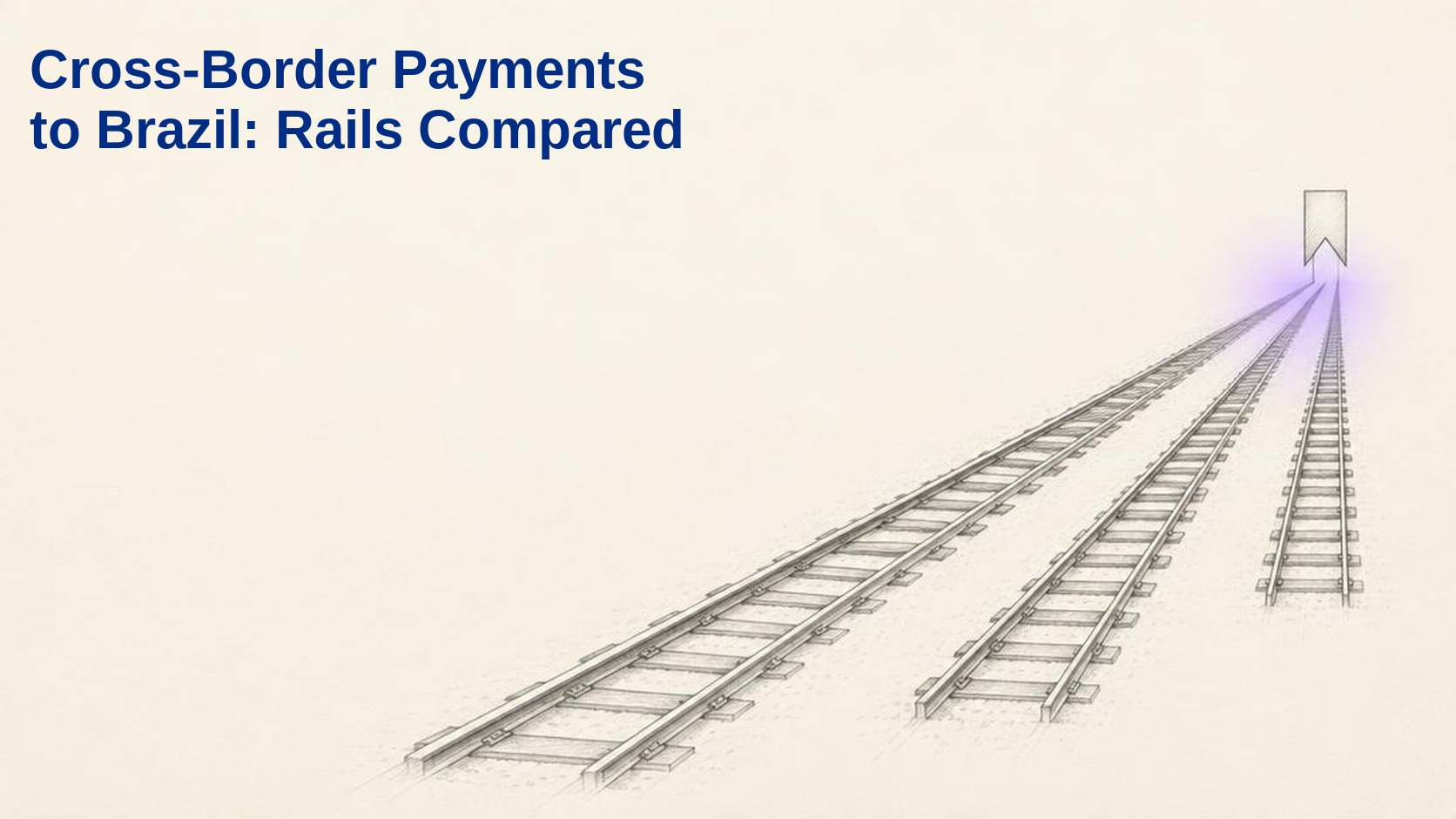
A business paying into or out of Brazil has three practical rail options: correspondent banking (SWIFT), a card network, or stablecoin settlement through a licensed off-ramp into PIX. Correspondent banking costs roughly 6.49% globally on average per the latest World Bank data and settles in one to five business days. Stablecoin settlement through a licensed provider typically lands under 1%, sometimes closer to 0.5 to 2% once realistic spreads are included, and settles in minutes. The trade-off isn't cost alone, correspondent banking remains the default for large institutional counterparties that require traditional banking relationships, while stablecoin rails win specifically on speed and cost for routine supplier payments and recurring flows.
The three rails compared
Correspondent banking (SWIFT). The traditional default: 1 to 5 business days, roughly 6.49% average total cost once wire fees, FX markups, and intermediary bank deductions are counted. Best for large institutional transactions where existing banking relationships and traditional compliance trails matter more than speed or cost.
Card networks. Faster than correspondent banking, typically 1 to 2 business days for network clearing, at roughly 2 to 3% plus FX spread. A reasonable middle ground for smaller transactions where card infrastructure already exists, but not built for large B2B supplier payments.
Stablecoin settlement via licensed off-ramp into PIX. USDC or USDT settles on-chain to a licensed Brazilian provider, BRLA, Bitso, Mercado Bitcoin, and Transfero are the main options, which converts to BRL and pays out via PIX, typically within minutes. All-in cost is generally under 1 to 2% once IOF-câmbio tax (roughly 3.5% on the FX leg as of 2026) and realized spread are included, still a substantial reduction versus correspondent banking for routine payment flows.
What actually determines the right rail for a specific payment
Payment frequency and size. A one-off, large institutional transaction often still makes sense through correspondent banking. Recurring supplier payments, payroll, or high-frequency B2B flows are where stablecoin settlement's cost and speed advantage compounds.
Regulatory status of the counterparty. As of October 1, 2026, Brazilian Central Bank Resolution 561 restricts regulated electronic FX providers from settling the offshore leg of a cross-border payment directly in stablecoins, that leg now runs through a traditional FX transaction or a non-resident BRL account instead. Confirm your specific provider's licensing path reflects this.
Recipient's actual need. PIX itself is BRL-only and domestic, it can't receive an international wire directly. Whichever rail is used, the final leg into a Brazilian recipient's account runs through PIX one way or another, either via traditional banking correspondent relationships or via a licensed stablecoin off-ramp.
FAQs
What is the cheapest way to pay a supplier in Brazil?
Stablecoin settlement through a licensed off-ramp into PIX is generally the cheapest option for routine payments, typically under 1 to 2% all-in versus roughly 6.49% average for correspondent banking, though large institutional transactions may still favor traditional banking relationships.
How fast do cross-border payments to Brazil settle?
Correspondent banking (SWIFT) typically takes 1 to 5 business days. Stablecoin settlement through a licensed off-ramp into PIX typically settles within minutes of the stablecoin transaction confirming on-chain.
Can I send money directly to a Brazilian bank account via PIX from outside Brazil?
Not directly, PIX is a domestic Brazilian rail. Cross-border payments into Brazil require either correspondent banking or a licensed off-ramp partner that converts incoming funds to BRL before the final PIX payout.
What tax applies to cross-border payments into Brazil?
The fiat-conversion leg is treated as an FX operation under Brazil's IOF-câmbio tax, roughly 3.5% for most outbound transactions as of 2026, applying regardless of which rail is used for the initial transfer.
Last updated: September 28, 2026 Written by the stablecoin.nyc Editorial Desk